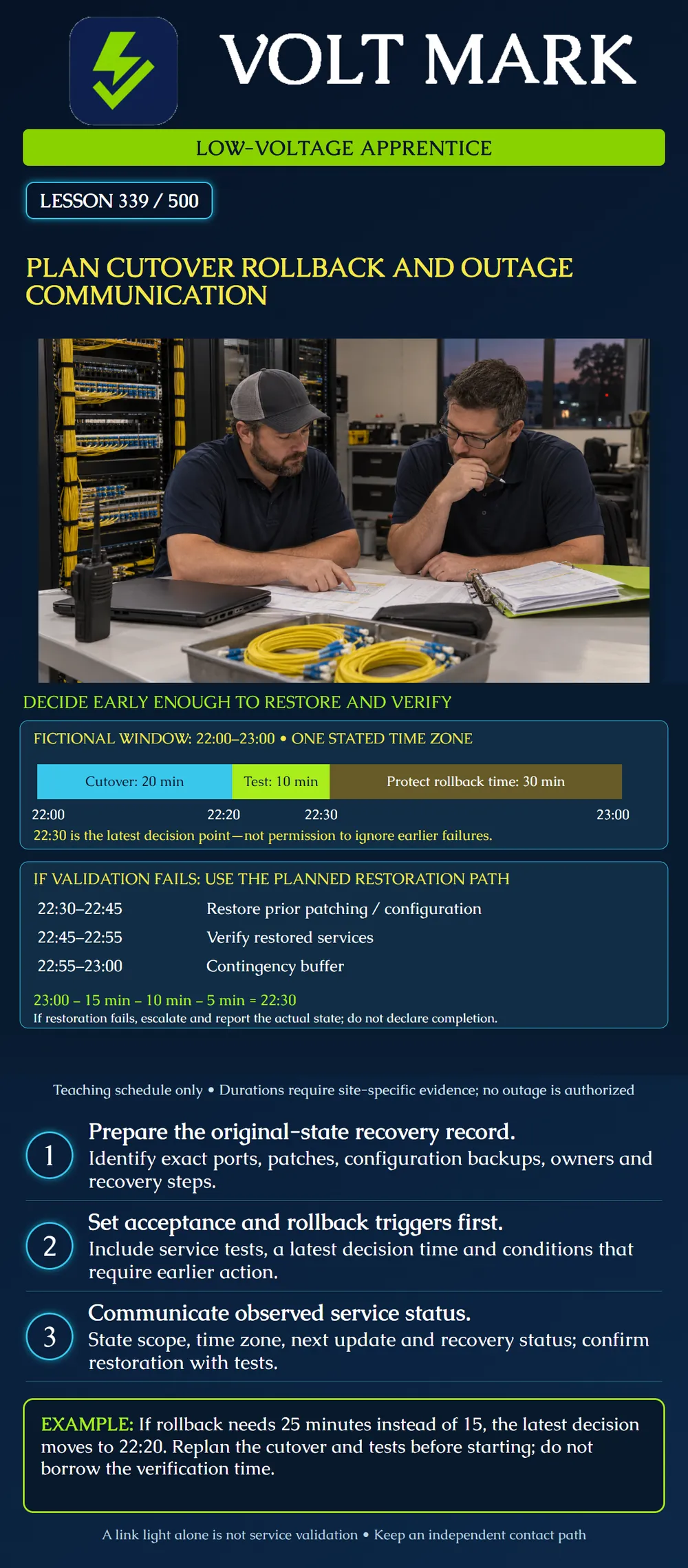
Prepare a fiber-backbone cutover plan with clear success criteria, an achievable restoration path, a latest rollback decision time and accurate outage communication.
A cutover moves a service from its existing arrangement to a planned replacement. Rollback restores a defined prior arrangement when the new state is unacceptable. Cisco's change-management guidance emphasizes validating changes, retaining a way to back out and comparing pre-change and post-change performance. These principles apply to the recordkeeping in this lesson; no router command or live-network action is prescribed.
The plan must identify who authorizes the change, who performs it, who validates affected services, who makes the proceed-or-rollback decision and who communicates status. A poster cannot supply those site-specific assignments.
A fictional change moves one campus data uplink to a replacement fiber path. The old path remains intact and available for recovery. The classroom window is22:00–23:00 on a single date in one explicitly stated time zone. This is an invented planning exercise, not a scheduled outage.
Before the window, the team reconciles the current patch schedule, equipment ports, configuration baseline, service list and new-path test evidence. Both endpoint technicians have the same revision. A separate contact path is available if the network being changed stops carrying communications.
The scope must be verified rather than assumed. If an unexpected affected service is found, follow the approved stop-and-escalate process instead of quietly expanding the change.
Assume a rehearsed restoration requires15 minutes, restored-service verification requires10 minutes and contingency needs5 minutes. Protected recovery time =15+10+5=30 minutes. Latest decision =23:00−30 minutes=22:30.
The poster's nominal plan assigns22:00–22:20 to cutover and22:20–22:30 to validation. If required validation fails, the rollback branch allocates22:30–22:45 to restoration,22:45–22:55 to verification and22:55–23:00 to contingency.
Earlier failure triggers still apply. The deadline is not permission to continue a known unacceptable state until22:30. If a prerequisite is missing before work begins, the designated owner may need to defer the change.
Suppose the restoration estimate increases from15 to25 minutes after rehearsal. Protected time becomes25+10+5=40 minutes. Latest decision becomes23:00−40 minutes=22:20. The old30-minute cutover-and-test plan no longer fits. Replan before starting; do not pretend the same schedule remains achievable or remove service verification merely to fit.
For the classroom fiber change, the recovery record identifies the old optical ports and each original patch connection, any configuration changes requiring reversal, retained materials and the order in the approved procedure. It also identifies dependencies that could prevent recovery.
A saved switch configuration does not reconstruct a cut fiber or repair a damaged connector. If the old path will be altered irreversibly, the restoration strategy must be resolved before the cutover is authorized. Do not label an unavailable prior state a working rollback plan.
List the actual required services and measurable acceptance criteria before the window. The fictional data-uplink checks include intended connectivity, service-owner functional checks, expected interface state and agreed error/performance observations. Optical levels and a link light support assessment but do not replace the service checks.
Record observed results, timestamps, deviations and the decision maker. If the new state passes, complete the approved observation and closeout process. If rollback is required, verify the restored services against the prior baseline. If restoration fails or exceeds the plan, escalate and communicate the current impact honestly.
Before-work notice template: “Planned change [ID] affects [verified services/sites] on [date], [start–end], [time zone and UTC offset]. Expected impact: [specific interruption or risk]. Change owner: [role/contact]. Next update: [time/channel].”
Rollback update template: “Change [ID] did not meet [acceptance criterion]. The designated owner initiated rollback at [time]. Current affected services: [observed scope]. Restoration is not yet confirmed. Next update: [time].”
Restoration update template: “Prior service state was restored at [time] and validated using [tests/owner confirmation]. Remaining issues: [actual issues or none identified within the test scope]. Change outcome: rolled back. Follow-up owner: [role].”
These are classroom templates. No notice has been sent and no outage is being requested. Never replace an unknown restoration estimate with an unsupported promise.
Mistake: Waiting until the outage ends to decide whether rollback is needed. Correction: Subtract restoration, verification and contingency time in advance; the baseline decision deadline is 22:30.
Mistake: Keeping the 22:30 deadline after restoration grows to 25 minutes. Correction: Recalculate the protected 40-minute recovery period and move the decision to 22:20 before authorizing the plan.
Mistake: Calling a saved configuration a complete physical rollback plan. Correction: Identify the retained old path, original patch connections, required materials and restoration verification as well as configuration records.
Cisco, Steps to Optimizing Your Network—Change Management & Network Management Strategies, June20,2013: https://blogs.cisco.com/networking/steps-to-optimizing-your-network-change-management-network-management-strategies Read October1,2026. Used for validation, ability to back out and pre/post-change monitoring. Historical software commands, product recommendations and reported outage times are not adopted.
The timeline, calculations, scenario and communication drafts are original teaching material.
Texas journeyman, 15 questions, scored by topic against the 70% mark. No card, and no account needed to start.
Free study material for low-voltage apprentices. This is a national foundation course: requirements differ by state and by local jurisdiction, and a practice that is common in one place is not a rule everywhere. Nothing here is a licence, a certification, or authority to work unsupervised, and completing it does not count as apprenticeship hours or continuing-education credit. Check the codes adopted where you are working, the licensing authority for that work, and your employer's safety programme. VoltMark is not affiliated with, endorsed by, or sponsored by NFPA, OSHA, NICET, BICSI, FOA, or any state or local licensing authority.
Electrician licensing exam prep: practice questions, timed exam simulations, and step-by-step help finding every answer in the NEC.