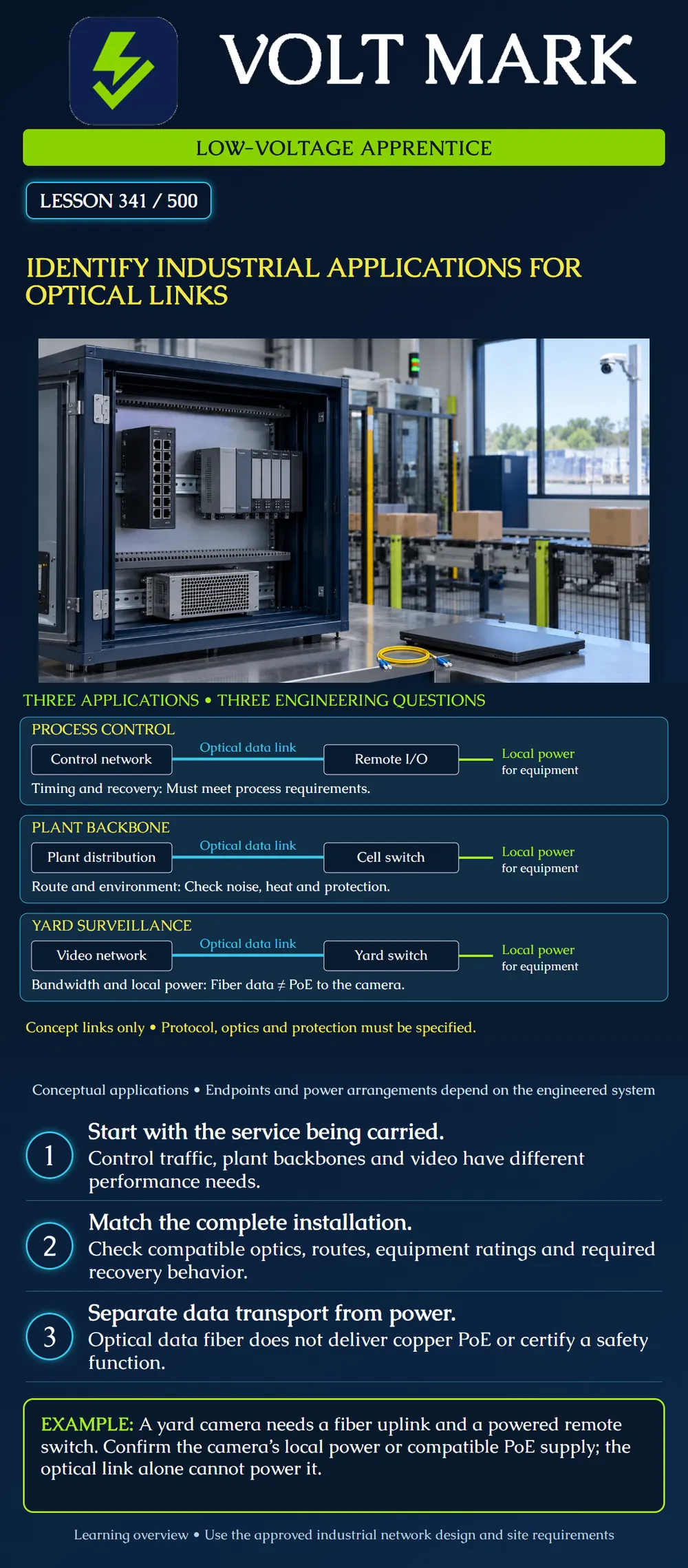
Given an industrial service request, identify where an optical data link could be useful and list the evidence needed before equipment or cable is selected.
Industrial networks connect equipment that participates in production, monitoring and site operations. An optical link is a transport path within that system. Start by naming the application, its endpoints and the consequences of interruption.
Fiber can be appropriate for plant switch uplinks and connections to distant equipment. Its optical signal is immune to electromagnetic interference, but that does not make the associated switches, power supplies or complete installation immune to disturbances. Compatibility, reach and the physical environment still matter. The Cisco/Rockwell Automation/Panduit physical infrastructure guide discusses these selection factors and industrial-zone fiber applications [1]. Cisco’s CPwE overview places the network within a broader automation and control architecture [2].
A project note says, “Connect the remote I/O cabinet to the control network; the pathway passes close to large drives.” Record a potential optical application, then request the approved network diagram, exact endpoint interfaces, route survey and required interruption tolerance. Do not conclude that any fiber switch will satisfy the control system. A favorable optical-loss calculation alone does not establish the required process performance. Worksheet response: service = remote I/O communications; endpoint evidence = supported interfaces and controller/network requirements; route evidence = measured route and environmental survey; acceptance evidence = agreed communications and recovery checks. No machine safety circuit or control program is altered in this exercise.
Four fictional cameras each use a planning allowance of 12 Mb/s. Their assumed combined traffic is 4 × 12 = 48 Mb/s. If the project adds 25 percent traffic headroom, the planning value is 48 × 1.25 = 60 Mb/s. This is a supplied classroom allowance, not a camera specification or universal design rule. A fictional candidate path has 80 Mb/s of usable capacity allocated to those cameras. Arithmetic remainder is 80 − 60 = 20 Mb/s. That favorable comparison still leaves unanswered questions: other traffic, bursts, recording requirements, remote power, compatible ports, environmental suitability, optical limits and the acceptance procedure. The remote switch must have an approved power arrangement. If it powers cameras through copper PoE, its supported PoE type, per-port allowance and total power budget must be checked against actual camera requirements. An optical uplink does not transfer that PoE power through its glass fibers.
A drawing proposes two fiber links between buildings, but both enter the same enclosure and depend on the same remote power source. Mark the shared dependencies. Two lines on paper do not establish independent service. Ask the designer to identify the required failure cases, physical routes and recovery behavior. This exercise authorizes no live interruption or failover test.
For each proposed link, enter:
Mistake: Selecting fiber for remote I/O without obtaining its interruption tolerance. Correction: Record the control-service timing and recovery requirements with the exact endpoint interfaces before selecting the link.
Mistake: Assuming the yard optical uplink powers the remote switch or its cameras. Correction: Document the remote supply and any supported copper PoE arrangement, including the actual device power budget.
Mistake: Calling the fictional 60 Mb/s camera allocation a complete design. Correction: Keep its 25 percent addition labeled as a classroom assumption and check other traffic, bursts and interface requirements.
[1] Cisco, Panduit and Rockwell Automation, Physical Infrastructure for the Converged Plantwide Ethernet Architecture, February 2023, optical fiber link basics and industrial media-selection sections: https://www.cisco.com/c/en/us/td/docs/sanity/suman/CPwE-Physical-Infrastructure_Feb2023.html [2] Cisco, Design Zone for Manufacturing — Converged Plantwide Ethernet: https://www.cisco.com/c/en/us/solutions/design-zone/industries/manufacturing/cpwe.html Accessed 2026-10-01. Source-derived overview is limited to industrial applications, architecture and selection factors; cases, numbers, worksheet and questions are original teaching material. No older guide’s generalized ratings or code language is adopted as a universal requirement.
Texas journeyman, 15 questions, scored by topic against the 70% mark. No card, and no account needed to start.
Free study material for low-voltage apprentices. This is a national foundation course: requirements differ by state and by local jurisdiction, and a practice that is common in one place is not a rule everywhere. Nothing here is a licence, a certification, or authority to work unsupervised, and completing it does not count as apprenticeship hours or continuing-education credit. Check the codes adopted where you are working, the licensing authority for that work, and your employer's safety programme. VoltMark is not affiliated with, endorsed by, or sponsored by NFPA, OSHA, NICET, BICSI, FOA, or any state or local licensing authority.

Electrician licensing exam prep: practice questions, timed exam simulations, and step-by-step help finding every answer in the NEC.