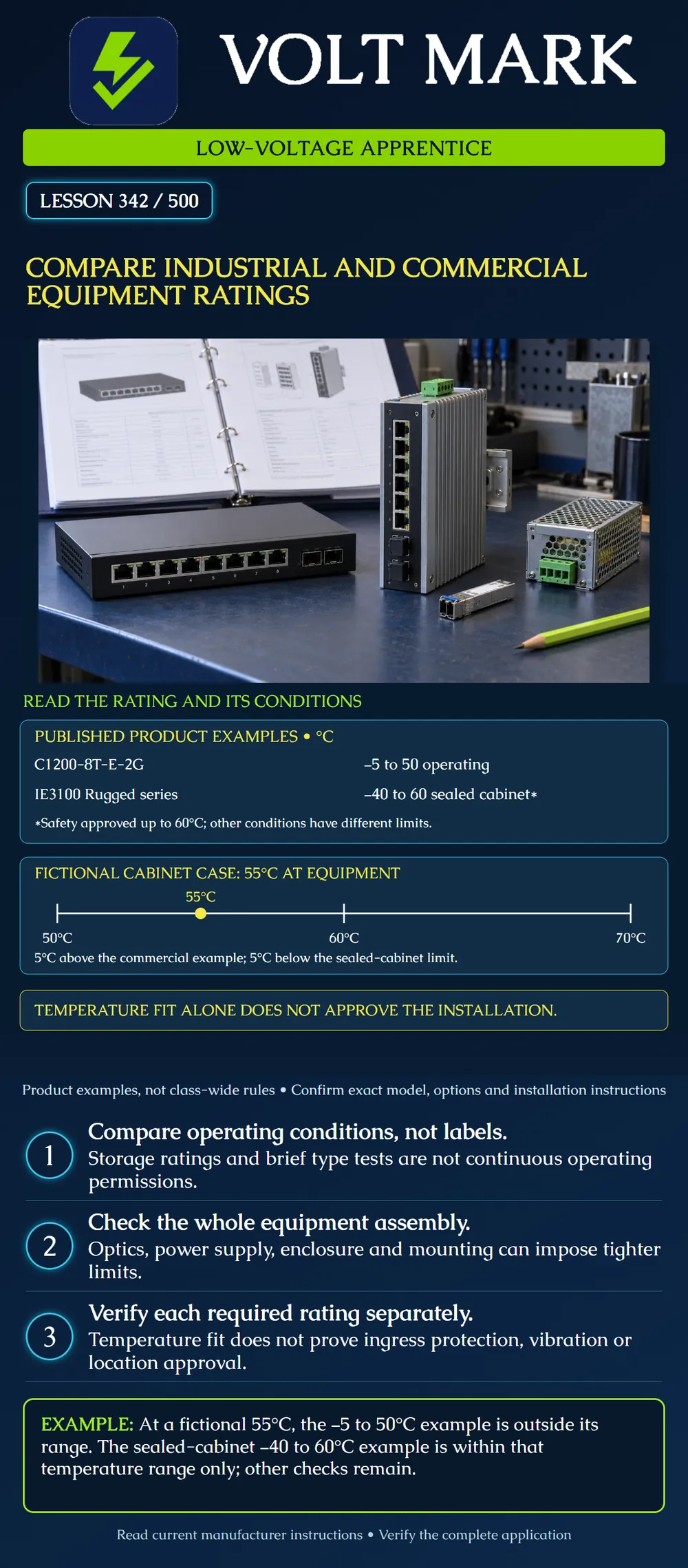
Compare documented operating conditions for two equipment candidates and distinguish a favorable temperature comparison from approval of an entire installation.
Do not choose equipment from the words “industrial,” “rugged,” or “commercial” alone. Record the exact product identifier, document revision and conditions attached to each rating. Then compare those facts with the intended location and configuration. This lesson teaches the comparison process; it is not a recommendation to buy either example.
Cisco’s Catalyst 1200 data sheet lists −5 to 50°C operating temperature for models other than C1200-8T-D; that exception is 0 to 50°C. Our commercial example is C1200-8T-E-2G. Storage temperature is a separate −25 to 70°C range, and operating humidity is specified as noncondensing [1]. Do not substitute the storage limit for the operating limit.
For IE3100 Rugged, the data sheet distinguishes −40 to 60°C in a sealed cabinet, −40 to 70°C in a vented cabinet, and −40 to 75°C in a blower-equipped cabinet. Its footnote states safety approval up to 60°C. The separately listed 85°C/96-hour type test is not a blanket continuous operating allowance. IP30, shock/vibration test references and installation-dependent approvals appear separately [2]. These conditions belong to this product documentation, not to every industrial device.
A worksheet calls for operation from −10 to 55°C at the equipment. Compare both endpoints of that requirement with the two poster ranges. Commercial example: −10 is 5°C below −5, and 55 is 5°C above 50. It fails both ends of this classroom temperature screen. Industrial sealed-cabinet example: −10 is 30°C above −40, and 55 is 5°C below 60. Both endpoints are within the illustrated temperature range. Record “temperature screen favorable; complete review pending.” Those differences are arithmetic separations from published limits, not a designer-approved safety margin.
A fictional optical module’s own documentation limits operation to 0 through 45°C. Assume it is otherwise compatible with the industrial host for this exercise. A location at 55°C is 10°C above that module’s limit. The host’s wider temperature range does not fix this mismatch. Record the module limitation and return the candidate assembly for review. Do not assume that any SFP fitting the cage is suitable. The fictional module range is an exercise input, not a specification of any named Cisco optic.
A procurement note says, “The new unit has a higher IP number, so it is approved for our washdown area.” The packet contains no exact enclosure configuration, connector sealing instructions, chemical compatibility evidence or site exposure description. The correct response is an evidence gap. A single ingress label cannot resolve every environmental question. Obtain the relevant installation instructions and site requirements before deciding suitability. Do not create a universal conversion between IP and NEMA designations or infer hazardous-location approval from either label.
Use columns for requirement, exact candidate rating, applicable conditions, document location and unresolved questions. Suggested rows:
Mistake: Using a storage or short-duration type-test temperature as a continuous operating limit. Correction: Compare the required equipment temperature with the operating range and its cabinet, safety and duration conditions.
Mistake: Approving an industrial host while its optic is limited to 45°C at a 55°C location. Correction: Check the complete assembly; record the optic's 10°C mismatch and return the selection for review.
Mistake: Taking an IP label as proof of chemical or hazardous-location suitability. Correction: Collect the separate exposure, enclosure and approval evidence for the actual installation before deciding suitability.
[1] Cisco Catalyst 1200 Series Switches Data Sheet, environmental specifications and model identifiers: https://www.cisco.com/c/en/us/products/collateral/switches/catalyst-1200-series-switches/nb-06-cat1200-ser-data-sheet-cte-en.html [2] Cisco Catalyst IE3100 Rugged Series Data Sheet, operating environment, associated footnote and separate standards/approval entries: https://www.cisco.com/c/en/us/products/collateral/networking/industrial-switches/catalyst-ie3100-rugged-series/catalyst-ie3100-rugged-series-ds.html Accessed 2026-10-01. Product specifications are examples as documented on that date. Original classroom requirements and cases are not manufacturer claims.
Texas journeyman, 15 questions, scored by topic against the 70% mark. No card, and no account needed to start.
Free study material for low-voltage apprentices. This is a national foundation course: requirements differ by state and by local jurisdiction, and a practice that is common in one place is not a rule everywhere. Nothing here is a licence, a certification, or authority to work unsupervised, and completing it does not count as apprenticeship hours or continuing-education credit. Check the codes adopted where you are working, the licensing authority for that work, and your employer's safety programme. VoltMark is not affiliated with, endorsed by, or sponsored by NFPA, OSHA, NICET, BICSI, FOA, or any state or local licensing authority.

Electrician licensing exam prep: practice questions, timed exam simulations, and step-by-step help finding every answer in the NEC.