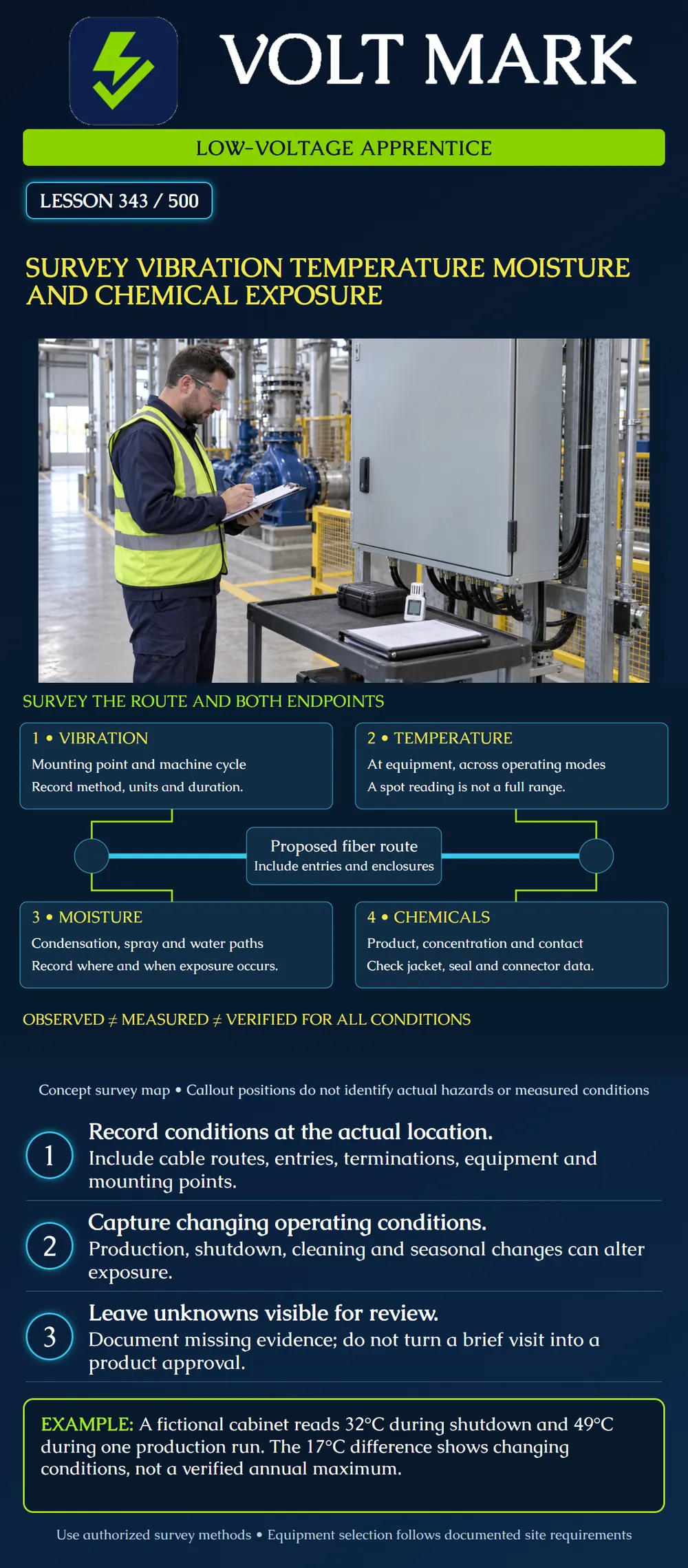
Prepare a location-specific environmental survey record that separates observations, measurements, reported history and unresolved requirements before industrial fiber infrastructure is selected.
An industrial fiber installation includes cable jackets, supports, connectors, closures, enclosures and powered equipment. These may encounter different conditions along one route. A protected endpoint does not establish that every intermediate location has equivalent protection.
The Cisco/Panduit/Rockwell Automation physical infrastructure guide describes M.I.C.E. as an environmental assessment: mechanical; ingress; chemical/climatic; and electromagnetic factors. Its examples include vibration, liquid and dust entry, temperature, humidity and contaminants. The assessment characterizes the environment for comparison with product specifications [1]. This lesson concentrates on four survey topics in the catalog title. It does not assign formal M.I.C.E. severity classes or substitute for the applicable assessment method.
The cyan center line represents a proposed fiber route, not installed cable. The circles represent its endpoints. The center box reminds the learner to include equipment enclosures and cable entries. Four connected callouts are survey prompts, not declarations that hazards were found. Real findings need specific location identifiers and supporting evidence.
Identify the proposed mounting point, nearby machinery and operating states. Record whether a statement comes from observation, maintenance history or a documented measurement. A useful measurement record identifies the instrument, sensor position, axes, units, duration and machine condition. Do not compare values from unlike measurement methods as if they were interchangeable. A sound or visible movement alone does not establish a numeric vibration rating. The apprentice’s task is to record evidence and obtain the responsible specialist’s assessment, not to improvise a test by touching moving machinery or changing its operation.
Record where the sensor is located relative to the equipment, how readings were collected and which operating modes they cover. Room temperature and temperature inside a working enclosure may differ. Identify unobserved conditions such as cold startup, peak process load, summer exposure or cooling failure. Do not infer an annual maximum from a single shift. Original case: a fictional cabinet is 32°C during shutdown and 49°C during one observed production run. The difference is 49 − 32 = 17°C. A hypothetical candidate upper limit is 55°C, leaving 55 − 49 = 6°C between that reading and the limit. This does not establish a six-degree design margin across all seasons or loads. The annual range and exact rating conditions remain unknown.
Distinguish humidity information from evidence of condensation, spray, immersion or water entry. Note cleaning activities and possible paths through doors, glands, conduit or damaged seals. Photograph only where authorized and label the location and time. “Dry during the visit” does not describe every cleaning or weather condition. Original case: an enclosure looks dry at 10 a.m., but maintenance reports droplets after a weekly cleaning cycle. Record both facts with their evidence type. Request information about the cleaning exposure and enclosure configuration. Do not erase the reported condition because it was not visible during the visit.
Ask for the identity of products used near the route and the actual exposure conditions. Record concentration, temperature, contact method, duration and frequency when available. Obtain the relevant material-compatibility information from the equipment, cable and seal manufacturers. A chemical name alone is incomplete evidence; a safety data sheet describes chemical hazards but does not by itself certify compatibility with every polymer or seal. Original case: the cleaning product name is known, but dilution and contact duration are not. Mark those fields unresolved. Do not invent a “chemical resistant” conclusion or test a sample on installed equipment.
Location: cabinet C-07 and the route entering its lower cable gland. Vibration: operator reports movement during pump startup; no instrument record supplied. Temperature: logged 32°C shutdown and 49°C during one production run; no seasonal dataset. Moisture: dry on visit; droplets reported after cleaning. Chemicals: product identified in site records; dilution and exposure duration unknown. Next evidence: authorized vibration assessment at the mounting location; temperature logging plan; cleaning exposure details; manufacturer compatibility review. Decision: survey incomplete. No product or installation is approved by this worksheet.
Location and route segment; date and time; observer; evidence type; operating condition; measurement method and units; document or photo identifier; result; uncertainty or missing conditions; follow-up owner. Preserve the distinction between “not observed,” “not measured” and “confirmed absent.” They are not equivalent.
Mistake: Calling the 49°C production reading the cabinet's annual maximum. Correction: Retain the observed operating state and request evidence covering the missing seasonal, startup and load conditions.
Mistake: Discarding reported cleaning droplets because the cabinet was dry during the visit. Correction: Record the dry observation and the reported history separately, then investigate the cleaning exposure and entries.
Mistake: Using a cleaner's name or safety data sheet as cable compatibility approval. Correction: Obtain concentration, temperature and contact duration, then seek material-specific evidence from the relevant manufacturer.
[1] Cisco, Panduit and Rockwell Automation, Physical Infrastructure for the Converged Plantwide Ethernet Architecture, February 2023, M.I.C.E. Assessment for Industrial Characteristics: https://www.cisco.com/c/en/us/td/docs/sanity/suman/CPwE-Physical-Infrastructure_Feb2023.html Accessed 2026-10-01. Only the environmental assessment framework is summarized; older standards references, broad cable claims and numerical tables are not adopted as universal requirements. Survey cases, numbers, worksheet and exercises are original instructional material.
Texas journeyman, 15 questions, scored by topic against the 70% mark. No card, and no account needed to start.
Free study material for low-voltage apprentices. This is a national foundation course: requirements differ by state and by local jurisdiction, and a practice that is common in one place is not a rule everywhere. Nothing here is a licence, a certification, or authority to work unsupervised, and completing it does not count as apprenticeship hours or continuing-education credit. Check the codes adopted where you are working, the licensing authority for that work, and your employer's safety programme. VoltMark is not affiliated with, endorsed by, or sponsored by NFPA, OSHA, NICET, BICSI, FOA, or any state or local licensing authority.

Electrician licensing exam prep: practice questions, timed exam simulations, and step-by-step help finding every answer in the NEC.