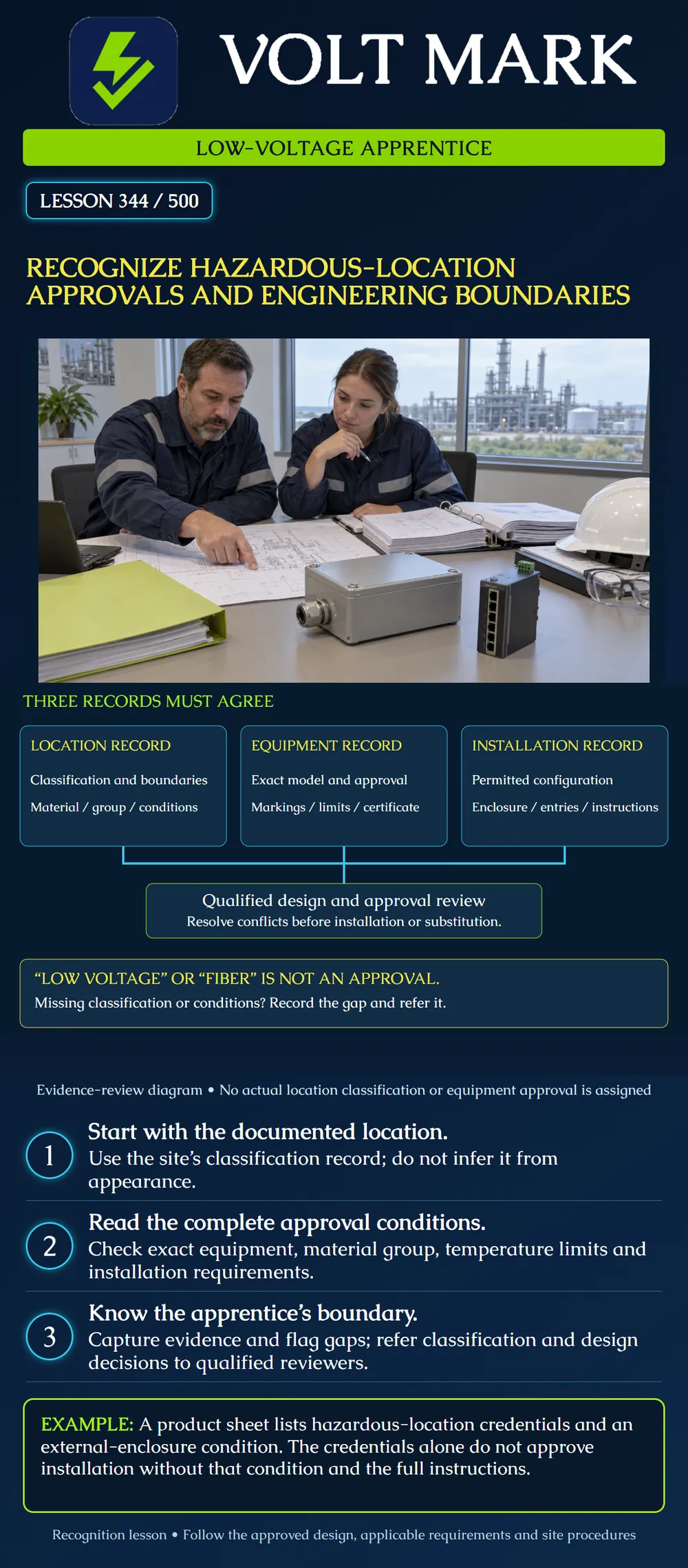
Recognize the evidence needed to review equipment for a hazardous location, identify an incomplete approval packet and explain which decisions require qualified design or approval review.
Hazardous locations may involve flammable gases or vapors, combustible dusts or ignitable fibers. OSHA 1910.307 addresses classification, documentation and suitable electrical installations. Suitability depends on the relevant location and material properties, not just a generic equipment label. Division and Zone systems have specific provisions; do not treat similarly numbered designations as automatic equivalents [1]. This is a recognition lesson, not a complete classification method or a statement that one code edition applies everywhere. The project must establish its governing requirements and approval process.
Location record: identify the approved drawing or other classification documentation, its revision, the installation position and applicable material information. Equipment record: identify the exact unit and its applicable approval evidence, markings and limits. A family brochure is only a starting point. Installation record: identify the configuration and instructions that make the proposed assembly eligible for review, including any required enclosure and accessories. All three feed the review in the diagram. A match in one box cannot substitute for missing facts in another.
Cisco’s IE3100 Rugged data sheet lists hazardous-location credentials and explicitly calls for an external IP54 enclosure for hazardous-location installations, directing readers to the hardware/hazardous-location instructions [2]. This demonstrates why a credential line cannot be separated from its conditions. It does not mean that adding any IP54 box makes any switch suitable, or that the data sheet alone establishes approval for a particular site. No exact switch assembly, optics, power supply, enclosure or installed location is approved by this lesson.
A work request says “put the fiber switch near the process skid.” A current equipment brochure is attached, but no location classification drawing or boundary information is supplied. Record the requested mounting point and ask the responsible project lead for the location documentation. Do not classify the area by odor, appearance or an assumption that the room is ordinarily ventilated. The packet cannot yet support a location-to-equipment comparison. Expected result: unresolved location information; refer for review before installation.
The location record and exact equipment identity are available. The proposed parts list omits an enclosure required by the equipment instructions. Record the missing item and the instruction reference. Do not change the assembly or select a replacement enclosure independently from a generic ingress label. The reviewer must resolve the complete configuration and other applicable conditions. Expected result: installation condition not demonstrated; no approval conclusion.
A substitute switch has the same port count, optical speed and advertised “industrial” description. The supplier has not provided approval evidence for the required location. Networking compatibility answers a different question from hazardous-location suitability. Record the substitution as unverified and send the exact product identity and missing evidence to the responsible reviewer. Expected result: hold the substitution. Similar ports do not transfer another product’s approval.
The packet contains an ambient operating range and a separate hazardous-location temperature marking. A learner proposes using whichever number is larger. Do not interchange these values. Record each value exactly with its source and conditions, and have the reviewer assess their respective meanings and applicability. This exercise supplies no material ignition temperature or approval data sufficient for a numerical suitability decision.
Collect document identifiers, preserve legible nameplate information obtained through authorized access, reconcile equipment identity against the parts list and flag conflicts. Record unresolved questions clearly enough that the designer can answer them. Do not revise location boundaries, declare an ordinary device intrinsically safe, approve a protection method, bypass an installation condition or authorize equipment substitution. Low supply voltage and optical data transport do not themselves establish suitability of the complete system. Use the site’s authorized work procedures; this lesson provides no permission to open, connect, disconnect or energize equipment in a classified location.
Mistake: Selecting a switch from its industrial label before obtaining the location record. Correction: Identify the exact mounting position and applicable classification documentation through the responsible project reviewer.
Mistake: Assuming any IP54 box transfers a hazardous-location credential to the assembly. Correction: Match the exact equipment, enclosure, accessories and installation conditions to the applicable approval instructions.
Mistake: Choosing whichever ambient or temperature-marking number is larger. Correction: Record each marking with its meaning and conditions; have the qualified reviewer evaluate the location-to-equipment match.
[1] OSHA, 29 CFR 1910.307, Hazardous (classified) locations: https://www.osha.gov/laws-regs/regulations/standardnumber/1910/1910.307 Used for the national recognition framework, location/material suitability and documentation context. This lesson is not a reproduction of the regulation or a complete compliance determination. [2] Cisco Catalyst IE3100 Rugged Series Data Sheet, Table 11: https://www.cisco.com/c/en/us/products/collateral/networking/industrial-switches/catalyst-ie3100-rugged-series/catalyst-ie3100-rugged-series-ds.html Used only to illustrate a stated enclosure condition and the need for full instructions. The full installation packet for a real site has not been evaluated. Accessed 2026-10-01. Cases, worksheet and questions are original teaching material.
Texas journeyman, 15 questions, scored by topic against the 70% mark. No card, and no account needed to start.
Free study material for low-voltage apprentices. This is a national foundation course: requirements differ by state and by local jurisdiction, and a practice that is common in one place is not a rule everywhere. Nothing here is a licence, a certification, or authority to work unsupervised, and completing it does not count as apprenticeship hours or continuing-education credit. Check the codes adopted where you are working, the licensing authority for that work, and your employer's safety programme. VoltMark is not affiliated with, endorsed by, or sponsored by NFPA, OSHA, NICET, BICSI, FOA, or any state or local licensing authority.

Electrician licensing exam prep: practice questions, timed exam simulations, and step-by-step help finding every answer in the NEC.