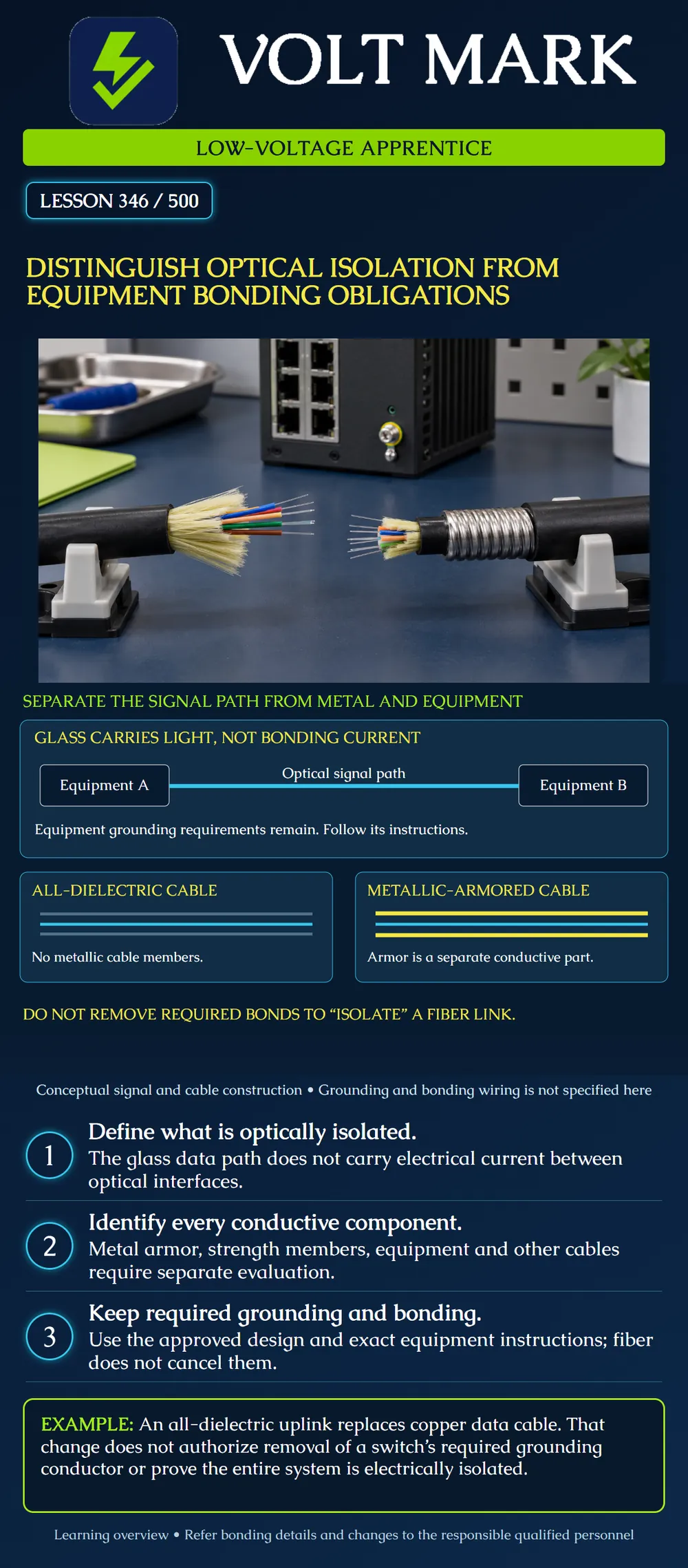
Identify which part of a fiber link provides a nonconductive data path and explain why equipment grounding and conductive cable components remain separate design considerations.
First: how does the data cross the link? Optical interfaces send and receive light through glass. That optical signal path does not carry bonding current between equipment. Second: what else is in the cable? Some optical cables are all-dielectric; others contain metallic armor, strength members or conductors. FOA’s outside-plant cable reference identifies these different constructions and the associated grounding/bonding considerations for metal [1]. Third: what do the connected devices require? The exact equipment instructions and approved installation determine its grounding requirements. Cisco’s IE3100 Rugged installation guide, for example, requires grounding and warns against defeating the ground conductor [2]. Optical ports do not cancel that instruction.
A fictional project replaces a copper Ethernet uplink with an all-dielectric fiber cable. A learner proposes disconnecting the switch grounding conductor because “fiber is isolated.” The proposal confuses the data path with equipment grounding. Record that the replacement removes the copper data connection from this segment, while the switch’s applicable grounding requirements remain. Do not disconnect the required conductor. Refer any proposed change to the responsible qualified personnel. The optical replacement also does not prove total electrical isolation between sites; power systems, other cables or metal structures may create additional paths.
A cable label says “optical fiber,” but its construction sheet identifies metallic armor. The outside jacket looks like plastic. The jacket appearance is insufficient evidence of an all-dielectric construction. Record the exact cable identifier, retrieve its construction and installation information, and identify the armor as a separate conductive component requiring the applicable design review. Do not assume either that the armor is absent or that an arbitrary bonding arrangement is acceptable. The exercise does not specify where this cable is installed, its exposure or the governing requirements, so it cannot produce a site-specific bonding detail.
The project uses a fictional hybrid assembly containing both fibers and electrical power conductors. The optical signal path is nonconductive, but the assembly is not all-dielectric. Create separate entries for the optical fibers and the electrical conductors. The power system and equipment must be evaluated under their own requirements. “It contains fiber” is not evidence that every component is electrically isolated or harmless.
A work note says to connect a DC supply terminal to ground because the switch chassis requires grounding. Do not infer a power-terminal connection from a chassis-grounding requirement. The Cisco example specifically includes model/configuration cautions concerning DC power-source terminals on PoE-supported switches [2]. Use the exact equipment and power-supply instructions; refer ambiguous directions for resolution. This case is a documentation check, not an instruction to alter a supply. A chassis connection, a signal reference and a supply terminal are different items even when an informal conversation calls each one “ground.”
A technician suggests removing a protective bond to see whether communication errors disappear. The apprentice should preserve the reported symptom and refer the proposal through the approved troubleshooting process. Do not treat a change in symptoms as justification for defeating a required protective connection. A useful record identifies which cable or equipment is affected, when the errors occur, and the existing drawing and installation instructions. This supports a proper investigation without improvising changes.
For each item, record whether it is an optical signal path, a conductive cable component, equipment or an unresolved item:
Mistake: Removing switch grounding because its new uplink is all-dielectric. Correction: Keep the equipment's required grounding intact and refer any proposed change to qualified personnel using the exact installation instructions.
Mistake: Identifying a cable as all-dielectric from its plastic jacket. Correction: Retrieve its construction record and separately identify armor, strength members and any power conductors.
Mistake: Connecting a DC terminal to ground because the chassis requires grounding. Correction: Distinguish chassis, supply terminals and signal references; resolve the exact model's connection requirements before work.
[1] Fiber Optic Association, Outside Plant Fiber Optic Cables: https://www.thefoa.org/tech/ref/OSP/cable.html Primary page inspected for dielectric/metallic cable construction and associated grounding/bonding distinctions. [2] Cisco Catalyst IE3100 Rugged Series Switches Hardware Installation Guide, Switch Installation, Ground the Switch: https://www.cisco.com/c/en/us/td/docs/switches/lan/cisco_ie3100/installation/ie3100-hw-install-guide/m-ie3100-switch-installation.html Primary indexed text inspected for equipment grounding and power-terminal cautions. No wire size, torque or model-specific field procedure is generalized in this lesson. Accessed 2026-10-01. Cases and worksheet are original. This is a national conceptual lesson; actual installation details depend on applicable requirements and the approved design.
Texas journeyman, 15 questions, scored by topic against the 70% mark. No card, and no account needed to start.
Free study material for low-voltage apprentices. This is a national foundation course: requirements differ by state and by local jurisdiction, and a practice that is common in one place is not a rule everywhere. Nothing here is a licence, a certification, or authority to work unsupervised, and completing it does not count as apprenticeship hours or continuing-education credit. Check the codes adopted where you are working, the licensing authority for that work, and your employer's safety programme. VoltMark is not affiliated with, endorsed by, or sponsored by NFPA, OSHA, NICET, BICSI, FOA, or any state or local licensing authority.

Electrician licensing exam prep: practice questions, timed exam simulations, and step-by-step help finding every answer in the NEC.