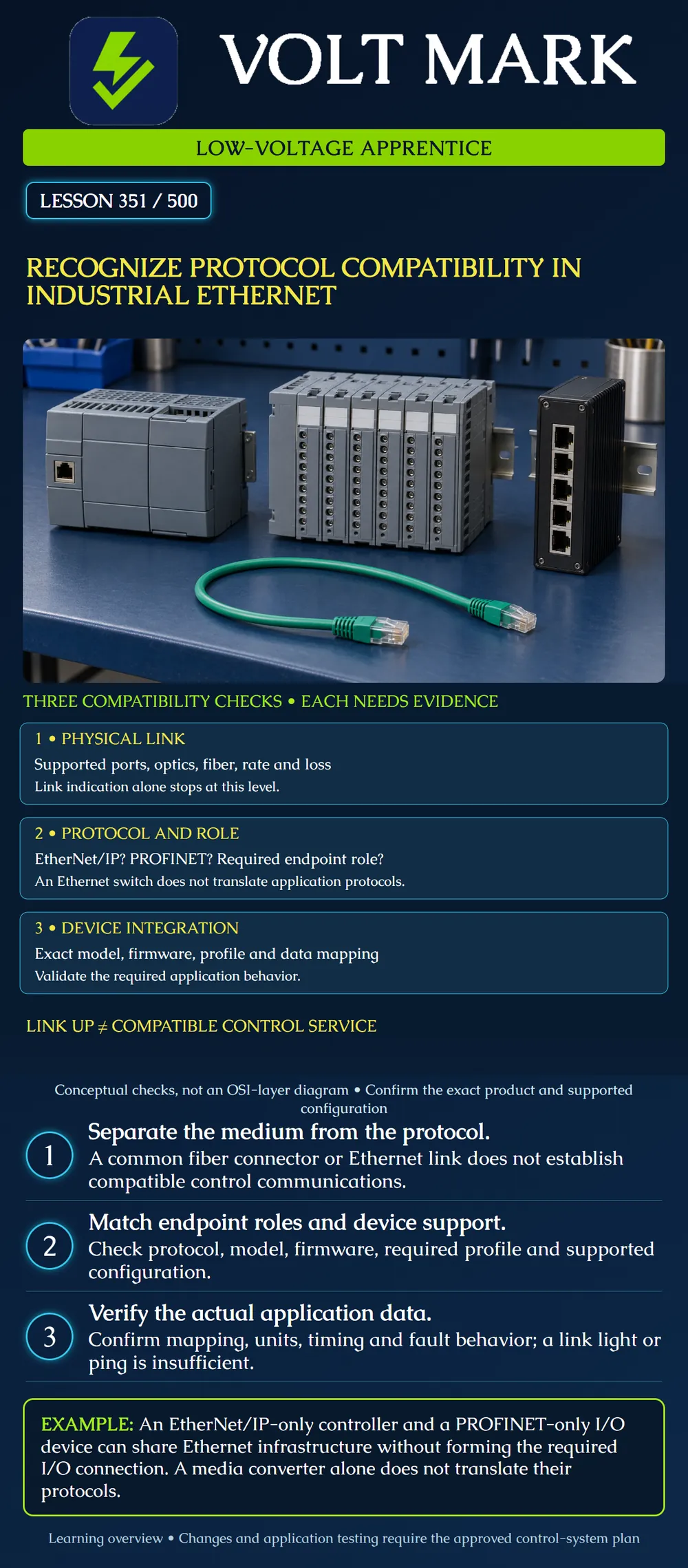
Separate physical-link compatibility from industrial application compatibility and identify the documentation needed before connecting a controller to an I/O device.
The poster divides the investigation into physical link, protocol/role and device integration. These are practical checks, not a formal model of network layers. A favorable result in one does not settle the others.
Confirm supported host ports, transceivers, data rate, wavelength pairing, fiber type, polarity and optical limits. The cable plant and interfaces must establish a suitable link. A link indication does not prove that the device’s industrial application is configured, supported or exchanging valid process data. Likewise, an optical media converter changes the physical medium; ordinary media conversion does not translate one industrial application protocol into another.
ODVA describes EtherNet/IP as adapting the Common Industrial Protocol, CIP, to Ethernet [1]. EtherNet/IP is a specific industrial protocol name, not shorthand for every use of Ethernet and Internet Protocol. PROFINET uses its own supported controller/device integration. Manufacturer documentation describes PROFINET IO device properties through GSDML files [2]. An ordinary Ethernet switch can carry suitable traffic without serving as a translator between these different application systems. Verify the endpoint roles required by the chosen system. Two devices advertising the same protocol are not necessarily a suitable controller-and-I/O pair for the intended task.
Record the exact device model, firmware, controller support and configuration documentation. Device descriptions or profiles help engineering software understand supported properties; they do not add a protocol implementation to hardware that lacks it. Then verify the required data objects or I/O layout, direction, sizes, units, timing and failure behavior. Product-family resemblance and connector fit are insufficient evidence.
A fictional controller is documented as EtherNet/IP-only for the required I/O function. The proposed I/O unit is documented as PROFINET-only. Both have Ethernet connectivity. The proposed direct I/O relationship is unsupported by this packet. Do not assume a switch or copper-to-fiber media converter fixes the mismatch. An engineered gateway may be an option in some systems, but its exact protocol roles, data mapping, timing, diagnostics and limitations must be verified. This exercise does not select or approve a gateway.
The replacement I/O unit has the expected protocol and model family, but the supplied firmware differs from the approved baseline. The compatibility documentation is missing. Mark the revision as unresolved. Do not declare it compatible because the link comes up, and do not declare it incompatible without evidence. Obtain the relevant manufacturer support information and review the proposed substitution through the control-system process.
The fictional device configuration produces 16 bytes of input data, while the controller project expects 12. The difference is 4 bytes. This mismatch is not an optical-loss problem. Compare the approved module configuration, data layout and controller connection settings. Do not silently discard four bytes or alter a live project to make a warning disappear. No actual device format or controller parameter is prescribed by these classroom numbers.
A fictional sensor sends a raw integer of 250. Its approved mapping states 0.1 degree Celsius per count, so the interpreted value is 250 × 0.1 = 25.0°C. A display using one degree per count would show 250°C despite successful communication. The numbers illustrate why “data received” is not the same as “application correct.” Actual scaling must come from the device and application documentation.
A device responds to an allowed diagnostic ping in an authorized test environment. This supports a limited observation about that IP exchange. It does not demonstrate the required industrial I/O relationship, data mapping or timing. Some valid device configurations may not respond to ping. Record the intended diagnostic and its limits rather than treating ping as a universal acceptance test.
Capture:
Mistake: Expecting a copper-to-fiber converter to translate PROFINET into EtherNet/IP. Correction: Check the actual endpoint protocols and roles; any gateway proposal needs its own supported mapping and timing review.
Mistake: Accepting a link light or ping as proof of correct I/O integration. Correction: Verify device support, data direction, size, scaling and application timing against the approved controller configuration.
Mistake: Discarding the extra four bytes to reconcile the 16-byte device with a 12-byte project. Correction: Resolve the approved device layout and connection settings through the control-system change process rather than truncating data.
[1] ODVA, EtherNet/IP — CIP on Ethernet Technology: https://www.odva.org/wp-content/uploads/2024/04/PUB00138R8_Ethernet.pdf Primary indexed text used for the CIP/Ethernet relationship only. [2] Siemens, GSD files for IO devices, STEP 7 V20: https://docs.tia.siemens.cloud/r/en-us/v20/editing-devices-and-networks/creating-configurations/configuring-profinet-io/using-gsd-files/gsd-files-for-io-devices?contentId=wPss6KLatN_gQYJwQ85xlg Primary indexed text used for GSDML representation of PROFINET IO device properties. Accessed 2026-10-01. Neither source establishes compatibility of the fictional devices. Cases, worksheet, byte counts and scaling values are original instructional material.
Texas journeyman, 15 questions, scored by topic against the 70% mark. No card, and no account needed to start.
Free study material for low-voltage apprentices. This is a national foundation course: requirements differ by state and by local jurisdiction, and a practice that is common in one place is not a rule everywhere. Nothing here is a licence, a certification, or authority to work unsupervised, and completing it does not count as apprenticeship hours or continuing-education credit. Check the codes adopted where you are working, the licensing authority for that work, and your employer's safety programme. VoltMark is not affiliated with, endorsed by, or sponsored by NFPA, OSHA, NICET, BICSI, FOA, or any state or local licensing authority.

Electrician licensing exam prep: practice questions, timed exam simulations, and step-by-step help finding every answer in the NEC.