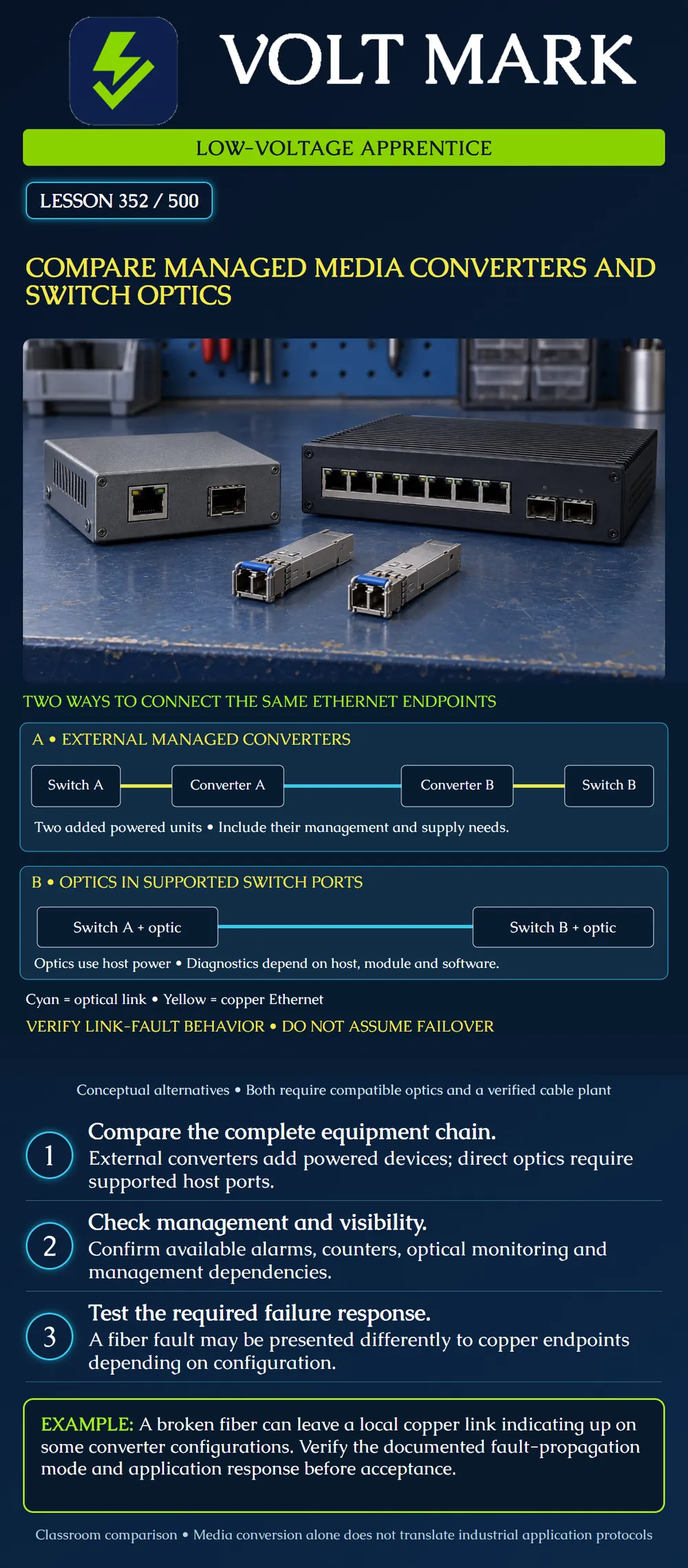
Compare two optical-link arrangements and identify their power, management, diagnostic and failure-behavior requirements without assuming that one product category guarantees the same functions as another.
Alternative A uses two existing copper switch ports, two local copper Ethernet connections and a managed media converter at each end of the optical span. Each converter needs an appropriate power arrangement. Depending on the product, management may be built in or provided through a chassis and management module. Alternative B uses supported optical modules directly in switch ports. The modules receive power from their hosts. Both switches still require power; removing external converters does not remove the switches’ shared or local supply dependencies. The examples compare ways to carry the same compatible Ethernet service. They do not specify actual product choices or universal price, reliability or latency rankings.
Perle’s managed SFP media-converter module documentation describes copper-to-fiber operation and management through a specified chassis/management arrangement, with features including link pass-through and fiber fault alerts [1]. Its managed Fast Ethernet converter description makes fault response dependent on link-pass-through settings [2]. These examples establish why exact models and configuration matter; they do not imply that all converters implement the same functions. Cisco’s digital optical monitoring documentation identifies support dependencies for host software and transceiver types [3]. A pluggable optic does not guarantee that every host will expose every measurement.
For A, identify the two switch copper interfaces, converter models, converter firmware, optical interfaces, management arrangement, supplies and cable plant. For B, identify host switches, software releases, supported optical modules, available ports, module power/thermal limits and the cable plant. For both, verify Ethernet rate, optical compatibility, fiber type, length/loss constraints, environmental ratings and required industrial service behavior. Connector fit and a link indicator are insufficient evidence.
Assume the fictional external converters each require an allocated 6 W at their own DC input. Together they add 2 × 6 = 12 W of DC load to their respective supply arrangements. This is not an AC wall-power figure and does not include conversion losses. In the fictional direct-optic alternative, each module requires a 1.5 W allocation from its host, totaling 3 W across the two hosts. These values are invented classroom inputs, not product specifications. The 9 W arithmetic difference between those allocations does not prove the complete system saves 9 W at the wall. The switch models, port behavior, supply efficiencies and actual loads must also be considered.
Identify how an authorized technician will obtain status, alarms and configuration records. A remotely managed converter may require a management module, chassis, network path or account configuration beyond the converter card itself. For direct optics, record which measurements the host exposes and whether they are supported for the exact module. Optical receive-power telemetry can assist troubleshooting, but it does not replace the agreed cable-plant acceptance measurements. A loss of management access is not automatically the same event as loss of data forwarding. Define both observations separately in the test plan.
In a fictional converter configuration, the local copper connection remains up after the optical path fails. The attached switch therefore sees a local link indication that does not represent end-to-end service availability. Another supported configuration propagates the relevant fault to the copper side. That may help the surrounding system detect the event, but it does not itself establish a successful redundant-path recovery or application outcome. Record the exact fault mode, direction, configuration and observed service response. Do not assume that link pass-through, far-end fault signaling and every vendor’s similarly named feature are identical.
In alternative B, the switch has a supported optical interface directly on the span. The project still needs to establish the relevant alarm and link-state behavior, monitoring records and application response. A direct interface simplifies this example’s equipment chain, but it is not proof against host failures, supply interruptions, unsupported optics or configuration errors.
Mistake: Assuming 'managed' means a converter card needs no additional management hardware. Correction: Identify the exact chassis, management module, access path and power dependencies in the proposed chain.
Mistake: Treating the local copper link as proof that the converter's optical path is healthy. Correction: Verify the configured fault propagation and end-to-end service response for the specified failure direction.
Mistake: Calling the 9 W allocation difference a measured wall-power saving. Correction: Keep DC-input and host-module allocations separate from complete AC consumption and supply efficiency.
[1] Perle, 10/100/1000 SFP Managed Media Converter Module: https://www.perle.com/products/10-100-1000-sfp-managed-media-converter-module.shtml [2] Perle, Managed Fast Ethernet Media Converters: https://www.perle.com/products/fast-ethernet-managed-media-converters.shtml [3] Cisco, Digital Optical Monitoring for Transceivers, ASR 900 IOS XE 16: https://www.cisco.com/c/en/us/td/docs/routers/asr903/software/guide/chassis/16-12-1/b-config-guide-xe-16-12-1-asr900/b-config-guide-xe-16-12-1-asr900_chapter_01011.html Primary indexed excerpts inspected 2026-10-01. Sources support model-dependent features and monitoring support, not compatibility of a real proposed installation. The Cisco source is platform-specific and does not establish identical support on every switch. Diagrams, power values and exercises are original.
Texas journeyman, 15 questions, scored by topic against the 70% mark. No card, and no account needed to start.
Free study material for low-voltage apprentices. This is a national foundation course: requirements differ by state and by local jurisdiction, and a practice that is common in one place is not a rule everywhere. Nothing here is a licence, a certification, or authority to work unsupervised, and completing it does not count as apprenticeship hours or continuing-education credit. Check the codes adopted where you are working, the licensing authority for that work, and your employer's safety programme. VoltMark is not affiliated with, endorsed by, or sponsored by NFPA, OSHA, NICET, BICSI, FOA, or any state or local licensing authority.

Electrician licensing exam prep: practice questions, timed exam simulations, and step-by-step help finding every answer in the NEC.