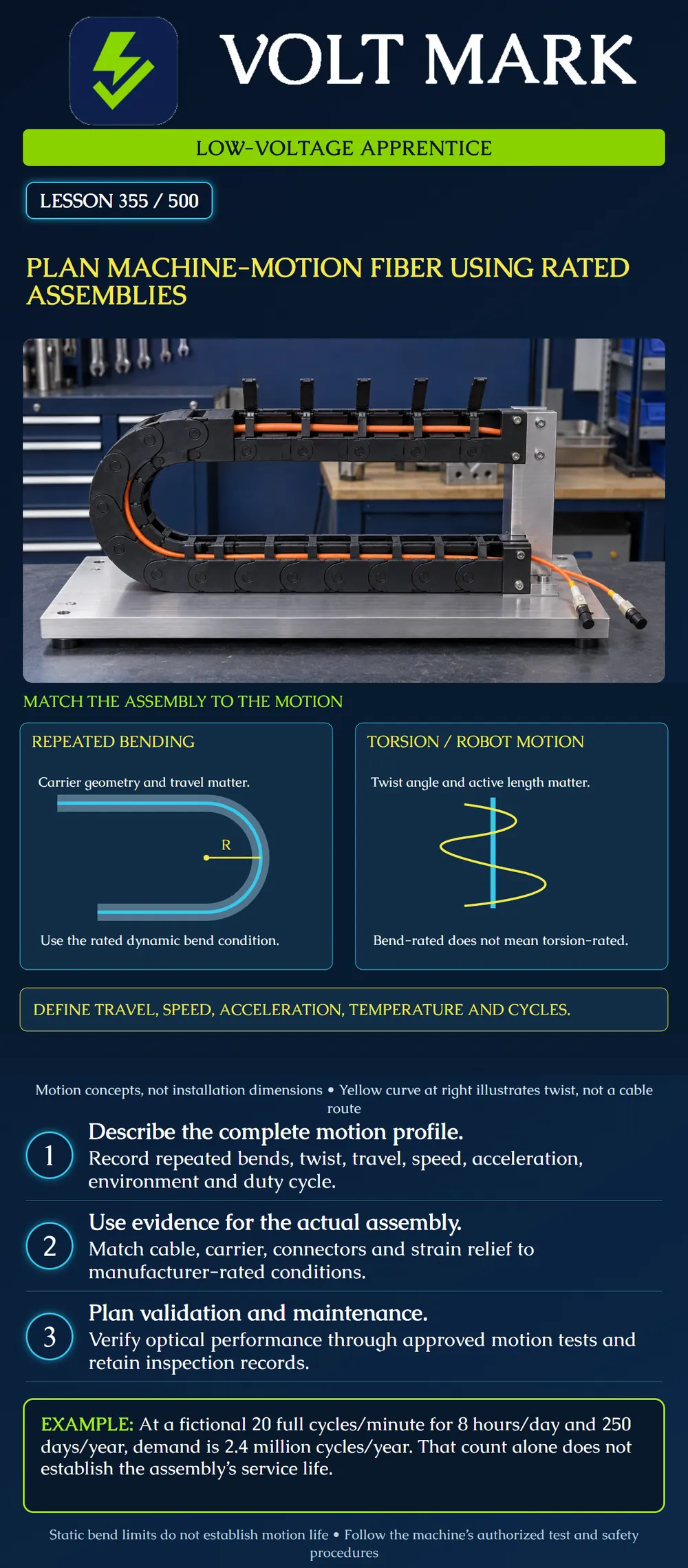
Define a machine-motion fiber requirement and distinguish dynamic bending, torsion and service-life evidence for the complete installed assembly.
Repeated bending changes the curvature of a cable as a carrier or moving mechanism travels. Torsion twists the cable about its length. A robot can combine these motions with other mechanical and environmental demands. The left poster sketch represents a U-shaped carrier bend. R marks its conceptual radius; no real dimension or cable specification is supplied. The right sketch uses a yellow curve to represent twisting motion around the cable axis. It is not a helical cable-installation instruction.
igus markets fiber-optic products specifically for torsion applications and presents service-life information with conditions such as temperature, angular motion and cycle categories [1]. Its fiber-motion discussion also treats the application and bend conditions as factors to evaluate [2]. The existence of these rated products is the lesson: a fiber cable suitable for a static route is not automatically suitable for repeated machine motion. A catalog cycle claim must be read with its exact test conditions and guarantee terms. This lesson does not adopt a manufacturer lifetime number for a real machine.
Record travel distance, direction and orientation, bend geometry, twist angle over active length, speed, acceleration and duty cycle. Identify combined motions, pauses, reversals and startup conditions. Add temperature, fluids, abrasion, contamination and any other exposure established by the site survey. Describe the carrier or dress-pack arrangement and how the cable transitions into fixed sections. Exact equipment identifiers and drawings are necessary. “Robot cable” or “continuous flex” is not a complete requirement.
A fictional machine completes 20 full out-and-back cycles each minute, operates eight hours a day and runs 250 days a year. 20 × 60 × 8 × 250 = 2,400,000 full cycles per year. If the project’s planning horizon is three years at that same schedule, the count is 7,200,000 full cycles. This is a usage estimate, not a predicted failure date. Confirm how the manufacturer defines a cycle, stroke or double stroke before comparing test results. Counting a one-way move as a full cycle can change the comparison.
A fictional moving assembly is rated for a minimum dynamic radius of 100 mm under its supplied operating conditions. The proposed carrier route provides 80 mm. The proposed radius is 20 mm below the stated minimum. A separate static limit of 50 mm does not make the moving 80 mm route acceptable. Use the rating applicable to motion and the complete set of conditions. These values are invented examples, not specifications of the cited products.
A drawing calls for a 90-degree twist distributed over a 0.5 m active cable length. Its nominal average twist demand is 90 ÷ 0.5 = 180 degrees per meter. That calculation does not prove the twist is uniformly distributed or that the cable can tolerate it. Clamps and geometry may concentrate movement. A compatible torsion rating, installation instructions and application review are still needed. Do not interpret a normalized twist figure as permission to twist connectors or arbitrary short cable sections.
Select compatible connectors and termination protection as part of the assembly. Provide strain relief and transition arrangements according to the manufacturer’s instructions so motion loads are not transferred improperly to optical terminations. Carrier fill, routing, separators, attachment points and freedom of movement must follow the applicable system instructions. Do not prescribe universal clamping distances or force a static patch cord into a moving carrier because its connector fits. A new connector, different jacket or alternate carrier arrangement may change the suitability of an otherwise familiar cable.
The cable has a supplied repeated-bend rating, but the machine drawing shows both bending and torsion. No combined-motion evidence is supplied. Mark the application unresolved. Ask the responsible designer/manufacturer to evaluate the full motion profile. Do not assume separate favorable statements can simply be added together into a combined-motion approval.
Define optical checks before and after installation and the monitoring required during authorized representative movement. Record the motion profile, test duration, equipment and acceptance criteria. A stationary light-level reading alone cannot reveal every intermittent movement-related fault. An approved test can provide evidence under its stated conditions; a short test does not demonstrate millions of cycles of service. Define inspection and replacement planning through the machine’s maintenance process. This classroom task authorizes no machine movement, guard removal or live adjustment.
Record assembly part/revision; fiber and optical interface requirements; motion geometry; dynamic radius; torsion demand; active length; speed/acceleration; temperature/exposures; annual usage count and its cycle definition; carrier/strain-relief details; manufacturer evidence; validation and maintenance plan; unresolved questions and reviewer.
Mistake: Comparing one-way strokes with a rating stated in full out-and-back cycles. Correction: Align the manufacturer's cycle definition with the usage record before comparing the 2.4 million annual cycles.
Mistake: Using a static 50 mm radius to approve an 80 mm moving bend. Correction: Use the fictional 100 mm dynamic limit and all its operating conditions; the moving bend is 20 mm below it.
Mistake: Assuming 180 degrees per meter proves a uniformly distributed and acceptable twist. Correction: Check active length, clamps, motion concentration and the complete assembly's applicable torsion and combined-motion evidence.
[1] igus, chainflex fiber optic cable CFROBOT5: https://www.igus.com/product/CFROBOT5 [2] igus, Can fiber optic cable be the solution for small bend radii?: https://toolbox.igus.com/motion-plastics-blog/fiber-optic-cable-for-small-bend-radii/ Primary indexed text inspected 2026-10-01 for motion-specific fiber products and application-dependent suitability. No advertised test result or guarantee is transferred to the fictional machine. Worked values, diagrams and worksheet are original.
Texas journeyman, 15 questions, scored by topic against the 70% mark. No card, and no account needed to start.
Free study material for low-voltage apprentices. This is a national foundation course: requirements differ by state and by local jurisdiction, and a practice that is common in one place is not a rule everywhere. Nothing here is a licence, a certification, or authority to work unsupervised, and completing it does not count as apprenticeship hours or continuing-education credit. Check the codes adopted where you are working, the licensing authority for that work, and your employer's safety programme. VoltMark is not affiliated with, endorsed by, or sponsored by NFPA, OSHA, NICET, BICSI, FOA, or any state or local licensing authority.

Electrician licensing exam prep: practice questions, timed exam simulations, and step-by-step help finding every answer in the NEC.