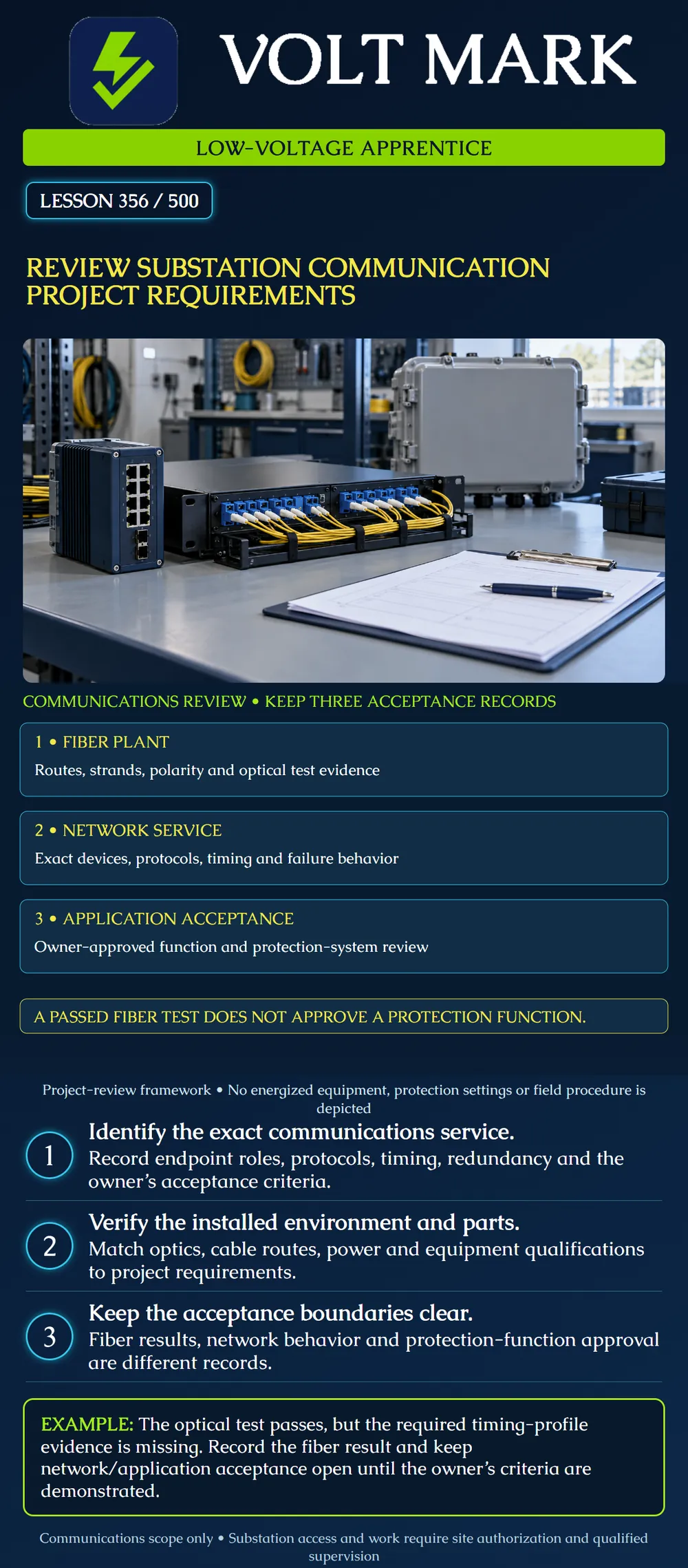
Review a substation fiber-communications packet and distinguish cable-plant evidence, network-service evidence and the owner’s application acceptance.
The apprentice task is communications documentation and review. This lesson does not teach high-voltage installation, relay settings, switching operations or live protection testing. A fiber assignment within a substation remains subject to the site’s access and work controls.
Identify what each link carries and which endpoints depend on it. Ask for the required application functions, device roles, protocol versions, performance criteria and the responsible owner. IEC describes IEC 61850 as a broader information and communication framework, with system requirements for communications among intelligent electronic devices [1,2]. The words “IEC 61850” in a brochure are not a complete project specification. Record the actual services and engineering requirements selected for the project.
Identify the exact location and equipment configuration. Obtain the required environmental and electromagnetic-compatibility evidence, temperature limits, supply arrangements, optical compatibility and installation conditions. For example, SEL’s published switch material separately identifies substation-oriented standards and timing-profile capabilities [3]. This illustrates different evidence categories, not approval of that switch or any other product for this fictional project. A cited standard and its applicable edition/class/test conditions must match what the project requires. Do not transfer a family-level claim to an undocumented device variant.
The fictional project connects cabinet A to cabinet B using four duplex Ethernet optical links. The packet supplies endpoint and strand identifiers, approved cable-test criteria and completed optical results for all eight working strands. It also requires a specific timing profile, a documented failure case and an owner-approved functional acceptance procedure. The timing-profile compatibility record is missing. The failure-case results have not been supplied. No application acceptance sign-off is attached. Review outcome: retain the completed optical evidence, but keep the unresolved network and application items open. Do not label the entire project “passed.”
Four links using two strands each require 4 × 2 = 8 working strand assignments. If the installed cable has 12 strands, 12 − 8 = 4 are not assigned to those links. That count does not prove the remaining four are terminated, tested or reserved for any particular purpose. Their status needs its own schedule. A strand count also says nothing about application redundancy unless the topology and failure requirements establish it.
Request the required time-distribution method/profile and the permitted timing error at the specified endpoint. Identify how loss of synchronization is detected and reported. Do not substitute a generic clock feature for an exact profile requirement. For redundancy, document the covered failures and shared dependencies. Two fiber paths may share a duct, cabinet, switch or supply. A passed cable test cannot prove application continuity after a failure. The communication engineer and owner must define the timing and availability limits. No universal microsecond or millisecond threshold is assigned in this lesson.
Keep approved device identities, software baselines and configuration records together with the drawings. Identify the authorized management path, access controls, monitoring and change process required by the owner. Do not attach a personal laptop, bridge networks, change an address or substitute an optic merely because the physical port is available. This exercise is a packet review and authorizes no system access.
A contractor submits a report headed “all links good.” It has optical power numbers but no strand IDs or documented test references. Record that the supplied summary cannot be reconciled to the required cable-plant evidence. Request identifiable results against the approved criteria. Do not infer a failed physical link from the documentation gap, and do not invent a pass. A second packet has complete optical records but incomplete endpoint configuration. Keep those observations separate rather than discarding valid optical evidence or using it to approve the configuration.
Record service/link ID; endpoints; route/strand schedule; required environmental/EMC qualifications; optical design and acceptance method; protocol/configuration baseline; timing profile and error requirement; failure/restoration cases; management/security requirements; evidence file references; unresolved items; responsible reviewer and final disposition. Use “not supplied” for missing records. Use “does not meet criterion” only when evidence establishes a mismatch.
Mistake: Marking the substation project accepted because all eight working strands passed. Correction: Retain the optical results while separately resolving the timing profile, failure case and owner application acceptance.
Mistake: Treating 'IEC 61850' on a brochure as the complete communications requirement. Correction: Obtain the selected services, roles, versions and performance criteria for the intended application.
Mistake: Calling the four unassigned strands ready spares from the strand count alone. Correction: Record each strand's termination, test and reservation status before assigning a restoration use.
[1] IEC, What is IEC 61850?: https://iec61850.dvl.iec.ch/what-is-61850/ [2] IEC, IEC 61850-5:2013+AMD1:2022 public scope: https://webstore.iec.ch/en/publication/75090 [3] SEL, SEL-2741 Ethernet Switch: https://selinc.com/products/2741/ Primary indexed descriptions inspected 2026-10-01. The full paid IEC standard was not accessed; no clause-level compliance claim is made. SEL information illustrates separate environmental and timing evidence categories, not a product selection. All packet details, counts and exercises are original.
Texas journeyman, 15 questions, scored by topic against the 70% mark. No card, and no account needed to start.
Free study material for low-voltage apprentices. This is a national foundation course: requirements differ by state and by local jurisdiction, and a practice that is common in one place is not a rule everywhere. Nothing here is a licence, a certification, or authority to work unsupervised, and completing it does not count as apprenticeship hours or continuing-education credit. Check the codes adopted where you are working, the licensing authority for that work, and your employer's safety programme. VoltMark is not affiliated with, endorsed by, or sponsored by NFPA, OSHA, NICET, BICSI, FOA, or any state or local licensing authority.

Electrician licensing exam prep: practice questions, timed exam simulations, and step-by-step help finding every answer in the NEC.