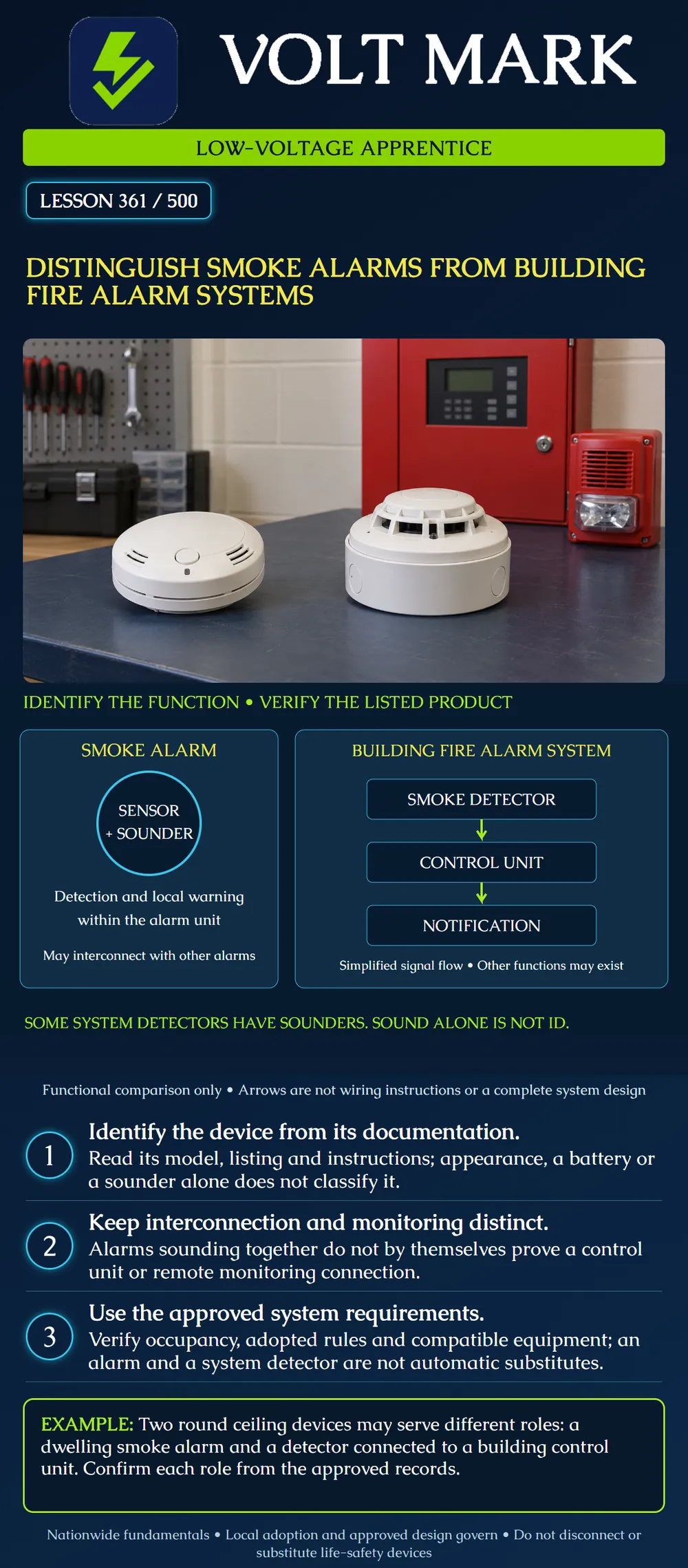
Explain the functional distinction between a smoke alarm and a smoke detector used in a building fire alarm system. Identify which records are needed before classifying a device or proposing a replacement. This lesson concerns identification and system literacy, not energized work or fire alarm programming.
A smoke alarm combines smoke sensing and an alarm sounder in a self-contained unit with a power provision. UL's published UL 217 scope describes this arrangement. Power arrangements vary, so the presence of a battery is not the definition. Some alarms are battery powered; others have another power source and may include backup power.
A building fire alarm system organizes multiple functions around its approved equipment and control arrangement. The simplified poster shows a smoke detector providing an input to a control unit, which operates notification functions according to the system design. Real systems can also contain manual initiating devices, sprinkler-related inputs, interfaces, remote annunciation and signal transmission. The three boxes are not a complete bill of materials.
A system smoke detector is not necessarily silent. Honeywell's B200S/B200S-LF information illustrates a detector sounder-base arrangement that interacts with a compatible fire alarm control panel. Therefore, hearing sound at a detector location does not prove the device is a household smoke alarm. Its listing, model and intended system application matter.
USFA recommends interconnected home smoke alarms so a detection event can sound the interconnected alarms. Interconnection may use a supported wired or wireless arrangement. Compatibility must come from the actual products' instructions; two devices that look alike are not automatically compatible.
From the observation “all three alarms sounded,” you can infer coordinated sounding during that event. You cannot infer that a supervising station received a signal, that emergency responders were dispatched, or that every building function operated. Those are separate questions needing separate records and authorized verification.
A building fire alarm system also should not be assumed to contact emergency responders solely because a control unit is present. Determine the required transmission arrangement and documented service. Never promise dispatch from a photograph of a panel or a sounding device.
A learner sees two circular ceiling devices in an apartment property. Approved records identify Device A as a smoke alarm serving a dwelling and Device B as a system smoke detector serving a common-area fire alarm system. Correct response: record both model numbers and their assigned roles. Their similar shape does not make them interchangeable. Incorrect response: replace B with A because both detect smoke. The case does not establish where either device must be installed or what that property legally requires. Those decisions depend on its actual requirements and design.
A device schedule identifies a compatible detector and sounder base connected to an approved control unit. Someone calls it “a standalone alarm because it beeps.” Correct response: classify it using the schedule and manufacturer documentation. The sounder is one function of this system arrangement. Do not generalize the behavior of one base to every detector family. Power, control and compatibility details are product-specific.
Three alarms sound together during an authorized demonstration. The property file contains no transmission documentation. Record: coordinated local sounding observed in the demonstration. Unresolved: whether there is an approved remote signaling arrangement. Next step: ask the responsible system representative for the applicable records. Do not create an emergency signal or call an emergency number as a classroom test.
For each device, record:
UL identifies separate standards for smoke alarms and smoke detectors for fire alarm systems: UL 217 and UL 268. These names help locate the right documentation. They do not, by themselves, establish an installation's legal compliance or the compatibility of a particular detector with a particular control unit.
This lesson teaches functional distinctions that can be used throughout the United States. It does not assign one code edition to every state or county. For a project, identify the applicable authority having jurisdiction, occupancy/use, adopted requirements and amendments, approved documents, product instructions and personnel qualifications. A product standard is not the same as a locally adopted installation requirement. Do not infer permission to replace equipment from a general education poster.
Some smoke alarms use line-voltage supplies. Recognizing them here does not expand an apprentice's authorized work scope. This low-voltage lesson does not provide line-voltage installation instructions. Never disconnect an occupied building's protection simply to identify a device.
Mistake: Identifying a ceiling device as a standalone alarm because it sounds locally. Correction: Check the exact model, base and approved schedule; a compatible system detector can also have a sounder base.
Mistake: Treating interconnected sounding as proof that a station received an alarm. Correction: Record local sounding separately and obtain the documented transmission arrangement and authorized receipt evidence.
Mistake: Replacing a system detector with a similar-looking household alarm. Correction: Match the intended product role, listing and compatible control equipment before any replacement is considered.
A fictional schedule identifies ceiling unit A as a dwelling smoke alarm and unit B as a system detector with a compatible sounder base. A report says both locations sounded but contains no station record. Classify the units and state one conclusion the report cannot support.
Answer: A is the scheduled smoke alarm; B remains a system detector arrangement despite its sounder. The report does not establish remote signal receipt or dispatch. Request the relevant records through the responsible system representative.
UL Standards & Engagement, UL 217 published scope: https://www.shopulstandards.com/ProductDetail.aspx?UniqueKey=36606 Scope: indexed public definition of the self-contained smoke alarm; no claim of reviewing the full standard. UL Solutions, Smoke Alarm Fire Testing Research: https://www.ul.com/resources/smoke-alarm-fire-testing-research Scope: public distinction between UL 217 smoke alarms and UL 268 smoke detectors for fire alarm systems. U.S. Fire Administration, Smoke Alarms: https://www.usfa.fema.gov/prevention/home-fires/prepare-for-fire/smoke-alarms/index.html Scope: interconnected home-alarm public guidance. Honeywell/Silent Knight, B200S-B200S-LF Intelligent Sounder Base datasheet: https://prod-edam.honeywell.com/content/dam/honeywell-edam/hbt/en-us/documents/literature-and-specs/datasheets/351565.pdf?download=false Scope: indexed manufacturer description of sounder-base/control-panel interaction; not a generic wiring method. All cases and worksheet structure are original teaching material. No device-specific replacement approval is given.
Texas journeyman, 15 questions, scored by topic against the 70% mark. No card, and no account needed to start.
Free study material for low-voltage apprentices. This is a national foundation course: requirements differ by state and by local jurisdiction, and a practice that is common in one place is not a rule everywhere. Nothing here is a licence, a certification, or authority to work unsupervised, and completing it does not count as apprenticeship hours or continuing-education credit. Check the codes adopted where you are working, the licensing authority for that work, and your employer's safety programme. VoltMark is not affiliated with, endorsed by, or sponsored by NFPA, OSHA, NICET, BICSI, FOA, or any state or local licensing authority.
Electrician licensing exam prep: practice questions, timed exam simulations, and step-by-step help finding every answer in the NEC.