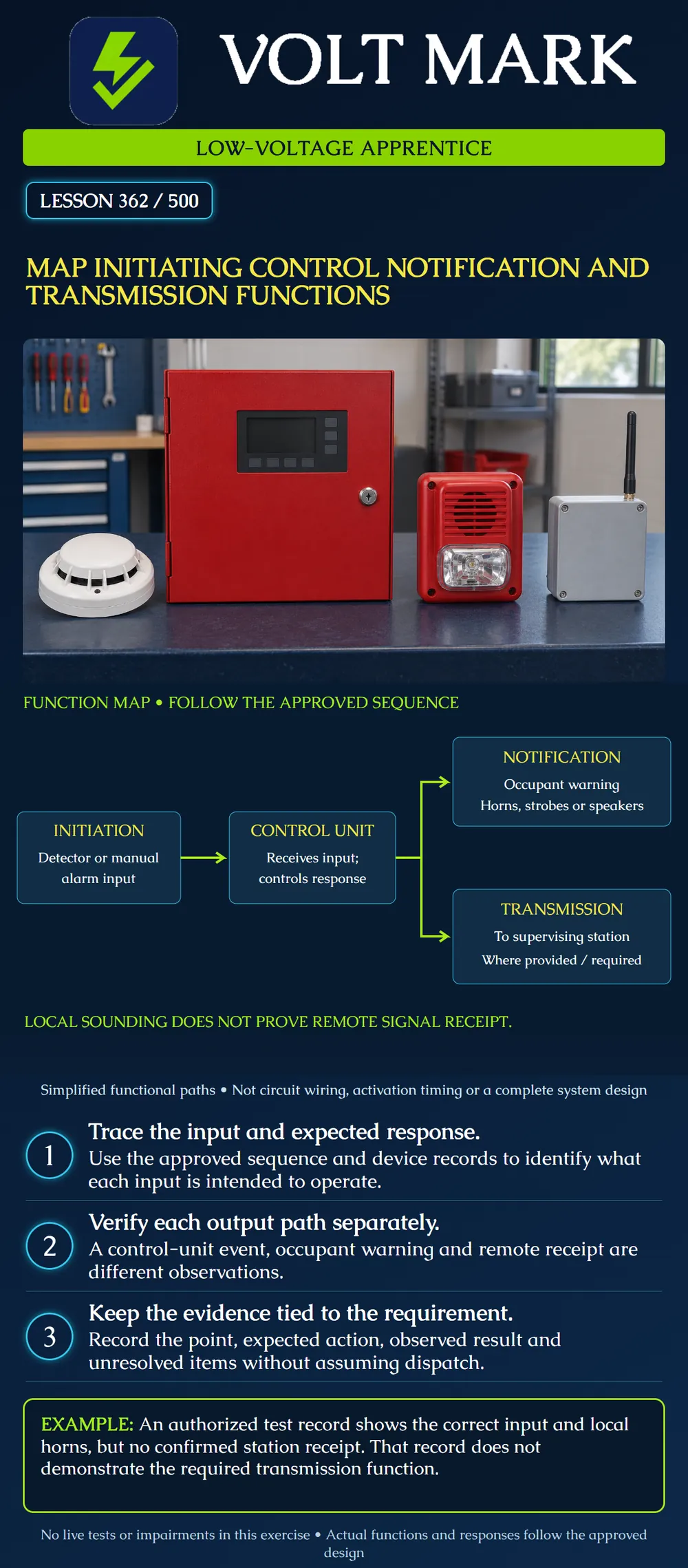
Draw a functional map that distinguishes the initiating input, control response, occupant notification and any required off-premises signal transmission. Explain what evidence would be needed to verify each part.
NFPA's public Fire Alarm Basics guide separates initiation, control, notification, emergency control functions and off-premises signaling. Initiating devices provide inputs. The fire alarm control unit receives inputs and directs outputs. Notification appliances provide occupant warning. Off-premises signaling carries information to a supervising station where that arrangement applies. Power and other functions also matter, although this poster omits them to focus on signal roles. Alarm, supervisory and trouble conditions are distinct; not every input means the same output response.
The poster's arrows represent relationships between functions. They specify no conductor count, circuit class, wiring topology, terminal assignment or permissible delay. A branch on this drawing is not permission to splice two real circuits together. A transmitter can be integrated or separately arranged according to the actual system; its box here identifies a function, not a required separate enclosure.
A fictional approved sequence, SEQ-A revision 2, contains this row: Input: manual alarm point M-01. Expected control indication: M-01 alarm. Expected occupant warning: the designated notification group N-01. Expected remote event: the designated alarm event associated with the correct account at Station S. Other interface actions: outside this worksheet's scope; refer to the full sequence.
This row is invented for learning. It is not a template for programming a building. It does not establish an acceptable notification zone, signal timing, transmission technology or dispatch procedure.
Write M-01 at the left. Connect its functional input to the control unit. Draw separate branches for N-01 and the station transmission path. At every branch, put the evidence you would need beside the expected response. Mark unknown details as unknown rather than filling them with a guess.
Evidence A: a control-unit event associated with the correct input. Evidence B: observations of the designated notification function under an approved test method. Evidence C: a confirmed corresponding station event under the authorized test procedure. A screenshot showing only Evidence A cannot stand in for B and C.
A fictional report says, “M-01 activated and horns sounded.” No station confirmation is attached. Supported conclusion: the report describes an input action and some local sounding. Unresolved: whether the correct station account received the required event; whether all required local notification performance was verified. Do not mark the transmission row passed from this report. Ask the responsible testing team for the missing evidence. Do not generate another signal on a live system yourself.
A station log contains an alarm at a similar time, but the account identifier belongs to another training record. Supported conclusion: the provided log is not traceable to this case. Next step: reconcile account, premises, point information where transmitted, timestamps and the authorized test record. A coincident time alone does not establish identity. Some arrangements transmit different levels of detail; do not demand point-level information that the approved arrangement does not provide.
The correct remote event is documented, but the required notification group has no evidence. The remote success cannot clear the local branch. Record that branch as unresolved and refer it to the responsible party. Conversely, a missing remote record does not establish that every local appliance failed. Keep conclusions as narrow as the evidence.
A confirmed station event is present. A learner writes, “Firefighters were dispatched.” That conclusion requires separate evidence of the actual response process. Receipt and dispatch are different facts. The worksheet should record only what the provided documents establish. Never use an emergency call or unauthorized alarm as a classroom verification tool.
Use one row per required relationship:
The row is not complete merely because every cell contains text. “Unknown” is useful when accurate; “passed” without evidence is not.
Your fictional file contains three required evidence references A, B and C. A and B are attached; C is missing. Two of three references are present. That arithmetic describes document completeness only. It is not a safety rating or system acceptance percentage. If C is required, the row remains unresolved until the proper evidence and review are available.
Use this functional vocabulary across U.S. projects while verifying each project's governing requirements. The approved sequence depends on the actual occupancy, design, adopted codes and amendments, equipment and authority having jurisdiction. No universal timing, device spacing or transmission method is assigned here. A dedicated-function arrangement may have a different scope from the classroom system shown. Do not add or remove functions from a design based on this poster.
Mistake: Using the control-unit event log to pass notification and station transmission. Correction: Attach separate evidence for the designated notification result and the corresponding receiving-station event.
Mistake: Matching a station record by time alone when its account belongs to another premises. Correction: Reconcile premises, account and available event identifiers before associating the record with M-01.
Mistake: Calling confirmed station receipt proof that responders were dispatched. Correction: Keep event receipt and response-process evidence separate; report only the facts the records establish.
NFPA, A Guide to Fire Alarm Basics: https://www.nfpa.org/-/media/project/storefront/catalog/files/code-or-topic-fact-sheets/FireAlarmBasicsFactSheet.pdf Scope: opened primary public PDF; functional categories and general signal relationships. The poster and cases are original educational material, not copied wiring diagrams. This lesson does not claim that the public guide supplies all project requirements or that a complete adopted code review was performed.
Texas journeyman, 15 questions, scored by topic against the 70% mark. No card, and no account needed to start.
Free study material for low-voltage apprentices. This is a national foundation course: requirements differ by state and by local jurisdiction, and a practice that is common in one place is not a rule everywhere. Nothing here is a licence, a certification, or authority to work unsupervised, and completing it does not count as apprenticeship hours or continuing-education credit. Check the codes adopted where you are working, the licensing authority for that work, and your employer's safety programme. VoltMark is not affiliated with, endorsed by, or sponsored by NFPA, OSHA, NICET, BICSI, FOA, or any state or local licensing authority.

Electrician licensing exam prep: practice questions, timed exam simulations, and step-by-step help finding every answer in the NEC.