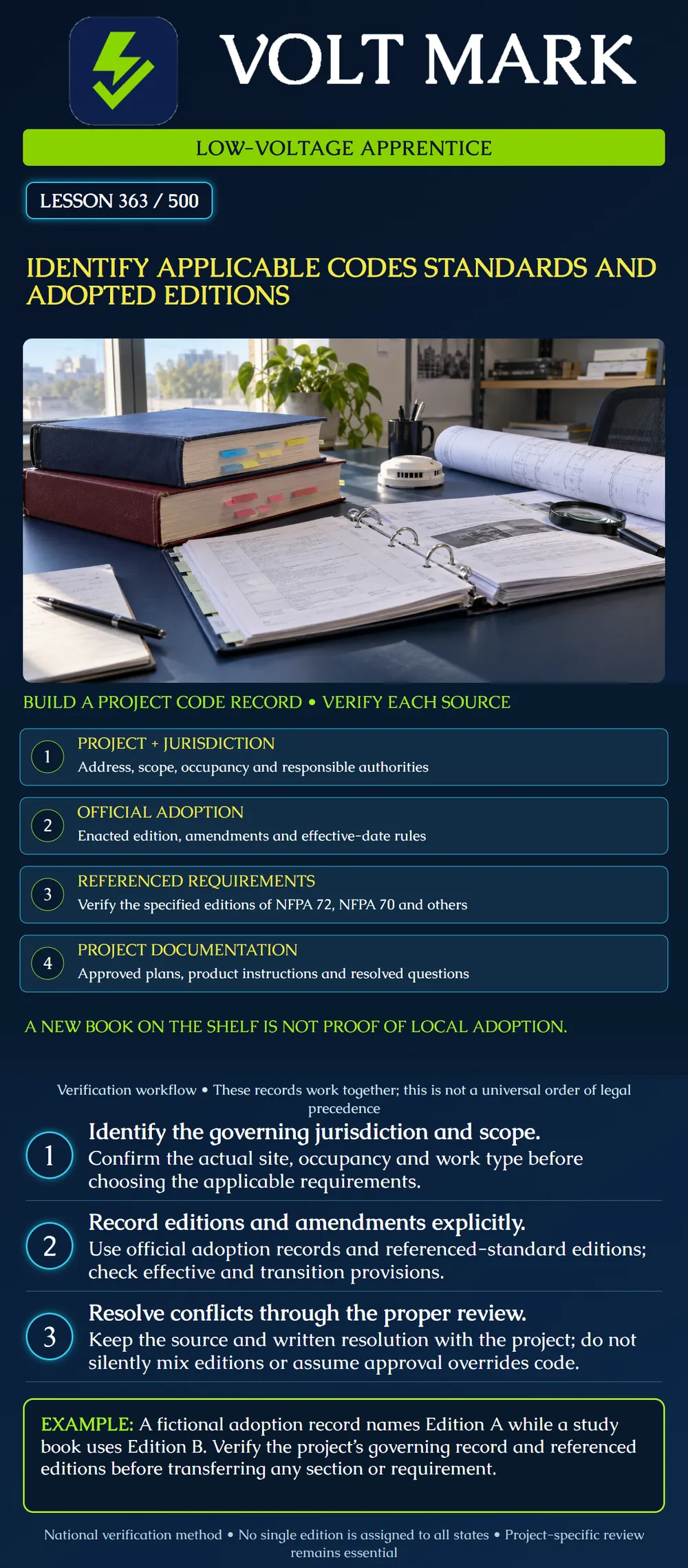
Prepare a traceable project code record that identifies applicable documents, editions, amendments and unresolved questions. Learn a method usable across U.S. jurisdictions without treating a national publication date as a local adoption date.
ICC's adoption material describes adoption through an ordinance, regulation or law and the establishment of an effective date. The model publication and the enacted requirement are related but distinct records. An adoption chart can help locate information, but detailed applicability and amendments need verification with the responsible jurisdiction. “We always use this book” is not enough.
The lesson does not determine the law for a particular site. It trains you to collect evidence so the responsible design and code-review team can make that determination.
Applicable building, fire, life-safety and other governing provisions establish project requirements within their scopes. NFPA 72 addresses fire alarm and signaling topics. NFPA 70, the National Electrical Code, addresses electrical installation safety. The editions referenced or adopted for a project must be identified; their publication years need not match. Product instructions, compatibility information and approved project documents supply additional project-specific information. Do not use a product brochure as an adoption record.
The poster's numbered rows are a research workflow, not a statement that one document always overrides every document below it.
Record the actual address and whether the work lies within a municipality, an unincorporated area or another jurisdictional arrangement. Identify the responsible building, fire and electrical authorities as applicable. Multiple authorities can have different roles. Do not assume the closest city's requirements govern a site outside its jurisdiction. Special facility or ownership requirements may also matter and should be referred to the responsible reviewer.
State the work: a new installation, addition, alteration, repair, replacement, occupancy change or existing-system evaluation. An apprentice should not independently invent the occupancy classification. Obtain the approved project classification and raise any discrepancy.
For each relevant document, capture:
Use a source URL and a retained copy or reference permitted by the project document process. Record when a source was checked because online pages can change. A search snippet can locate an official source but should not be the final evidence for a detailed compliance decision.
Fictional Town A's provided adoption packet identifies Edition A. A training book discusses Edition B. The assignment is to document Town A's requirements for the described project. Correct action: examine the adoption packet, amendments, applicability and referenced editions. Keep the training book identified as explanatory material. Incorrect action: transfer a section from Edition B and label it an Edition A requirement. This case supplies no real jurisdiction or actual edition-year ruling.
A fictional adoption notice has an effective date after the date of a project's permit application. Its transition text is missing from your file. Correct entry: applicability unresolved pending the complete transition provisions and responsible review. Incorrect entry: automatically choose the old edition solely because the application is earlier, or the new edition solely because construction will be later. The date is evidence, but the governing transition rule decides how it is used. This lesson supplies no universal permit-date rule.
A fictional base code references a particular edition of a technical standard. Your newest copy is a later edition. Record the referenced edition rather than assuming the two documents must carry the same year or that “latest” is automatically acceptable. If a different edition is proposed, refer the proposal through the actual approval process. Do not claim an alternative has been accepted without evidence.
A drawing note names one edition, while the official adoption packet appears to identify another. Do not silently edit the note or proceed on an assumption that an approved drawing cancels a governing requirement. Write a focused question: identify both sources, their revisions and the specific discrepancy. Ask the responsible designer and authority to resolve applicability through the established process. Retain the written resolution and update affected records as authorized.
Start with the scope and table of contents of the edition actually applicable to the project. Identify the fire-alarm circuit provisions and related installation requirements rather than assuming one article answers every wiring question. Older course material may refer to NEC Article 760; verify the relevant article, section, cross-references and amendments in the governing edition before using that reference. This lesson deliberately does not quote a wiring permission or spacing value.
NFPA's official materials show that publication and reorganization work continues. A committee proposal, meeting agenda or draft change is not automatically final published text, and published text is not automatically adopted locally. Keep those statuses distinct in research notes.
Your draft record contains six required fields: title, edition, adoption source, amendments, applicability and section reference. Only four are filled, while amendments and applicability remain unknown. You have four completed fields, not a completed code determination. The useful next action is to obtain the two missing pieces, not calculate a compliance score.
Apply this same method in every state. This poster does not certify a fifty-state adoption inventory, identify a county's licensing scope or select the controlling edition for a real permit. Requirements can vary by location and project. Keep examination study editions separate from jobsite requirements: an exam bulletin's chosen book is not, by itself, proof of the edition applicable to a construction project.
Mistake: Using the newest published standard as the governing edition without adoption evidence. Correction: Record the official adoption, amendments, effective date and project applicability before applying a section.
Mistake: Choosing an edition from permit or construction dates without the transition provisions. Correction: Obtain the complete transition rule and responsible interpretation rather than selecting by date alone.
Mistake: Copying a section number from the training edition into the project's code record. Correction: Verify that section and its cross-references in the applicable edition and retain the document identifier.
ICC, Code Adoption Resources: https://www.iccsafe.org/advocacy/code-adoption-resources/ ICC, published adoption preface: https://shop.iccsafe.org/media/wysiwyg/material/3100S24-TOC.pdf Scope: indexed primary adoption mechanism and effective-date information. NFPA, NFPA 70 official document information: https://www.nfpa.org/codes-and-standards/nfpa-70-standard-development/70 Scope: electrical-code role and published document information, not local adoption. NFPA LiNK, NFPA 72 2022 contents: https://link.nfpa.org/all-publications/72/2022 Scope: official topic structure; this edition is not assigned to all projects. ICC, NFPA 72 2025 publisher-supplied product description: https://shop.iccsafe.org/nfpa-72-national-fire-alarm-and-signaling-code-2025-edition.html Scope: general subject coverage, not section-level compliance. Original fictional cases are educational. No exhaustive state/county adoption audit or full paywalled-standard review is claimed.
Texas journeyman, 15 questions, scored by topic against the 70% mark. No card, and no account needed to start.
Free study material for low-voltage apprentices. This is a national foundation course: requirements differ by state and by local jurisdiction, and a practice that is common in one place is not a rule everywhere. Nothing here is a licence, a certification, or authority to work unsupervised, and completing it does not count as apprenticeship hours or continuing-education credit. Check the codes adopted where you are working, the licensing authority for that work, and your employer's safety programme. VoltMark is not affiliated with, endorsed by, or sponsored by NFPA, OSHA, NICET, BICSI, FOA, or any state or local licensing authority.
Electrician licensing exam prep: practice questions, timed exam simulations, and step-by-step help finding every answer in the NEC.