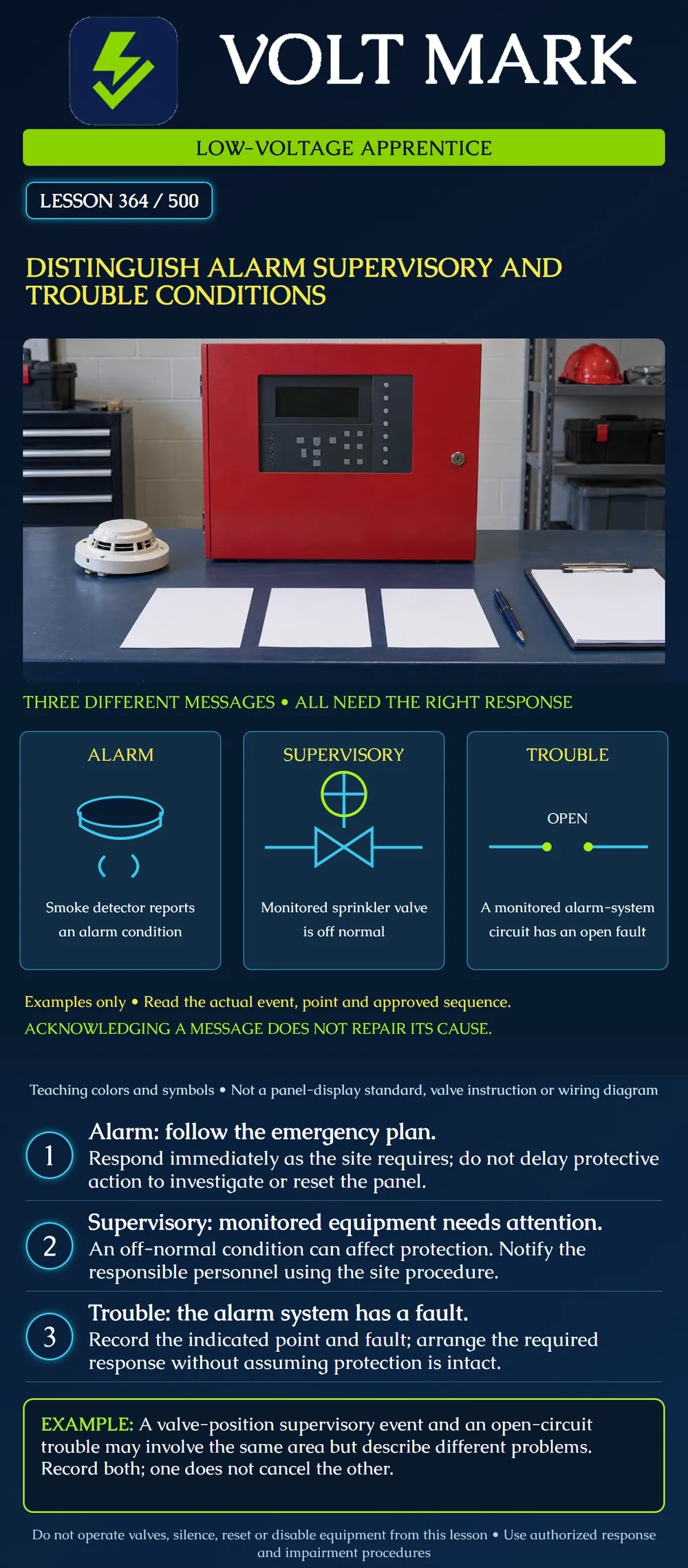
Distinguish three common fire alarm condition categories, describe their meaning using examples and create a useful event handoff without performing unauthorized panel operations.
NFPA's public Fire Alarm Basics guide distinguishes alarm, supervisory and trouble. An alarm indicates a condition requiring emergency response, such as an alarm from a smoke detector. Supervisory indicates an off-normal condition of monitored equipment or a process, such as a sprinkler control valve moved from its normal position. Trouble indicates an alarm-system fault, such as a broken monitored circuit. The category and the actual point/message both matter. These examples are not an exhaustive list or a universal output sequence.
For an alarm, follow the site's emergency plan immediately. Do not postpone protective action while searching for a cause, counting events or trying a reset. Do not decide that a signal is false from a familiar location or a previous nuisance event. Supervisory and trouble messages also require the site's designated response. “Not an alarm” is not the same as “safe to ignore.” Escalate through the proper procedure, including impairment management where applicable. This lesson does not assign one response time or staffing arrangement to every building.
You receive three fictional paper records, not a live panel: A: ALARM — SMOKE POINT D-14. B: SUPERVISORY — VALVE POSITION V-02. C: TROUBLE — CIRCUIT OPEN C-03. Classify A, B and C exactly as the records indicate. Then write what is known and unknown. A identifies a detector alarm report; it does not establish the cause of smoke or show that responders arrived. B identifies a monitored equipment condition; it does not tell you why the valve position changed. C reports a fault; it does not tell you where the conductor is broken or whether every device is affected.
The training log contains a V-02 supervisory event and a C-03 trouble event in the same mechanical area. A learner writes, “The trouble explains the supervisory, so we can delete one.” That conclusion is unsupported. Preserve both records, their timestamps and identities. They may have different causes or be related; the documents supplied do not establish which. Refer the record to the responsible personnel rather than inventing a repair.
A training report says an operator acknowledged an event at 09:12. It contains no cause correction or restoration evidence. Correct conclusion: an acknowledgement was recorded. Incorrect conclusion: the underlying condition was repaired at 09:12. Acknowledgement, audible silencing, reset and restoration are different concepts. Their control behavior depends on equipment and authorization. This exercise provides no button sequence or permission to operate controls.
A historical training entry shows a trouble condition. A new alarm then appears in the exercise. Do not dismiss the new alarm because a fault existed first. The alarm still requires the emergency response established for the site. Existing faults should be communicated to the responsible response team through the applicable procedure; they do not prove there is no emergency.
After taking the response actions required by your role, preserve the available information without delaying safety actions:
Avoid writing “all clear” when you only know that one message disappeared. Avoid replacing the displayed text with a diagnosis such as “bad detector” unless the cause has been established and documented.
A fictional log shows three entries. Later, two entries have documented restoration, while one remains active. Two restored records do not clear the third. Retain the unresolved entry and its follow-up. This is an exercise in traceability, not an instruction to leave an actual impairment unmanaged.
Do not restore a valve or circuit solely to clear a message. The underlying work can affect fire protection and must follow the authorized process. A quiet panel is not, by itself, a substitute for the required verification and records.
Use these concepts across the United States while consulting the actual system instructions, approved sequence, governing requirements and site emergency plan. Do not assume the same color, sound, display priority, latching behavior or remote response on every control unit. The responsible authority and qualified personnel determine the required response and any impairment measures for the real situation.
Mistake: Treating acknowledgement at 09:12 as evidence that the cause was repaired. Correction: Record acknowledgement as its own action and require separate cause-resolution and restoration evidence.
Mistake: Merging the valve supervisory and circuit trouble entries because they share a location. Correction: Preserve both identifiers and timestamps; let the responsible personnel establish whether the events are related.
Mistake: Discounting a new alarm because the system already has a trouble condition. Correction: Follow the site's emergency plan for the alarm and communicate the existing fault without delaying protective action.
NFPA, A Guide to Fire Alarm Basics: https://www.nfpa.org/-/media/project/storefront/catalog/files/code-or-topic-fact-sheets/FireAlarmBasicsFactSheet.pdf Scope: opened primary public PDF, page 1 condition-category descriptions and examples. Original artwork, training records and exercises are educational, not copied manufacturer displays or operational instructions. No full adopted-code or manufacturer procedure review is claimed.
Texas journeyman, 15 questions, scored by topic against the 70% mark. No card, and no account needed to start.
Free study material for low-voltage apprentices. This is a national foundation course: requirements differ by state and by local jurisdiction, and a practice that is common in one place is not a rule everywhere. Nothing here is a licence, a certification, or authority to work unsupervised, and completing it does not count as apprenticeship hours or continuing-education credit. Check the codes adopted where you are working, the licensing authority for that work, and your employer's safety programme. VoltMark is not affiliated with, endorsed by, or sponsored by NFPA, OSHA, NICET, BICSI, FOA, or any state or local licensing authority.
Electrician licensing exam prep: practice questions, timed exam simulations, and step-by-step help finding every answer in the NEC.