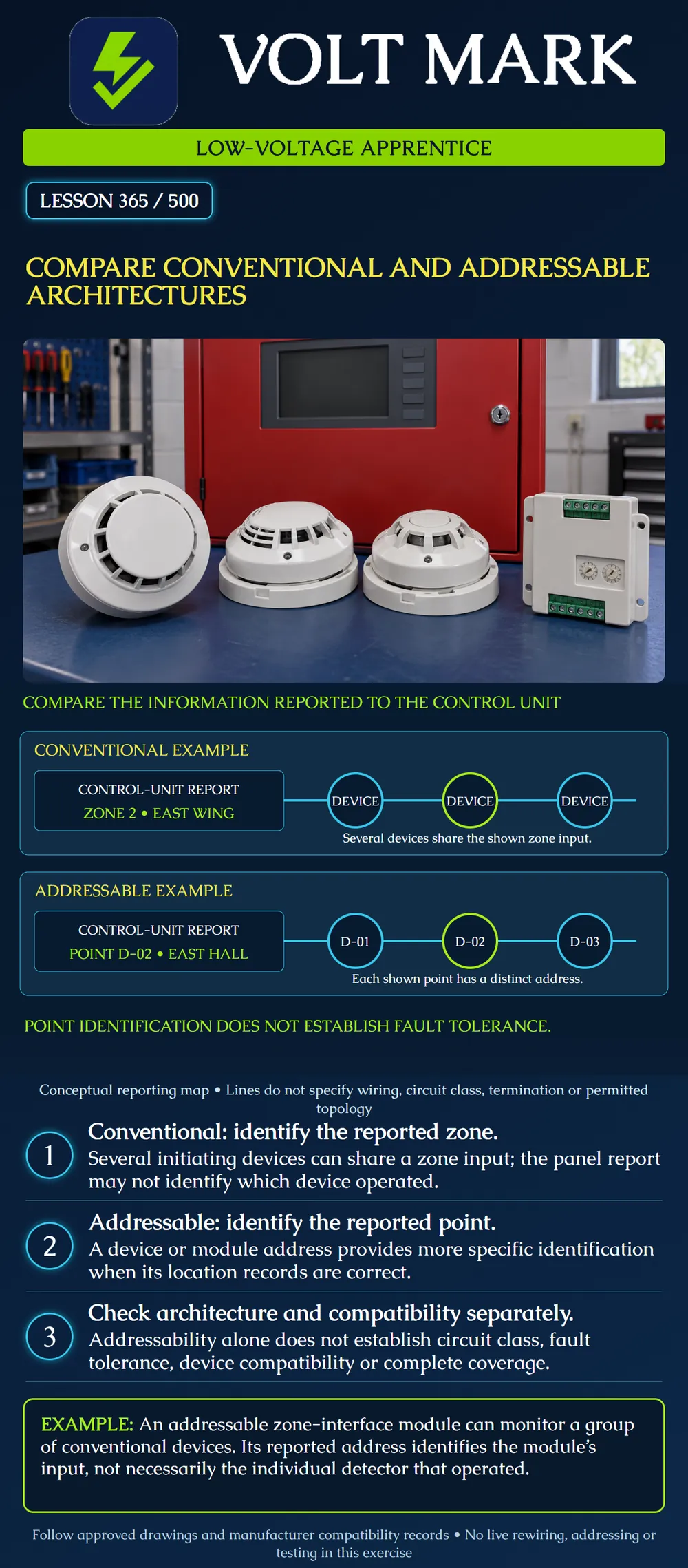
Compare the information available from a conventional zone input with the information from an addressable point. Recognize a mixed architecture and identify which details still need documentation.
NFPA's Fire Alarm Basics describes conventional zone reporting and devices that communicate an address to the control unit. In the conventional example, several devices share an initiating zone. An event indicates that zone rather than automatically identifying the individual device. In the addressable example, the reported address identifies a device or interface point. The system's programmed description and installation records connect that identifier to a physical location.
These are reporting distinctions. The word addressable does not by itself specify circuit class, behavior under faults, cable routing, equipment compatibility or adequacy of detector coverage.
The top row contains three generic devices sharing the illustrated zone. The bottom row contains D-01, D-02 and D-03. The lime outline highlights the middle event source in each classroom example. The control-unit reports differ: “Zone 2 — East Wing” versus “Point D-02 — East Hall.” The connecting line is an information relationship, not an installation drawing. No end-of-line component, return path, polarity or terminal arrangement is specified. Do not use it to wire either system.
A fictional schedule assigns three detectors to Zone 2. A paper panel record says “Zone 2 alarm.” Supported conclusion: the zone associated with those devices reported an alarm. Unsupported conclusion: the middle detector caused it just because it sits in the middle of the drawing. Use the approved event-response process and the correct records; do not delay emergency action while investigating which device operated. This exercise uses paper evidence and does not authorize a test.
The fictional device list identifies D-02 as East Hall. A copied programming sheet describes D-02 as West Office. The address provides a specific point identifier, but conflicting descriptions make location information unreliable. Record both sources and refer the discrepancy through the responsible review process. Do not edit a production database to make the display look right without verifying the actual device, approved sequence and authorized change process.
The useful lesson is that greater information detail still depends on accurate commissioning and records. An address is not a geographic position by itself.
A fictional approved arrangement uses addressable interface M-07 to monitor one group of three conventional detectors. When that group operates, the control unit identifies M-07. This does not automatically reveal which of the three detectors operated. Draw the module and the group as distinct information levels. Do not rename the group's three members M-07A, M-07B and M-07C and claim those invented identifiers are individually reported addresses.
Honeywell's M502M engineering specification gives a real example of a conventional-zone interface for compatible two-wire detectors on an intelligent system. This confirms that mixed arrangements exist. It does not authorize the fictional example's products, quantities or wiring. Those require the actual manufacturer's compatible-equipment information and approved design.
A salesperson's note says, “It is addressable, so one cable fault cannot affect detection.” The note is insufficient. The reviewer needs the actual pathway design, applicable circuit classification, fault-isolation arrangement and product documentation. A specific point address does not prove every fault leaves that point operating. Conversely, do not label every conventional architecture incapable of meeting a particular project requirement without reviewing the actual design.
For either architecture, record:
Identify each dimension separately. “Addressable” is one answer to one architecture question, not a substitute for the full record.
A fictional diagram has three directly addressed detectors and one addressed interface representing four conventional detectors. Under the exercise's simplified assumption of one reported address per shown detector or module: Reported addresses = 3 + 1 = 4. Physical detectors = 3 + 4 = 7. The interface group does not create four additional individually reported detector addresses. This arithmetic is a learning example, not a panel-capacity calculation. Real products can use different address allocations, device categories and capacity rules.
Do not select solely from the slogans “small means conventional” or “large means addressable.” A real selection must meet the actual functional, information, service, expansion and governing requirements using supported equipment. This lesson does not recommend a product, change an existing installation or claim that the illustrated architectures satisfy a particular occupancy.
The reporting concepts are useful across U.S. jurisdictions. Applicable codes, adopted editions, approved design, manufacturer instructions and licensing/work authorization still govern the installation. Do not assume different brands or product families interoperate because both use the word addressable. The lesson establishes no universal wire count, detector limit or cable length.
Mistake: Naming an individual detector from a shared Zone 2 alarm report. Correction: Keep the conclusion at zone level unless additional authorized evidence identifies the device.
Mistake: Assuming M-07 identifies which of its three conventional detectors operated. Correction: Document the module and its monitored group as separate information levels; do not invent individually reported addresses.
Mistake: Using addressability to promise continued operation after any cable fault. Correction: Review the actual pathway, isolation arrangement and required fault behavior separately from point identification.
NFPA, A Guide to Fire Alarm Basics, initiation section: https://www.nfpa.org/-/media/project/storefront/catalog/files/code-or-topic-fact-sheets/FireAlarmBasicsFactSheet.pdf Scope: primary indexed descriptions of conventional zones and addressable identification. Honeywell/System Sensor, M502M Conventional Zone Interface Engineering Specification: https://prod-edam.honeywell.com/content/dam/honeywell-edam/hbt/en-us/documents/literature-and-specs/engineering-specifications/M502M_EngSpec.pdf?download=false Scope: primary indexed example of a conventional-zone interface; not a complete compatibility or installation review. All diagrams, records and counting examples are original educational scenarios.
Texas journeyman, 15 questions, scored by topic against the 70% mark. No card, and no account needed to start.
Free study material for low-voltage apprentices. This is a national foundation course: requirements differ by state and by local jurisdiction, and a practice that is common in one place is not a rule everywhere. Nothing here is a licence, a certification, or authority to work unsupervised, and completing it does not count as apprenticeship hours or continuing-education credit. Check the codes adopted where you are working, the licensing authority for that work, and your employer's safety programme. VoltMark is not affiliated with, endorsed by, or sponsored by NFPA, OSHA, NICET, BICSI, FOA, or any state or local licensing authority.

Electrician licensing exam prep: practice questions, timed exam simulations, and step-by-step help finding every answer in the NEC.