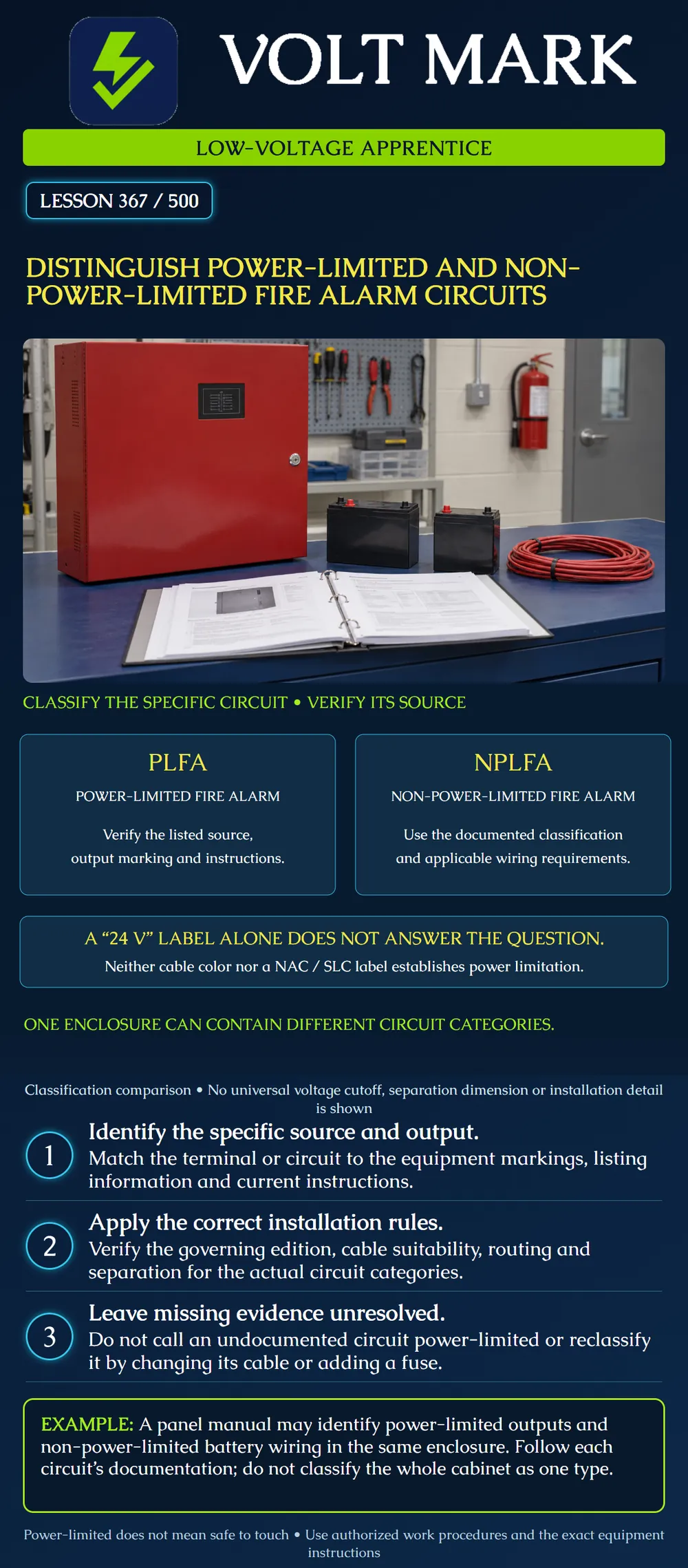
Distinguish power-limited fire alarm (PLFA) and non-power-limited fire alarm (NPLFA) circuit classifications from the evidence supplied by the source and equipment documentation. Avoid using nominal voltage, circuit function or cable appearance as a substitute.
PLFA and NPLFA describe different fire alarm circuit classifications. Power limitation is associated with the source's recognized limitations and the applicable requirements, not merely the load's normal current draw. OSHA 1910.308(d) distinguishes these classifications and specifies listed equipment marked as a PLFA power source for the PLFA source. It also addresses identification and separation. This federal general-industry text is one scoped source, not a complete substitute for a project's adopted electrical code or the actual equipment instructions.
A label reading 24 V tells you a voltage rating; by itself it does not establish PLFA status. Do not equate non-power-limited with a particular high voltage. Do not assume that a small connected load makes an otherwise undocumented source power-limited.
Honeywell's NFS-320 listing document illustrates power-limited circuits and non-power-limited battery wiring within an equipment arrangement. That is a concrete reason to classify the particular circuit rather than the entire enclosure. Its routing diagram applies to that equipment, not to every panel.
The teaching poster provides no separation dimension or knockout assignment. Those depend on the governing requirements and the exact equipment. Never transfer a spacing note from one manual into a different installation without the responsible review.
A fictional drawing says “Output A: 24 VDC” and nothing more. A learner labels it PLFA. That label is unsupported. Record “classification not established from supplied documents” and obtain the correct source/output markings, listing information and instructions. The missing evidence also does not authorize you to declare a final NPLFA design and choose wiring on your own.
A fictional equipment record identifies Output B as a listed power-limited fire alarm output. The terminal schedule matches the identified equipment revision. You now have relevant classification evidence. Still check the full installation conditions, output limitations, compatible loads and wiring requirements. The words power-limited do not remove the need for those checks or authorize energized handling.
A fictional cabinet has one documented PLFA output and a separate battery connection. Someone copies the output's classification onto the battery record because both belong to the same panel. Correct response: trace the battery circuit to its own applicable documentation. Do not borrow the adjacent output's classification. The example teaches record matching, not a general instruction to disconnect or modify batteries.
An installer proposes to use cable bearing a power-limited fire alarm designation on an undocumented output, then call the output PLFA. The cable's identification does not establish source classification. UL publishes separate cable standards for power-limited and non-power-limited fire alarm applications; suitability must be checked for the actual use. Changing the cable cannot independently establish a source's listing or limitations.
Likewise, adding an arbitrary fuse does not establish a listed PLFA source. Source design and permitted protection arrangements require the actual applicable documentation and authorized engineering review. This lesson gives no conversion method.
IDC, NAC and SLC describe circuit functions learned in lesson 366. PLFA/NPLFA concerns another classification dimension. Record both as applicable. “It is a NAC” does not, by itself, tell you its power limitation. “It is PLFA” does not, by itself, identify the appliances or approved output sequence.
Use a separate row for each relevant circuit:
Do not open energized equipment to obtain a missing label as part of this paper exercise. Use available approved records and route needed field identification through the authorized work process.
A fictional cabinet drawing contains three identified circuits, but the proposed cable route crosses an area reserved by the actual manufacturer's drawing for a different category. The classification worksheet alone cannot approve that route. Record the conflicting drawing references and obtain a compliant reviewed arrangement. Do not apply a remembered generic separation number to settle it.
An equipment drawing can impose details in addition to broadly applicable rules. If the documents appear inconsistent, preserve the discrepancy and seek the responsible resolution rather than selecting whichever instruction is easier.
For actual work, confirm the adopted edition and amendments, equipment listing/instructions and applicable workplace rules. Federal general-industry requirements are not presented here as the sole rules for every construction activity or jurisdiction. The lesson intentionally avoids a nationwide spacing, voltage cutoff or cable-substitution table. It provides a repeatable identification method across states.
Mistake: Labeling Output A PLFA from its 24 VDC notation alone. Correction: Obtain the identified source/output markings, listing and instructions; leave classification unresolved until supported.
Mistake: Copying the panel's PLFA output classification onto its battery connection. Correction: Trace each circuit to its own documentation and applicable routing conditions.
Mistake: Expecting a power-limited cable marking or an added fuse to reclassify the source. Correction: Verify the source's applicable recognized limitations and approved arrangement instead of inferring classification from the cable or an improvised change.
OSHA, 29 CFR 1910.308(d), Special systems — Fire alarm systems: https://www.osha.gov/laws-regs/regulations/standardnumber/1910/1910.308 Scope: opened primary regulatory page; classification, source marking and identification principles. No universal construction-code determination. Honeywell, NFS-320 Listing Document: https://prod-edam.honeywell.com/content/dam/honeywell-edam/hbt/en-us/documents/manuals-and-guides/ul-listed-documents/hbt-fire-52745LD-G9.pdf?download=false Scope: indexed manufacturer depiction of power-limited and non-power-limited battery wiring; no model-specific installation instruction copied. UL Standards & Engagement, UL 1425 published scope: https://www.shopulstandards.com/ProductDetail.aspx?productId=UL1425 Scope: primary public cable-standard scope distinguishes non-power-limited applications from UL 1424 power-limited applications; no full standard review or substitution permission. All scenarios and worksheet content are original educational material.
Texas journeyman, 15 questions, scored by topic against the 70% mark. No card, and no account needed to start.
Free study material for low-voltage apprentices. This is a national foundation course: requirements differ by state and by local jurisdiction, and a practice that is common in one place is not a rule everywhere. Nothing here is a licence, a certification, or authority to work unsupervised, and completing it does not count as apprenticeship hours or continuing-education credit. Check the codes adopted where you are working, the licensing authority for that work, and your employer's safety programme. VoltMark is not affiliated with, endorsed by, or sponsored by NFPA, OSHA, NICET, BICSI, FOA, or any state or local licensing authority.

Electrician licensing exam prep: practice questions, timed exam simulations, and step-by-step help finding every answer in the NEC.