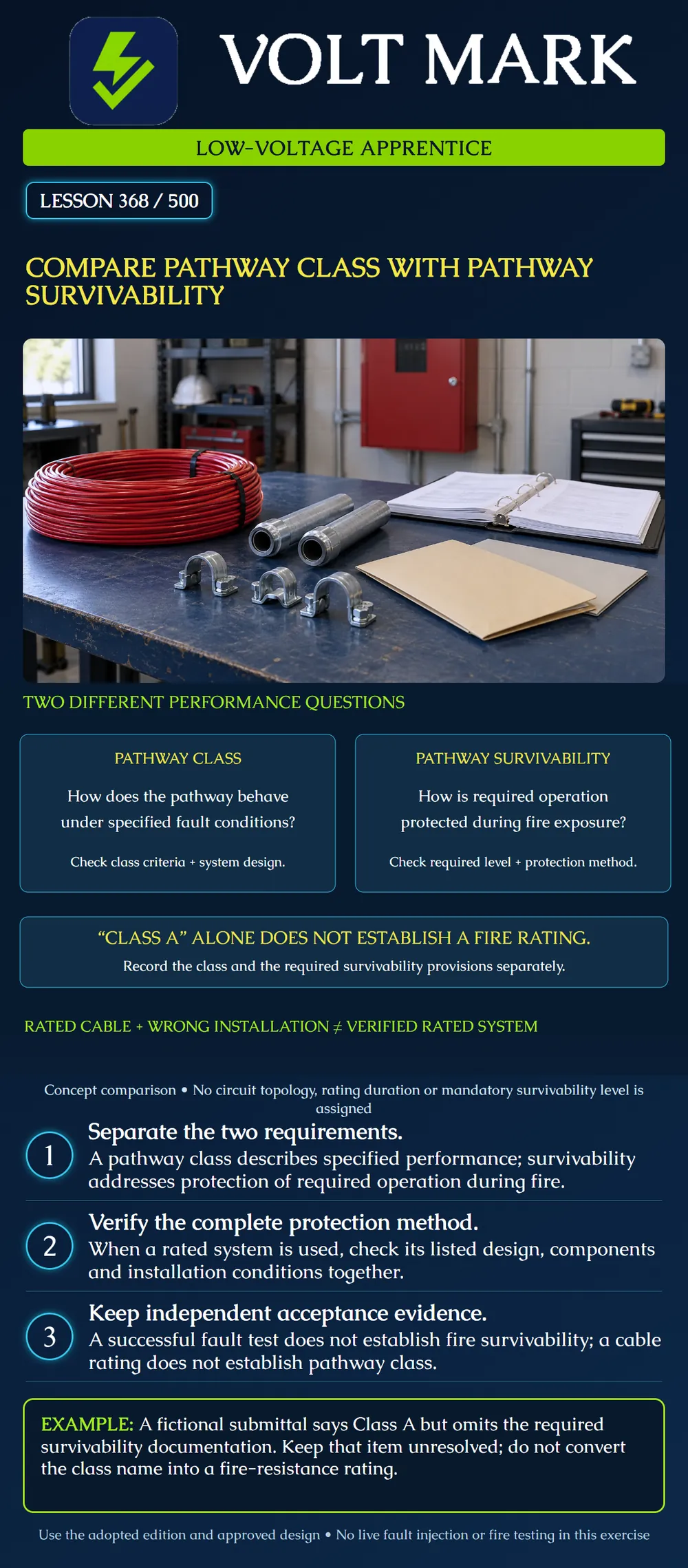
Explain why pathway class and pathway survivability answer different questions. Assemble separate evidence for each instead of treating a class designation or cable label as proof of both.
Pathway class addresses specified pathway performance, including behavior under defined fault conditions. Pathway survivability addresses maintaining required operation during fire exposure through the applicable protection provisions. NFPA's Fire Protection Research Foundation report discusses class designations and survivability levels as distinct concepts. The specific criteria depend on the governing edition and application.
This lesson does not reproduce a table of every class or assign a survivability level to every system. It teaches the distinction needed to read the actual requirements correctly.
A fictional approved design requires a named pathway class and separately specified survivability provisions. The contractor's submittal gives the class designation but includes no documentation for the protection method. Supported conclusion: one subject has been identified, while the other remains undocumented. Incorrect conclusion: the class name automatically satisfies the missing fire-exposure requirement. The next step is a focused request for the required protection details and supporting evidence. Do not invent a rating duration or level.
An authorized training report documents the expected response during one specified fault test. A learner writes, “The route is therefore fire rated.” That conclusion is unsupported. The observed fault behavior is evidence about the stated test. It does not reproduce the conditions or evaluation of a fire-resistance system. Keep its scope attached to the record.
The reverse is also true: a product's fire-test documentation does not prove that the installed pathway meets all class requirements. Both design and verification need the appropriate evidence.
UL explains that electrical circuit integrity system ratings depend on installation in accordance with the associated system details, applicable requirements and referenced manufacturer instructions. A project using such a system needs the actual system identifier and installation conditions. Do not treat a cable brand name or a similar-looking product as the whole design.
Original example: a fictional approved system detail names a specific support arrangement, but the submitted drawing substitutes an unverified support. The cable label remains the same. The system match is unresolved until the proper review confirms or corrects the substitution. The example supplies no real support spacing or approved alternative.
A plenum or riser suitability marking answers a different product question from continued circuit operation during fire. UL distinguishes reaction-to-fire evaluation from fire-resistance/circuit-integrity evaluation. Do not silently convert one into the other.
A classroom sketch shows two pathway legs routed through the same vulnerable area. Someone assumes that having two legs removes every failure risk. The sketch alone cannot support that claim. Ask what fault behavior is specified, how routing is required to be arranged and what survivability provisions apply. Multiple paths can share a hazard. This observation is a design-review question, not a new routing permission or an assessment of a real installed system.
A purchase note says “two-hour cable,” but the installation package lacks the identified system and conditions. Correct response: request the actual certification/system details and the approved application. Incorrect response: promise two hours of operation for the entire fire alarm system. Even a properly supported rating has a defined scope and evaluation conditions. It is not a blanket guarantee about every component, power source or real fire.
Column 1 — Class: Record the required designation, governing edition/reference, actual pathway design, equipment limitations and authorized verification evidence. Column 2 — Survivability: Record the applicable requirement, specified protection method, supporting design/system documentation and installation verification. Add an owner and unresolved-item field to both. Where a requirement does not apply, obtain a documented basis; do not leave a blank and call it satisfied.
Three fictional routes each require a class record and a survivability record. There are six required evidence slots: 3 × 2 = 6. All three class records and two survivability records are present. Five slots are filled; one remains missing. That count is document completeness, not an acceptance percentage or a measure of life safety. The missing record needs resolution even if the other five are complete.
An apprentice can compare approved documents and record observed installation details within the assigned role. Do not create cable opens, shorts or fire exposure to explore these concepts. Real testing and any impairment require the site's authorized procedures. Do not approve substitutions or decide that missing protection is acceptable from this poster.
Determine requirements from the actual adopted edition, application, approved design and authority having jurisdiction. A survivability requirement can involve more than a cable choice. Different editions or applications may specify different provisions. A training reference to one class or level must not be applied universally to every U.S. building.
Mistake: Reading Class A as an hourly fire-resistance rating. Correction: Keep the required fault-behavior class and fire-exposure protection evidence in separate review columns.
Mistake: Accepting a 'two-hour cable' purchase note as the complete rated installation. Correction: Obtain the identified system details and verify the installation, supports and accessories against their conditions.
Mistake: Using a passed fault test to clear missing survivability documentation. Correction: Retain the fault result within its test scope and resolve the separate protection requirement with the responsible reviewer.
NFPA Fire Protection Research Foundation, Evaluating Data and Voice Signals in Pathway Survivable Cables for Life Safety Systems: https://content.nfpa.org/-/media/Project/Storefront/Catalog/Files/Research/Research-Foundation/Reports/RFPathwaySurvivability.pdf?rev=44660d4afef44f15972de732d010452d Scope: indexed primary research-report excerpt distinguishing class and survivability designations. Direct PDF opening failed; no full-report review claimed. Research context is not adopted code text. UL Solutions, Q&A: Fire Resistive Cables and Circuit Integrity Systems: https://www.ul.com/news/qa-fire-resistive-cables-and-circuit-integrity-systems Scope: opened primary article and indexed system-rating explanation; no particular project system selected. UL Solutions, Fire Performance Testing Solutions for Cables and Busways: https://www.ul.com/services/fire-performance-testing-solutions-cables-and-busways Scope: primary public distinction between fire performance evaluations. All cases and worksheet arithmetic are original educational examples. No complete adopted-class or survivability-level table is asserted.
Texas journeyman, 15 questions, scored by topic against the 70% mark. No card, and no account needed to start.
Free study material for low-voltage apprentices. This is a national foundation course: requirements differ by state and by local jurisdiction, and a practice that is common in one place is not a rule everywhere. Nothing here is a licence, a certification, or authority to work unsupervised, and completing it does not count as apprenticeship hours or continuing-education credit. Check the codes adopted where you are working, the licensing authority for that work, and your employer's safety programme. VoltMark is not affiliated with, endorsed by, or sponsored by NFPA, OSHA, NICET, BICSI, FOA, or any state or local licensing authority.

Electrician licensing exam prep: practice questions, timed exam simulations, and step-by-step help finding every answer in the NEC.