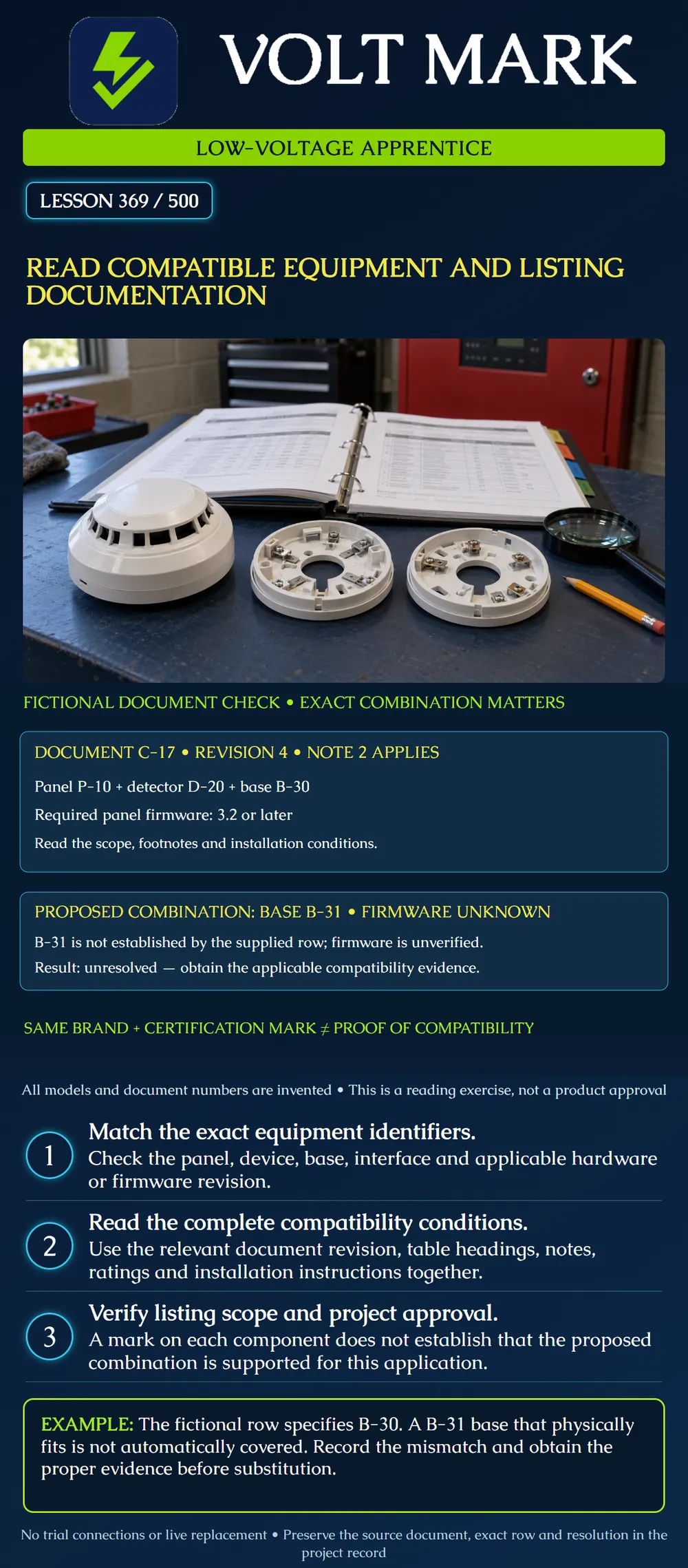
Read equipment compatibility and listing information as a set of conditions. Identify a mismatch or missing fact without treating a brand name, physical fit or certification mark as blanket approval.
The useful question is not simply, “Is this detector listed?” It is, “Does the documented equipment combination support this intended application under the stated conditions?” Identify the control unit, connected device, base or interface, and relevant version information. The exact relationships depend on the equipment.
UL's published explanation of fire alarm equipment evaluation distinguishes individual products from the compatible system arrangement described in referenced instructions. UL's marking and application resources help users assess suitability for a particular installation. A mark is relevant evidence about certification scope, not a universal promise that any two marked products interoperate.
Fire-Lite Device Compatibility Document 15384 revision BR, dated January 25, 2022, includes control-circuit specifications, compatible detector information, quantity tables and notification-appliance sections. It also contains revision-specific information and different application categories. It is an example of why a learner must read headings and notes rather than copy an isolated model number. This lesson does not assert that this is the latest revision or select equipment from it for a real project.
Use the revision applicable to the installed or proposed equipment, along with current manufacturer information resolving any updates. “Newest file I found” is not automatically a match for every legacy panel.
The poster's invented Document C-17, revision 4, contains this example: Panel P-10; detector D-20; base B-30. Minimum panel firmware: 3.2. Note 2 applies.
For this exercise, Note 2 reads: “Combination limited to the application described in the referenced installation instructions.” All model names, firmware numbers and notes in this exercise are invented. They cannot be used to order parts or configure equipment.
Read the table as a combination. P-10 and D-20 appearing somewhere in the same document does not establish every possible base, interface or configuration. Follow the row, column headings and notes that actually apply.
A proposal names P-10, D-20 and B-31. The supplied row names B-30. The proposal is not established by that row. Record the exact mismatch and request applicable evidence for B-31 or a corrected proposal through the authorized review process. Do not claim B-31 is definitely incompatible with every possible arrangement; you have established only that the supplied evidence does not cover this proposal. Physical fit is not a substitute for the missing evidence.
The proposed models match, but the panel firmware is not documented. The version condition remains unresolved. Do not assume compliance from the panel model alone. Do not update firmware just to satisfy a training table; an actual update requires the manufacturer's process, system impact review and authorized work. If the fictional record later shows version 3.1, it does not meet the stated 3.2 minimum. If it shows 3.2, that one condition is met; the remaining conditions still require review. Treat version identifiers as product identifiers, not ordinary decimal arithmetic.
A source lists an accessory under one application heading. The proposed job uses a different function. The model's appearance in the document does not establish coverage of the different use. Identify the application-specific evidence and any restrictions. Do not generalize from a notification use to releasing service, or from one certification jurisdiction to another, without the applicable documentation.
A fictional trainee says two parts “worked when connected.” That observation does not establish the evaluated combination, all required operating conditions, fault behavior or installation approval. Keep any legitimate test evidence within its actual scope. This lesson authorizes no bench or live connection and provides no wiring instructions.
Record:
Do not reduce a multi-condition record to a checkbox beside the manufacturer's name. Record limitations in the same row so they are not lost when the table is copied.
Compatibility does not remove load, quantity, voltage-drop, synchronization or other applicable design limits. For example, a fictional row may support a device family but have a separate quantity restriction. Use the actual conditions rather than treating inclusion as unlimited capacity. No real quantity, output rating or design calculation is provided in this lesson.
A fictional review requires five records: equipment identity, compatibility row, notes, version evidence and application evidence. Four are supplied; version evidence is missing. Four of five documents being present does not approve the combination. The unresolved condition remains visible until properly resolved.
Use this reading method across U.S. projects. Confirm the actual adopted requirements, authority having jurisdiction, approved design and certification scope. Do not assume same-brand parts are interchangeable or that different-brand parts are automatically excluded. The applicable evaluated arrangement and documentation decide the technical support for the proposed combination. Final project acceptance is a separate responsibility.
Mistake: Accepting B-31 because it physically fits where the fictional row specifies B-30. Correction: Identify the base mismatch and obtain applicable combination evidence or a corrected proposal.
Mistake: Checking firmware compliance from the panel model when its version is unknown. Correction: Record the actual version and compare it with the applicable minimum and remaining conditions.
Mistake: Treating a listed model in one application section as approved for every use. Correction: Follow the correct row, headings and restrictions for the intended function; keep capacity checks separate.
Honeywell/Fire-Lite, Device Compatibility Document 15384, revision BR, January 25, 2022: https://prod-edam.honeywell.com/content/dam/honeywell-edam/hbt/en-us/documents/manuals-and-guides/device-compatibility-manuals/hbt-fire-15384-BR.pdf Scope: opened primary PDF; document structure and conditional specifications only. No claim this is the latest applicable revision or approval of a real combination. UL Solutions, Marking and Application Guides: https://code-authorities.ul.com/about/inspection-resources-for-code-authorities/application-guides/ Scope: primary guidance purpose and certification-suitability context. UL Solutions Question Corner, hosted by IAEI, “Are fire alarms listed as a system and not just listed components?”: https://iaeimagazine.org/2005/july05/are-fire-alarms-listed-as-a-system-and-not-just-listed-components/ Scope: indexed primary UL-authored explanation of product evaluation and referenced compatible equipment; historical explanatory source, not current product approval. All table entries, model numbers, version conditions and classroom cases are original fictional material.
Texas journeyman, 15 questions, scored by topic against the 70% mark. No card, and no account needed to start.
Free study material for low-voltage apprentices. This is a national foundation course: requirements differ by state and by local jurisdiction, and a practice that is common in one place is not a rule everywhere. Nothing here is a licence, a certification, or authority to work unsupervised, and completing it does not count as apprenticeship hours or continuing-education credit. Check the codes adopted where you are working, the licensing authority for that work, and your employer's safety programme. VoltMark is not affiliated with, endorsed by, or sponsored by NFPA, OSHA, NICET, BICSI, FOA, or any state or local licensing authority.

Electrician licensing exam prep: practice questions, timed exam simulations, and step-by-step help finding every answer in the NEC.