Explain basic smoke-sensing mechanisms and identify the application facts needed to evaluate a proposed detector. Separate a technology's operating principle from approval of a particular installation.
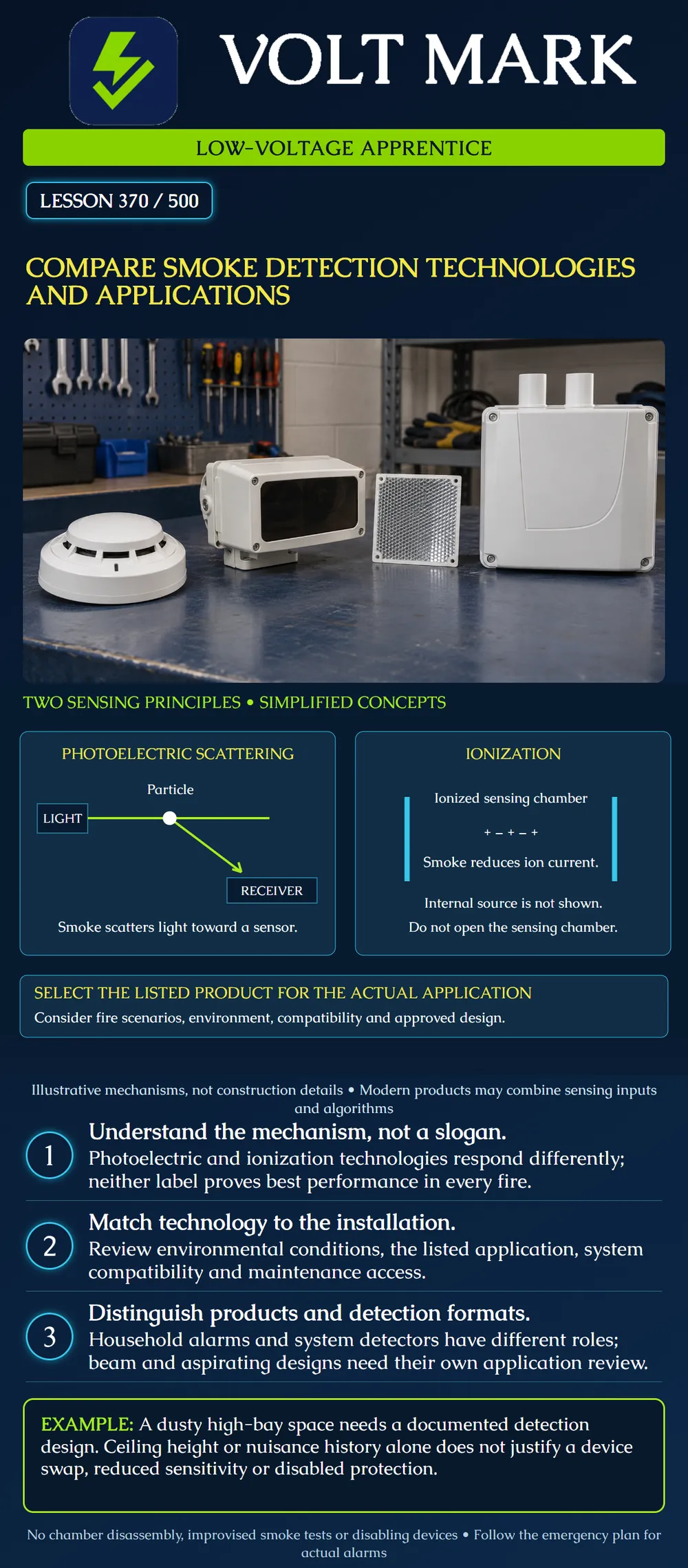
In a scattering-type photoelectric chamber, smoke particles redirect light toward a receiver outside the direct beam. An ionization chamber uses an internal radioactive source to ionize air; smoke reduces the small ion current between electrodes. The diagrams simplify these principles and are not assembly instructions. Do not open, alter or extract material from a sensing chamber.
NIST explains that both technologies can respond to flaming and smoldering fires, with different response tendencies. Ionization commonly responds sooner to some flaming-fire particles; photoelectric commonly responds sooner to some smoldering-fire particles. These are tendencies, not a guarantee for every product, fuel or location. Do not translate them into “this type cannot detect that fire.”
The left drawing shows light passing a smoke particle; a redirected ray reaches the off-axis receiver. The straight ray does not point directly at that receiver. The right drawing represents an ionized chamber and reduced current, without exposing or depicting a source assembly. Dimensions, particle sizes and electrical values are deliberately absent.
UL describes fire-test and cooking-nuisance evaluation developments for smoke alarms and system smoke detectors, including polyurethane fire scenarios. Modern designs may use additional sensing inputs and algorithms. UL 217 addresses smoke alarms; UL 268 addresses smoke detectors for fire alarm systems. Do not assume a household alarm and a panel-connected detector are interchangeable because both use optical sensing.
A technology name alone does not tell you a product's listing, compatible control equipment, environment limits or application restrictions. Use the exact product documentation and approved design.
Aspirating smoke detection draws sampled air through a designed pipe network to a detector. Honeywell's public description identifies this sampling approach. Sampling holes, pipe configuration, airflow and maintenance require the actual system's design process, not improvised tubing. Beam detection monitors a projected optical path for smoke-related light reduction. Its optical arrangement and application requirements must come from its manufacturer. A beam detector is not simply a spot detector mounted farther from the floor. Multi-criteria or multi-sensor products combine information according to their specific design; the terms do not guarantee identical sensor combinations across products.
A fictional warehouse has a high ceiling, obstructions and changing stored materials. A learner proposes beam detection solely because the room is tall. Correct response: collect the actual geometry, obstructions, expected environmental conditions, access and project requirements. Have the responsible designer evaluate an appropriate listed arrangement. Incorrect response: select a detector and spacing from the room label alone. No ceiling-height threshold or spacing permission is supplied in this exercise.
A fictional maintenance log records repeated detector events during a dusty production operation. The log does not establish whether each event was a nuisance alarm or an actual hazardous condition. Follow the emergency plan for real alarms. For the design/maintenance review, preserve event information, environment observations and authorized service findings. Do not reduce sensitivity, cover a detector or remove protection merely to stop the events. The correct response may require investigation of the environment, installation, contamination or application by responsible personnel.
A proposed aspirating layout contains extra holes added by someone who assumes “more holes means better detection.” The change is not supported by that assumption. Refer it to the actual design method and manufacturer requirements. This lesson does not calculate sampling-hole sizes, transport times or permitted pipe lengths. The apprentice's task is to recognize that the pipe is a designed part of the detection system.
A sales note says “photoelectric, therefore suitable everywhere.” Identify the missing evidence: exact model, intended application, environmental range, compatibility, approved location and required performance. The same review principle applies to ionization, beam, aspirating and multi-criteria products. The label names a concept; it is not a complete selection decision.
A homeowner-style alarm and a system smoke detector both use photoelectric sensing. A spare alarm appears to fit a similar ceiling space. This does not establish a permitted replacement. Return to lesson 361's distinction and lesson 369's compatibility review. Confirm the intended role and approved equipment rather than substituting by appearance or sensor type.
Record:
A complete worksheet informs review; it does not itself approve coverage. Do not invent missing fire-engineering conclusions to fill the blanks.
Technology principles apply across the United States. Selection and installation still depend on adopted requirements, approved design and manufacturer instructions. Do not transfer historical home-alarm test rankings directly into a commercial detector specification. Keep the scope and age of research attached to the claim. No universal “best detector,” national placement rule or product recommendation is made here.
Mistake: Turning response tendencies into a guarantee that one technology always wins. Correction: Use exact product and application evidence; retain the distinction between a general tendency and a particular fire response.
Mistake: Selecting beam detection solely because the room has a high ceiling. Correction: Provide geometry, obstructions, environmental conditions and access information for the responsible design review.
Mistake: Adding aspirating-pipe holes on the assumption that more openings improve detection. Correction: Record the proposed deviation and require review of the sampling-network design and its performance.
A fictional high-bay warehouse proposal names only 'beam detector' and omits the rack plan and mounting information. List the missing evidence and the correct review disposition.
Answer: Obtain the optical-path geometry, possible obstructions, mounting stability, environment, exact product and approved protection requirements. Selection remains unresolved; height alone does not establish suitability. This is a paper review, not permission to interrupt a beam or test a live system.
NIST, How Do Smoke Detectors Work? https://www.nist.gov/how-do-you-measure-it/how-do-smoke-detectors-work Scope: opened primary explanation of sensing mechanisms and general response tendencies. UL Solutions, Gas and Smoke Detector Testing and Certification: https://www.ul.com/services/fire-smoke-and-gas-device-certification-services Scope: primary indexed UL 217/268 scope and updated fire/nuisance-test context; no full standard review. Honeywell, Fire Sensors and Detection Systems: https://www.honeywell.com/us/en/solutions/building-sensors/fire Scope: primary indexed description of aspirating air sampling; no “earliest warning” guarantee adopted. NFPA, A Guide to Fire Alarm Basics: https://www.nfpa.org/-/media/project/storefront/catalog/files/code-or-topic-fact-sheets/FireAlarmBasicsFactSheet.pdf Scope: primary guide's beam-detection overview previously retrieved in this sequence; no design limits copied. All diagrams and application cases are original educational material.
Texas journeyman, 15 questions, scored by topic against the 70% mark. No card, and no account needed to start.
Free study material for low-voltage apprentices. This is a national foundation course: requirements differ by state and by local jurisdiction, and a practice that is common in one place is not a rule everywhere. Nothing here is a licence, a certification, or authority to work unsupervised, and completing it does not count as apprenticeship hours or continuing-education credit. Check the codes adopted where you are working, the licensing authority for that work, and your employer's safety programme. VoltMark is not affiliated with, endorsed by, or sponsored by NFPA, OSHA, NICET, BICSI, FOA, or any state or local licensing authority.

Electrician licensing exam prep: practice questions, timed exam simulations, and step-by-step help finding every answer in the NEC.