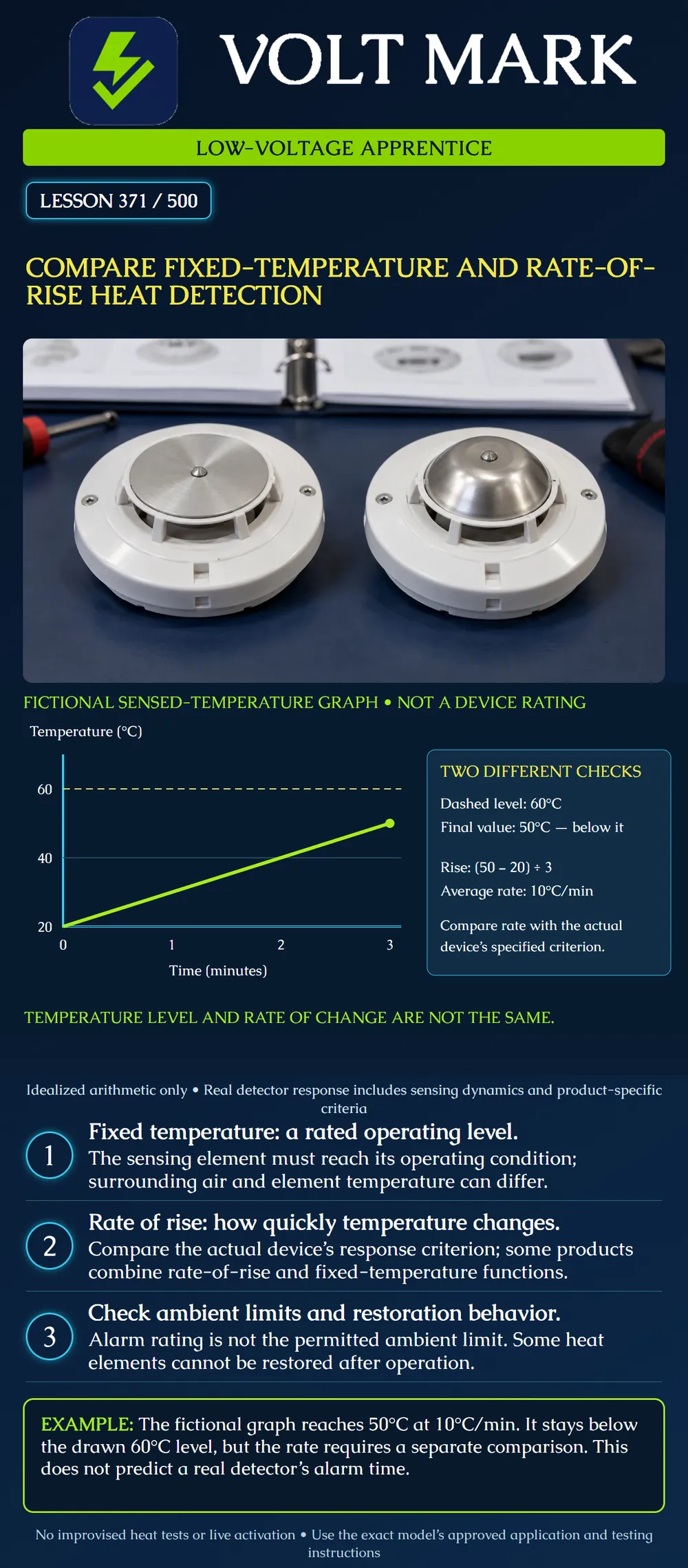
Distinguish temperature level from rate of temperature change. Read product ratings without confusing alarm temperature, allowed ambient conditions or restoration behavior.
Fixed-temperature detection responds when its sensing element reaches the specified operating condition. Rate-of-rise detection responds to a sufficiently rapid temperature increase according to the device's design. A combination product can include both functions. They are not interchangeable descriptions of the same measurement.
NFPA's public heat-detection discussion distinguishes fixed-temperature and rate-of-rise mechanisms. Heat transfer takes time, so the temperature of surrounding air is not automatically the sensing element's temperature. That delay is commonly called thermal lag. A nearby air-temperature reading therefore does not establish an exact operating instant.
The poster shows an invented, idealized sensed-temperature trace. It is not a room-fire simulation, measured device response or published detector rating. At minute 0: 20°C. At minute 3: 50°C. Change: 50 − 20 = 30°C. Average rate: 30°C / 3 minutes = 10°C per minute. The line is drawn linear, so its slope is constant in this example.
The dashed comparison level is 60°C, also invented. The final value is 10°C below it. This tells us about the plotted level only. Rate-of-rise performance would require a separate product criterion and its actual response behavior. Do not claim that a real detector would alarm at a particular minute from this diagram.
A second fictional trace rises from 20°C to 50°C over 15 minutes. It reaches the same final temperature. Its average rate is 30 / 15 = 2°C per minute. Thus the two traces have equal final temperature but different rates. Neither trace reaches the invented 60°C level. This exercise compares quantities, not product pass/fail performance.
If a real recorded trace is uneven, its average over several minutes can hide faster changes within that interval. Use the actual manufacturer's evaluation and testing method rather than replacing it with a classroom average.
System Sensor's 5600 family includes fixed-only and combination models with different temperature ratings. Its datasheet separately lists maximum installation temperature and alarm temperature. Those fields answer different questions. The applicable model's temperature rating is not permission to expose it continuously to every temperature below the alarm setting.
The manufacturer's manual also distinguishes restoration behavior: for specified combination models, the rate-of-rise element is self-restoring, while the fixed-temperature element is not. Do not generalize that behavior to every heat detector or every electronic product. Identify the exact model and activated element.
A fictional product sheet gives a maximum ambient condition distinct from its operating threshold. The project's ordinary environment exceeds the stated ambient limit but is below the alarm threshold. The product is not established as suitable merely because it has not reached its alarm threshold. Refer the mismatch for the correct selection review. Do not increase settings or substitute a higher-rated product on your own.
A training equipment record says “fixed temperature plus rate of rise.” A learner records only the fixed value. The record omits one operating function. Capture both functions and their documented conditions. Do not infer that all temperature changes below the fixed rating are ignored.
An operated detector has cooled. Someone assumes it can return to service because the room is cool again. Cooling alone does not establish restorability. Determine the actual product and element behavior through the approved service process. Some elements require replacement after operation. This lesson supplies no reset, replacement or live test instructions.
A fictional space experiences rapid normal temperature changes during a process cycle. A learner chooses rate-of-rise detection without reviewing those changes. Record the actual environmental profile and bring it to the responsible designer's attention. The technology name alone does not establish suitability. The selection must also meet the fire-protection objective and governing requirements; avoiding unwanted activations is not the only consideration.
Record the model, detection functions, rated operating condition, maximum ambient/installation limits, environment restrictions, compatibility, placement design reference, restoration behavior and authorized test method. Keep the manufacturer's revision and relevant table notes with the record. Do not use one model's temperature, spacing or testing instructions for another model because the housings look alike.
A dusty or steamy environment may require an application review, but that does not itself authorize removing required smoke detection and replacing it with heat detection. The approved protection objective and governing requirements still matter. Refer changes through the responsible design and approval process.
The distinction between level and rate is useful throughout the United States. Actual product selection, detector spacing, allowable ambient and testing methods depend on the listed equipment, adopted requirements and approved design. This poster assigns no universal operating temperature, rise-rate threshold or spacing.
Mistake: Treating equal final temperatures as equal rates of rise. Correction: Divide each temperature change by its own interval: 30°C over 3 minutes is 10°C/min, while over 15 minutes it is 2°C/min.
Mistake: Using a detector's alarm temperature as its allowed continuous ambient temperature. Correction: Read the exact model's separate installation and environmental limits before comparing the location.
Mistake: Returning an operated detector to service merely because it cooled. Correction: Identify the model and activated element, then follow its authorized restoration or replacement process.
Honeywell/System Sensor, 5600 Series Mechanical Heat Detectors datasheet: https://prod-edam.honeywell.com/content/dam/honeywell-edam/hbt/en-us/documents/literature-and-specs/datasheets/5600-Series_DataSheet_SPDS300.pdf?download=false Scope: indexed primary model functions and separate installation/alarm ratings. Product-specific thresholds are not assigned universally. Honeywell/System Sensor, 5600 Series Installation and Maintenance Instructions: https://prod-edam.honeywell.com/content/dam/honeywell-edam/hbt/en-us/documents/manuals-and-guides/user-manuals/5600_Series_Manual_I56-2175.pdf?download=false Scope: indexed primary restoration distinction; live heat-test procedures are not reproduced. NFPA, A Guide to Fire Alarm Basics: https://www.nfpa.org/-/media/project/storefront/catalog/files/code-or-topic-fact-sheets/FireAlarmBasicsFactSheet.pdf Scope: primary guide heat-detection mechanisms previously retrieved in this sequence. NFPA 914 technical-development report: https://docinfofiles.nfpa.org/files/AboutTheCodes/914/914_F2022_CUL_AAA_FD_FRStatements.pdf Scope: indexed explanatory thermal-lag discussion only; committee-development material is not represented as adopted code. All plotted values, time intervals and classroom cases are original fictional examples.
Texas journeyman, 15 questions, scored by topic against the 70% mark. No card, and no account needed to start.
Free study material for low-voltage apprentices. This is a national foundation course: requirements differ by state and by local jurisdiction, and a practice that is common in one place is not a rule everywhere. Nothing here is a licence, a certification, or authority to work unsupervised, and completing it does not count as apprenticeship hours or continuing-education credit. Check the codes adopted where you are working, the licensing authority for that work, and your employer's safety programme. VoltMark is not affiliated with, endorsed by, or sponsored by NFPA, OSHA, NICET, BICSI, FOA, or any state or local licensing authority.

Electrician licensing exam prep: practice questions, timed exam simulations, and step-by-step help finding every answer in the NEC.