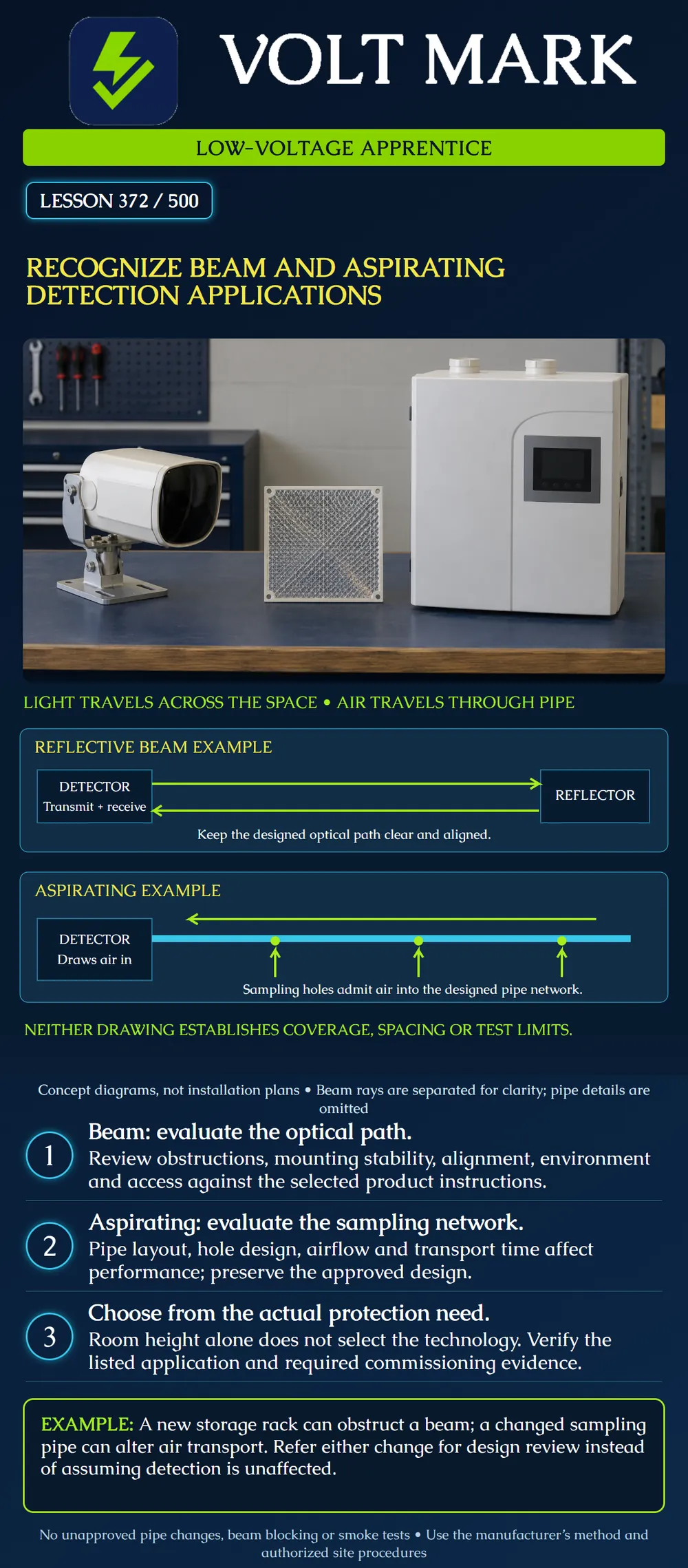
Recognize how beam and aspirating smoke detection collect evidence of smoke. Identify application questions that must be resolved before selection, installation or a change to the protected space.
A reflective beam arrangement sends light across a protected space to a reflector and receives returned light. Smoke along the optical path changes the received light. Other beam configurations exist; the poster depicts only the reflective concept. An aspirating detector draws air from sampling locations through a pipe network. Smoke in the sampled air is transported to the detector. Xtralis describes the pipe design as a major determinant of system performance.
The diagram separates outgoing and returning beam rays for readability. It does not establish a required separation between actual rays. In the lower drawing, air enters the sample holes and travels toward the detector at the left. The pipe end and other construction details are omitted; the sketch is not permission to leave a pipe end open.
Large or high spaces may be candidates for an appropriate beam design, but geometry alone does not establish suitability. Document the optical path, possible obstruction sources, mounting conditions, environment and maintenance access. Use the selected model's actual limitations and alignment method. A reflector is part of that detector's arrangement, not an ordinary mirror to substitute by appearance.
The manufacturer's installation document for BEAM1224/BEAM1224S describes a single-ended reflected projected-beam product. It is a useful concrete example of the optical arrangement. This lesson does not approve that historical model for a new job or reproduce its limits as universal requirements.
Sampling networks can bring air to an accessible detector from distributed locations, subject to the actual design. Xtralis's ASPIRE documentation identifies pipe-network modeling as part of assessing performance. Hole locations and sizes, pipe configuration and airflow are design inputs, not arbitrary installation choices. Transport time concerns movement from a sampling point to the detector; it is not automatically the total time from ignition to an alarm.
A system's sensitivity at its sensing unit does not alone establish effective detection at every sampling location. Use the approved design and commissioning method for the full arrangement.
A fictional warehouse adds a tall rack across the documented beam path. A learner says the detector is still powered, so protection is unchanged. Power status cannot establish a clear optical path or preserved coverage. Record the changed geometry and refer the impact for responsible review. Do not reposition the detector or reflector on your own to clear the rack; the new route may no longer satisfy the approved design.
A fictional service report notes that a mounting surface moves during normal operations. The learner proposes repeatedly realigning the beam whenever it reports a problem. The underlying mounting condition needs review against the product requirements. Repeated adjustment is not evidence of a stable approved installation. The exercise does not specify how much movement a particular detector can tolerate.
An installer adds holes to a fictional sampling pipe because an unprotected-looking area worries them. The added holes change the network from its documented design. Record the deviation and obtain the appropriate redesign/review and verification. Do not assume that more sampling openings always improve performance or that each hole has identical sensitivity.
A proposed accessory is placed in a sample-air path. Xtralis's in-line-component note explains that flow restriction can lengthen transport time. Do not infer that every accessory is acceptable from a matching pipe diameter. The particular component, application and revised network need appropriate evidence.
A fictional test confirms a detector responds when an approved test sample is presented near the unit. Someone declares the entire remote pipe network accepted. That observation does not demonstrate air transport from the required remote sampling locations. The test record must match the actual acceptance requirements and method. This lesson does not authorize a live smoke test or prescribe where to apply a test agent.
For beam detection, record the selected configuration, optical route, mounting references, obstruction assessment, product limits and authorized verification record. For aspirating detection, record the approved pipe design revision, sampling locations, hole schedule, relevant modeling report, airflow/transport criteria and commissioning evidence. For both, record the protection objective, responsible designer, compatible fire alarm interface, environment and maintenance provisions.
Keep subsequent building changes tied to these records. A detector may remain electrically normal while a building modification creates an unresolved detection-design issue.
A fictional project requires three beam-path records and four sampling-network records. Five of seven are present. Two are missing. This arithmetic measures document availability only; it does not quantify protected area or establish acceptance. Identify which two are absent and why each matters.
No minimum or maximum beam length, detector spacing, sampling-hole diameter, maximum transport time or sensitivity setting is assigned. Those values depend on the actual listed system, adopted requirements and approved application. Do not measure the poster to obtain installation dimensions.
Use these concepts throughout the United States while confirming the adopted requirements and product documentation. Beam, aspirating and spot detection are not automatically interchangeable. Required coverage and performance must be preserved when reviewing a technology or layout change. Actual alarms still require the site's emergency response; application analysis must not delay protective action.
Mistake: Assuming a powered beam detector remains properly applied after racks obstruct its path. Correction: Record the geometry change and obtain review of the optical path and coverage before accepting the altered space.
Mistake: Treating an added sampling hole or matching-diameter accessory as harmless. Correction: Reconcile the change with the approved pipe model, airflow and transport evidence.
Mistake: Accepting all remote sampling points from a response test near the detector. Correction: Match the evidence to the required remote-path acceptance scope and obtain the missing commissioning results.
Honeywell/System Sensor, BEAM1224/BEAM1224S Installation Document: https://prod-edam.honeywell.com/content/dam/honeywell-edam/hbt/en-us/documents/manuals-and-guides/installation-guides/I56-2294-005R.pdf Scope: indexed primary reflected-beam arrangement and alignment context; no real model selection or current applicability approval. Xtralis, Aspirating Smoke & Gas Detection: https://xtralis.com/subpage/2005/aspirating-smoke-gas-detection Xtralis, ASPIRE Pipe Network Design Software: https://xtralis.com/product/7/aspire-pipe-network-design-software Scope: primary indexed air-sampling principle and pipe-design dependency; no universal earliest-warning claim adopted. Xtralis, Open-Flow In-Line Components Application Note: https://xtralis.com/file/6925 Scope: primary indexed explanation of restriction and transport-time effects; not blanket accessory approval. All diagrams, project examples and counting exercises are original educational material.
Texas journeyman, 15 questions, scored by topic against the 70% mark. No card, and no account needed to start.
Free study material for low-voltage apprentices. This is a national foundation course: requirements differ by state and by local jurisdiction, and a practice that is common in one place is not a rule everywhere. Nothing here is a licence, a certification, or authority to work unsupervised, and completing it does not count as apprenticeship hours or continuing-education credit. Check the codes adopted where you are working, the licensing authority for that work, and your employer's safety programme. VoltMark is not affiliated with, endorsed by, or sponsored by NFPA, OSHA, NICET, BICSI, FOA, or any state or local licensing authority.

Electrician licensing exam prep: practice questions, timed exam simulations, and step-by-step help finding every answer in the NEC.