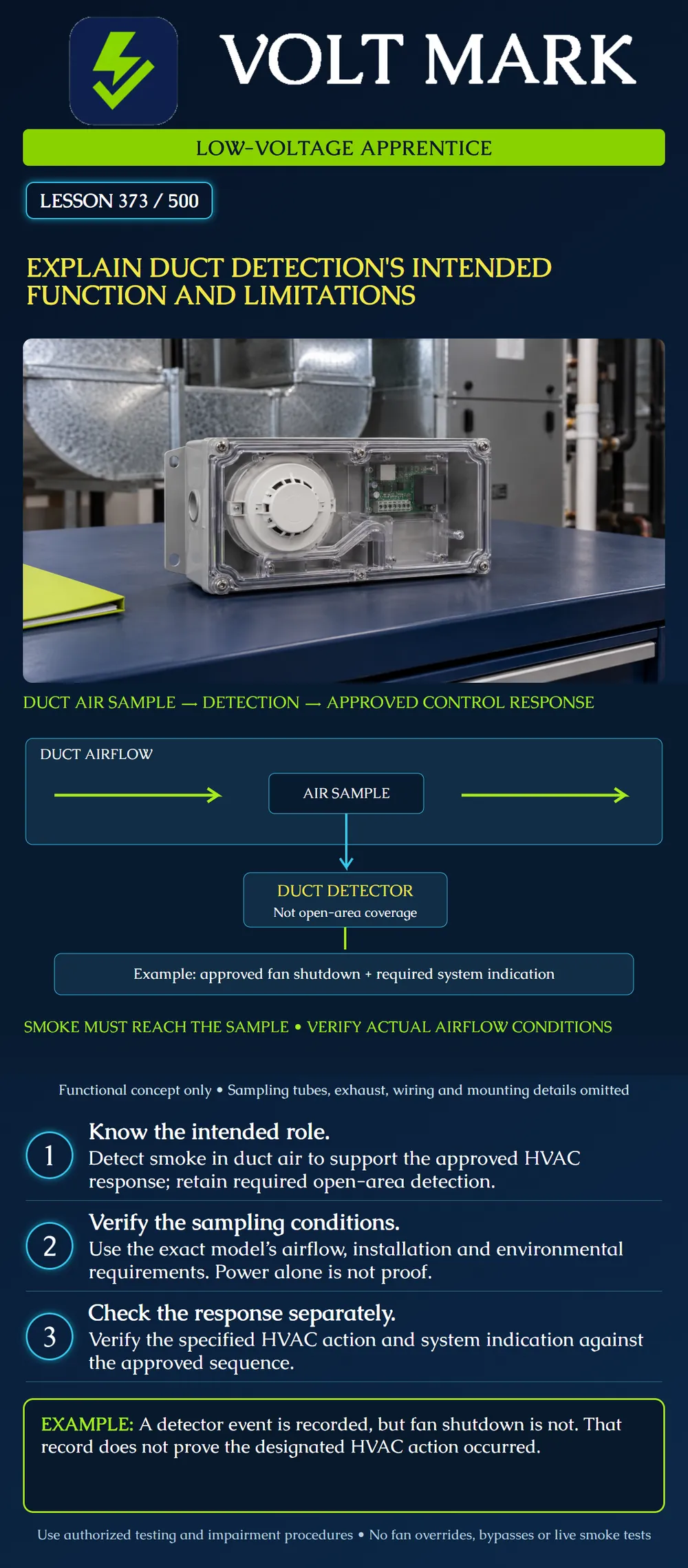
Explain the purpose and limits of duct smoke detection. Distinguish successful sensing, the intended HVAC response and required fire alarm indication.
A duct detector senses smoke in the sampled airstream and can initiate an approved air-handling response to reduce smoke distribution. It is not a substitute for required open-area detection or a building's regular early-warning system. Smoke must reach the sensing arrangement. Power being available does not prove adequate sampling.
System Sensor's D4120 manual emphasizes ventilation operation, an installed cover, proper installation and operation within the model's electrical and environmental specifications. Its functional description includes fan or blower control. These are product-specific instructions and context, not a universal installation layout. Different equipment requires its own documents.
The upper arrows represent duct airflow. The center box represents an air sample reaching the detector. The lower box represents a possible approved response, not a compulsory response for every duct detector. The illustration omits sampling-tube orientation, exhaust path, mounting dimensions and wiring. It cannot be used as an installation detail.
A fictional property record says one duct detector serves AHU-1. A learner writes, “All rooms served by AHU-1 have smoke detection.” That claim is unsupported. The duct detector's role does not establish open-area detector coverage. Locate the approved detection design for the occupied spaces. Do not remove a required room detector because air from that room may eventually reach the duct.
A training scenario describes a fire in a room while the associated air handler is off. The learner assumes smoke will promptly reach the duct detector. The supplied facts do not support that assumption. Record the air-handler operating condition and the limitation of relying on transported smoke. Do not start a fan during an actual emergency to “help detection.” Follow the site's emergency plan and approved control strategy.
A fictional authorized test report records D-01's event. The required sequence also calls for AHU-1 shutdown and a specified system indication, but those observations are absent. The report supports the recorded detector event only. The control action and indication remain unverified in the supplied evidence. Request the appropriate coordinated test records from the responsible team rather than performing an unplanned shutdown.
The report shows a fan stopped, but its identifier is AHU-2 while the sequence names AHU-1. Do not check the row passed merely because some equipment stopped. Reconcile the exact point, equipment identifier, approved sequence and observation. The discrepancy could involve records, mapping or equipment; the paper evidence does not diagnose the cause.
A maintenance photograph shows an opened detector housing, while a later note says “powered and normal.” That note does not establish correct final assembly or sampling. Obtain the authorized service completion and verification record for the actual product. Do not copy a model's cover behavior to all products, and do not open a live detector to explore it.
For each duct point, document the associated air-handling equipment, required input classification, control action, indication and any applicable remote reporting. The approved response may differ by purpose and governing requirements. Do not label every duct event alarm or supervisory from the words duct detector alone. Do not assume all fans must stop in every engineered smoke-control arrangement.
Use the design team's sequence to define expected actions. A relay operation is not the same observation as the actual fan reaching the required state. Where a test requires status feedback or direct observation, retain that evidence with the relevant event record.
Record the exact model and manual revision; the selected sampling arrangement; the associated duct and unit; intended operating modes; environment and airflow verification references; maintenance access; approved control sequence; and unresolved questions. The worksheet references the actual manufacturer's requirements. It supplies no generic tube length, differential pressure, velocity limit or HVAC capacity threshold.
Do not infer suitability from nominal air-handler capacity alone. A model's published operating range is not proof of the conditions at the installed sampling location. Relevant measurements and verification must follow the authorized method and project requirements.
The fictional acceptance row requires: A — detector function evidence. B — designated HVAC action evidence. C — required system indication evidence. A and C are supplied, but B is missing. Two of three evidence items are present. This does not establish complete operation. Keep B unresolved until the responsible team provides the appropriate result. The count is document completeness, not a life-safety performance score.
A changed air-handling arrangement, replaced sampling component or modified duct can affect the documented installation. Record the change and route it through the applicable review and testing process. Do not bypass shutdown control to avoid operational inconvenience. Actual service and impairment management require authorization and the site's procedures.
The intended role and limitations are relevant across the United States. Requirements for placement, system indication, air-handler control and testing depend on the adopted building/mechanical/fire provisions, approved design and exact equipment instructions. This lesson does not assign one HVAC capacity threshold or one output sequence to all jurisdictions.
Mistake: Claiming all AHU-1 rooms have open-area detection because the duct has a detector. Correction: Review the separate occupied-space detection design; duct sensing does not establish room coverage.
Mistake: Passing AHU-1 shutdown because a report shows AHU-2 stopped. Correction: Reconcile the detector point, designated equipment and approved sequence before closing the control-action row.
Mistake: Treating power or a normal display as proof of adequate smoke sampling. Correction: Obtain the exact product's completed assembly, airflow and sampling verification records through authorized personnel.
Honeywell/System Sensor, D4120, D4S and D4P120 Installation and Maintenance Instructions, I56-2967-008R: https://prod-edam.honeywell.com/content/dam/honeywell-edam/hbt/en-us/documents/manuals-and-guides/user-manuals/D4120_Manual_I56-2967.pdf?download=false Scope: opened primary PDF, limitations and general-description sections. The model-specific sampling, cover and operation cautions are summarized as documentation-review issues. No universal installation dimensions, testing steps or code thresholds are reproduced. All cases, diagram and evidence exercises are original educational material. This is not a complete duct-detector design or adopted-code review.
Texas journeyman, 15 questions, scored by topic against the 70% mark. No card, and no account needed to start.
Free study material for low-voltage apprentices. This is a national foundation course: requirements differ by state and by local jurisdiction, and a practice that is common in one place is not a rule everywhere. Nothing here is a licence, a certification, or authority to work unsupervised, and completing it does not count as apprenticeship hours or continuing-education credit. Check the codes adopted where you are working, the licensing authority for that work, and your employer's safety programme. VoltMark is not affiliated with, endorsed by, or sponsored by NFPA, OSHA, NICET, BICSI, FOA, or any state or local licensing authority.

Electrician licensing exam prep: practice questions, timed exam simulations, and step-by-step help finding every answer in the NEC.