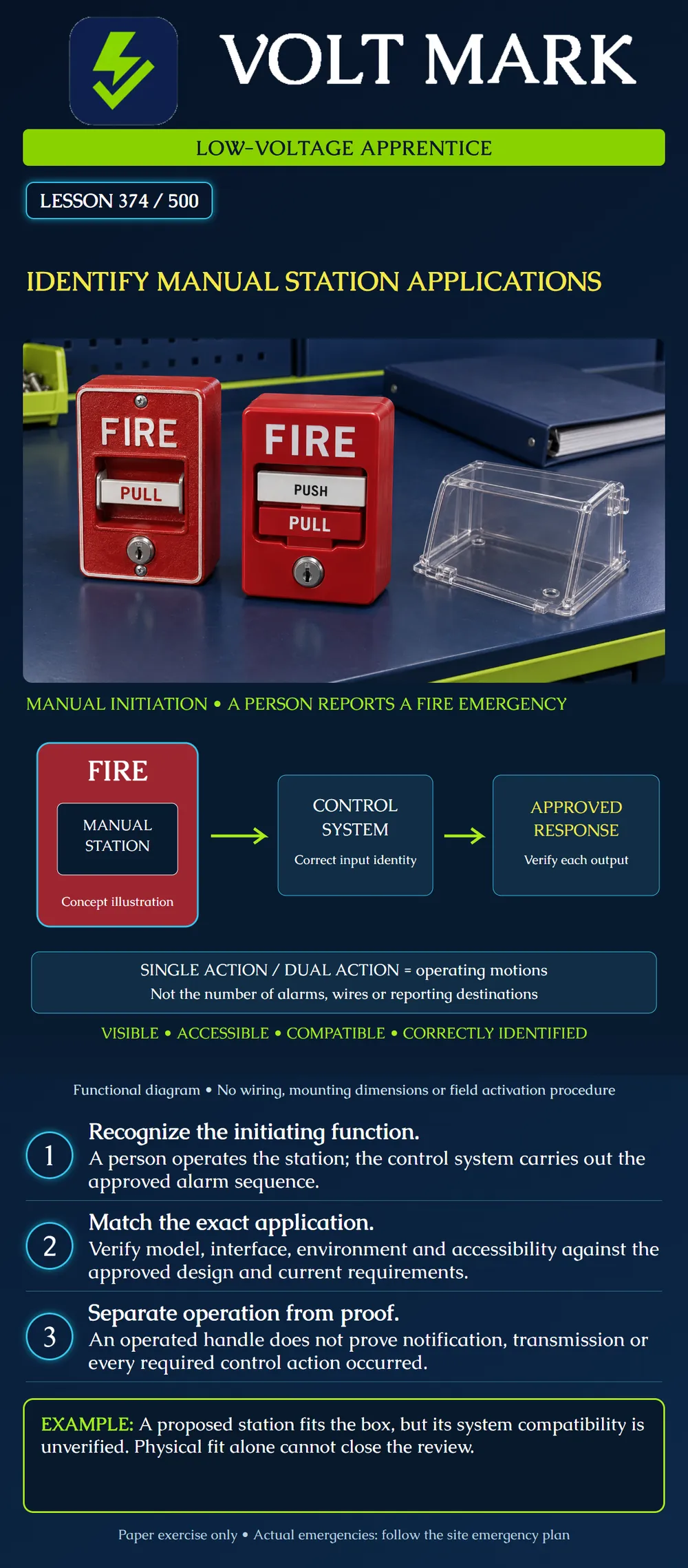
Recognize a manual fire alarm station as a person-operated initiating device. Separate operating motions, electrical interface, installation application and the resulting system response. This is a nationwide learning overview, not an installation design, emergency-response replacement or permission to activate an occupied building's system.
A manual station lets a person report a fire emergency through the fire alarm system. Its initiating function differs from automatic smoke or heat sensing. The station supplies an input; the control system implements its approved response. Do not assume that operating a handle proves every notification appliance, transmission path or associated control has worked. The diagram shows functional relationships rather than field wiring.
In an actual emergency, follow the site emergency plan promptly. This lesson's document-review activities must not delay emergency reporting or evacuation. Do not use an installed station as a classroom demonstration.
Single-action and dual-action descriptions concern the motions used to operate the station. The exact instructions depend on the product. The cited BG-12 example uses two motions and a conventional contact input. That example does not establish a universal operating method for every manual station.
Two actions do not mean two alarm events, two circuits or two destinations. A protective cover can introduce a separate access operation; do not casually infer the listed station's action classification from a photo of the whole assembly. Review the station and accessory documentation together.
A station may provide a conventional contact input or use an addressable interface. The cited BG-12LX is one manufacturer's addressable example. Its compatibility and installation limits are product-specific. Similar-looking housings are not evidence of interchangeability. The proper review includes the exact station, control equipment, interface, permitted accessories and current compatibility documents.
An addressable input identifies a configured point. Correct labels and records still matter: a wrong description can send responders toward the wrong location. A shared conventional input may identify a zone rather than an individual station. Describe only the identification that the approved arrangement actually provides.
Check whether the proposed station and enclosure are suitable for their environment. A lobby, exterior walkway and washdown area are different applications. A cover that physically fits is not automatically a listed solution for moisture, impact or environmental exposure.
Use the project's applicable building/fire requirements, accessibility requirements, approved drawings and product instructions together. The U.S. Access Board identifies occupant-operated alarm pulls as covered operable parts. Its guide discusses one-hand use, prohibited tight grasping/pinching/wrist twisting and operating force. Reach and clear-floor-space conditions also require review under the applicable standards.
Do not take a dimension from an old brochure and apply it to every new installation. The opened BG-12 instruction sheet includes historical accessibility wording. Its old side-reach dimension is deliberately not taught here as a current universal rule. Resolve conflicts through the responsible designer and authority having jurisdiction; do not choose whichever document makes the work easiest.
A station can be visible yet obstructed by furniture. A clear route to the area does not by itself establish usable approach, reach and operation. The lesson poster intentionally omits dimensions rather than imply that one sketch satisfies every project.
Case A — Same box, different interface: The approved schedule identifies an addressable model. A spare contact-type station fits the box. Record the mismatch and request compatibility/design resolution. Do not replace it merely because its face looks similar.
Case B — Correct station, blocked approach: A plan shows a clear area, but a site photograph shows a display cabinet in front of the station. Record the obstruction and location for responsible correction. The device listing does not approve the changed surroundings.
Case C — Wrong location label: The station schedule says east lobby; the event report says west lobby. Trace identifiers and records with the responsible team. Do not operate another station to guess which label is correct.
Case D — Incomplete evidence: An authorized historical test report records the initiating event but leaves the required notification-result field blank. The input record does not complete the missing result. Request documented resolution under the approved testing process.
Case E — Old instruction sheet: A contractor cites an older product sheet to settle an accessibility question. Separate the device's installation instructions from the applicable accessibility requirements and edition. Escalate the discrepancy for documented resolution; this lesson does not make that legal determination.
For a fictional station M-07, record:
Practice inventory: six scheduled stations have six location records, five compatibility records and four response records. There are eighteen expected records and fifteen present, leaving three missing records. That does not prove that exactly three stations have deficiencies: missing records can concern the same station. This arithmetic is an original paperwork exercise, not a code-required form or acceptance criterion.
Mistake: Interpreting dual action as two alarm circuits or two transmitted events. Correction: Read the product's required operating motions separately from its electrical interface and system response.
Mistake: Approving a manual station because the device is visible and listed despite an obstructed approach. Correction: Record the surrounding obstruction and obtain the required accessibility and placement review.
Mistake: Substituting a contact station for an addressable one because the housing fits. Correction: Match the scheduled interface and compatibility documents before an authorized replacement decision.
Texas journeyman, 15 questions, scored by topic against the 70% mark. No card, and no account needed to start.
Free study material for low-voltage apprentices. This is a national foundation course: requirements differ by state and by local jurisdiction, and a practice that is common in one place is not a rule everywhere. Nothing here is a licence, a certification, or authority to work unsupervised, and completing it does not count as apprenticeship hours or continuing-education credit. Check the codes adopted where you are working, the licensing authority for that work, and your employer's safety programme. VoltMark is not affiliated with, endorsed by, or sponsored by NFPA, OSHA, NICET, BICSI, FOA, or any state or local licensing authority.

Electrician licensing exam prep: practice questions, timed exam simulations, and step-by-step help finding every answer in the NEC.