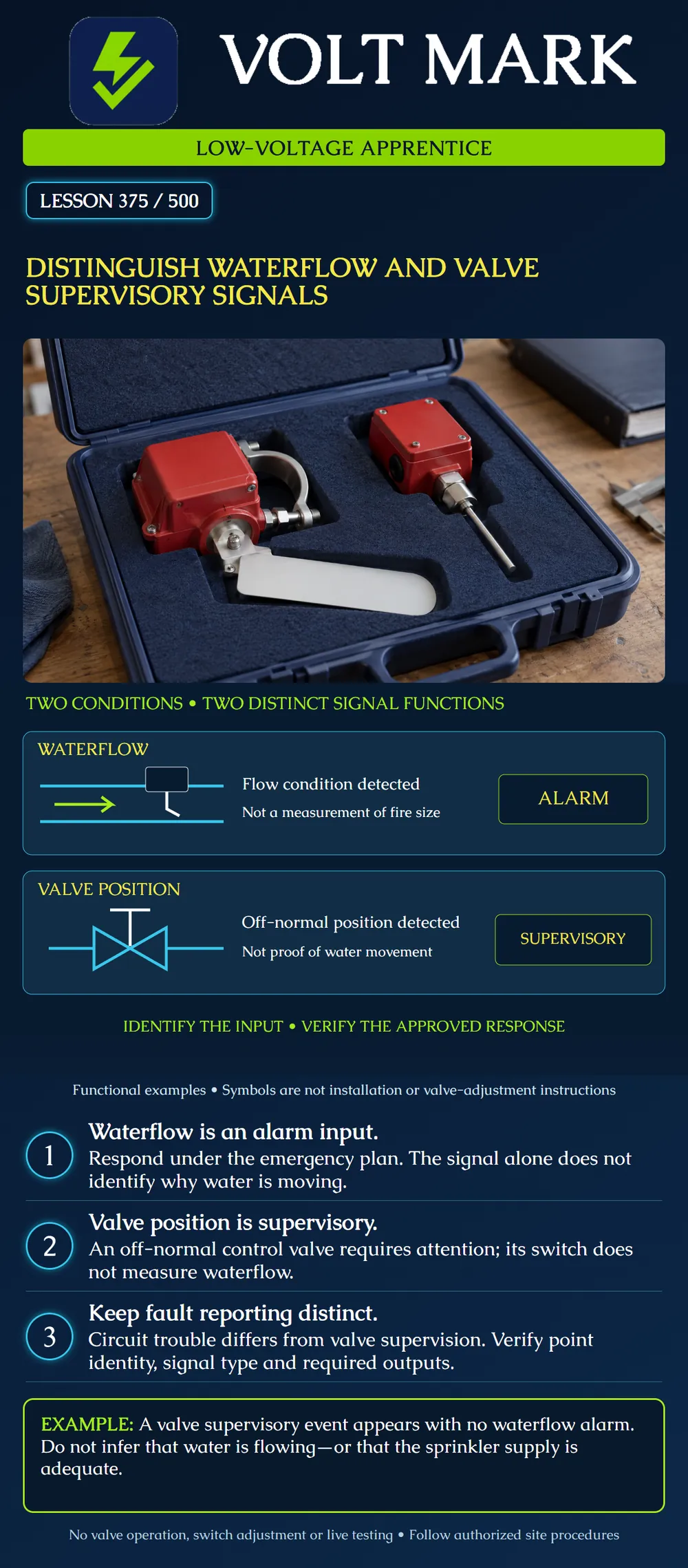
Explain the difference between detecting sprinkler waterflow and monitoring a control valve's normal position. Identify the separate alarm, supervisory and trouble functions without operating valves, changing programming or conducting live tests.
Waterflow detection is an alarm initiating function. A valve supervisory switch monitors whether its associated control valve remains in the intended normal position. These inputs answer different questions. Flow detection does not establish valve position; valve position monitoring does not measure flow.
Treat an unexpected waterflow alarm under the site's emergency plan. Do not delay emergency response to determine whether the cause is a fire, pipe damage or some other water discharge. An alarm signal reports a detected condition rather than a complete diagnosis. It does not measure fire size, identify every operating sprinkler or certify hydraulic performance.
The poster separates the two functions into rows. Its icons are conceptual: the valve icon does not depict a particular gate valve's internal construction, exact travel or switch mechanism. It provides no field wiring or commissioning instructions.
Potter describes the VSR as a vane-type waterflow alarm switch for wet sprinkler systems. This is a specific product family, not a device suitable for every sprinkler system. Selection depends on the exact system, pipe and product listing.
A waterflow switch can incorporate a retard mechanism that requires the detected condition to persist before operating its contacts. The selected arrangement must follow the applicable design, code and exact product instructions. This lesson intentionally gives no universal delay setting. Do not increase a delay, disable an input or change an alarm into a supervisory event to hide repeated signals.
A pressure-operated device can also serve a waterflow alarm application; other pressure devices serve different functions. Read the installed device's assigned function and documentation instead of classifying every pressure switch the same way.
Potter's OSYSU is an example designed to monitor the open position of an outside-screw-and-yoke gate valve. The mechanism's adjustment and operating characteristics are product-specific. Other valve types require appropriate arrangements.
For a normally open sprinkler control valve, departure from its normal position produces a supervisory condition through the approved arrangement. Do not wait for a valve to be fully closed before considering supervision relevant. Do not infer an exact percent-open position from a simple supervisory contact.
A normal supervisory indication is not a flow test. It does not establish that the entire water supply is adequate, every downstream path is clear or the switch has been properly installed and maintained. Supervision is one part of protection, with its own verification needs.
A circuit fault, such as an open connection in a supervised input circuit, is different from the monitored valve moving off normal. The first concerns the ability to monitor/report; the second concerns the equipment being monitored. The actual circuit design determines fault behavior.
Do not use the word "tamper" as a complete diagnosis. A point label may refer to valve position, enclosure access or another specific monitored condition. Match the identifier to the device schedule and approved sequence. Acknowledge, silence, restoration and repair are separate concepts; none of this lesson authorizes panel operation.
Case A — Two rows were swapped: An approved schedule identifies WF-02 as waterflow alarm and VS-02 as valve supervisory. A draft point list reverses their classifications. Mark the discrepancy and route it for authorized correction and verification. Do not accept a working indicator as proof that the classification is right.
Case B — Supervisory without waterflow: VS-04 reports off normal while no waterflow event is recorded. The correct conclusion is that a valve-related supervisory condition was reported. The record does not establish water movement or adequate supply. The responsible team must respond to the supervisory condition under site procedures.
Case C — Flow event without a confirmed fire: WF-01 reports alarm and the cause is unknown. Follow the emergency plan. The absence of a confirmed cause is not grounds to downgrade the signal or assume a harmless test.
Case D — One test report, two different claims: A historical report documents a waterflow input and required alarm notification. Its valve-supervision section is blank. The waterflow evidence cannot fill that blank because the functions differ. Request the missing evidence through the responsible testing team.
Case E — Repeated nuisance reports: A note proposes changing the input type to avoid alarms. Preserve the event history and ask for investigation of the cause and approved corrective action. Changing the label or event category does not repair the initiating condition.
Case F — All indicators normal: A screenshot shows normal status. It documents that display at that moment; it is not acceptance evidence for every valve, flow switch, transmission path or hydraulic condition.
For fictional riser R-2, create separate rows for WF-02 and VS-02. Enter: Device function; exact model; physical location; point identifier; approved event classification; drawing and sequence revision; expected outputs; test record reference; open discrepancies; responsible reviewer.
Keep actual observations separate from expected behavior. If an output is required but not recorded, write "evidence missing," not "passed." If a supervisory event is restored, retain evidence showing how the underlying condition was resolved rather than assuming restoration proves the whole system ready.
Practice arithmetic: four risers each have one waterflow record and two valve-supervision records. The expected inventory is 4 × (1 + 2) = 12 records. Ten are present, leaving two missing. This exercise invents a paperwork scope; it does not impose a universal number of devices per riser or a testing frequency.
Mistake: Using normal valve supervision as proof of adequate waterflow or supply. Correction: Keep valve-position evidence separate from the required waterflow and hydraulic evidence.
Mistake: Reclassifying repeated waterflow alarms as supervisory to quiet the system. Correction: Preserve the event history and refer the cause and corrective action through the approved process.
Mistake: Filling a blank valve-supervision result with a successful waterflow test. Correction: Retain separate WF and VS records and request the missing functional evidence.
For fictional R-2, WF-02 has a documented waterflow alarm result, while VS-02 has no valve-position test record. State what is supported and what remains unresolved.
Answer: Retain the WF-02 result within its documented scope. Valve supervision remains unverified; the waterflow record does not demonstrate VS-02's function. Refer the missing record to the responsible testing team without operating a valve for this exercise.
National fundamentals; verify applicable adopted requirements, approved design and exact manufacturer instructions for actual projects.
Texas journeyman, 15 questions, scored by topic against the 70% mark. No card, and no account needed to start.
Free study material for low-voltage apprentices. This is a national foundation course: requirements differ by state and by local jurisdiction, and a practice that is common in one place is not a rule everywhere. Nothing here is a licence, a certification, or authority to work unsupervised, and completing it does not count as apprenticeship hours or continuing-education credit. Check the codes adopted where you are working, the licensing authority for that work, and your employer's safety programme. VoltMark is not affiliated with, endorsed by, or sponsored by NFPA, OSHA, NICET, BICSI, FOA, or any state or local licensing authority.

Electrician licensing exam prep: practice questions, timed exam simulations, and step-by-step help finding every answer in the NEC.