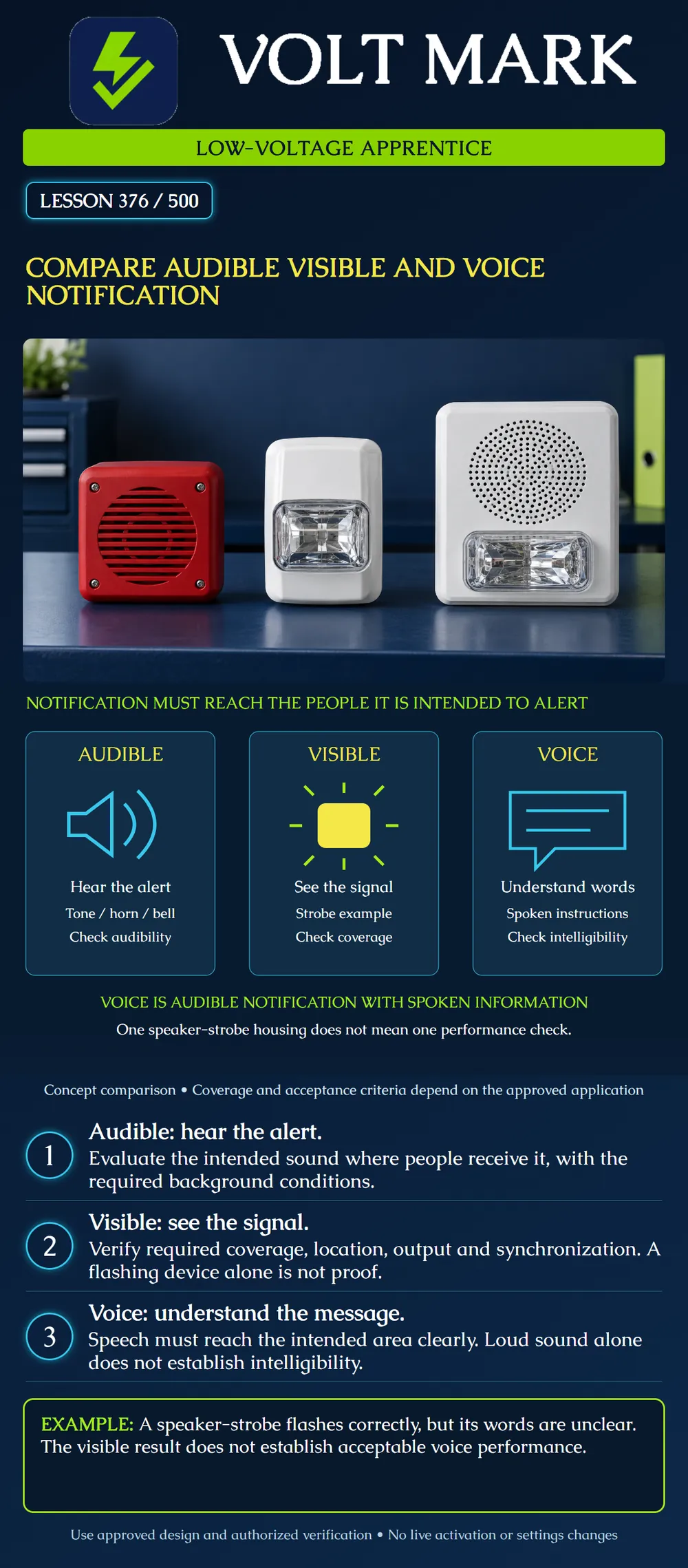
Compare notification by sound, visible signal and spoken information. Recognize that voice is a form of audible notification, and that hearing a sound does not necessarily mean understanding its words. Identify the evidence needed for each required function without operating a live system.
Audible appliances produce sound: examples include horns, bells and speakers. Visible appliances provide a visual signal, commonly a strobe. Voice systems use speakers to convey spoken information. These are overlapping functions, not three interchangeable device categories. A speaker can carry a tone and a voice message; a speaker-strobe can combine audible and visible functions in one housing.
The approved building emergency strategy determines what information is delivered and to whom. A notification output is not the same thing as smoke detection, system control, remote transmission or dispatch. A panel record showing an output command does not by itself establish effective notification throughout the intended space.
Audibility concerns whether the intended sound is sufficiently perceptible under the required conditions. Background noise, distance, doors, partitions and the room's use matter. Product output data helps design a system, but a catalog value is not a measurement at an occupant's location.
Do not infer room performance from an appliance being loud nearby. A person beside a speaker and a person behind a closed door may experience different conditions. Nor does a listening impression establish compliance for an entire space. The applicable design and acceptance criteria define how performance must be verified.
Visible notification provides a different means of receiving an alert. Review the required coverage, appliance location, mounting orientation, selected output and applicable synchronization requirements. A strobe flashing in a photograph is not proof that all required locations are covered.
Candela describes luminous intensity; it is not a unit of sound or an automatic room-size approval. A higher setting alone does not resolve every obstruction or placement problem. A new partition or tall storage fixture can change the application and should trigger responsible review of the affected design.
The U.S. Access Board's official guidance points to audible and visual requirements for covered fire alarm systems. This lesson does not replace accessibility scoping or claim every room in every building has identical requirements.
Voice adds words that people must understand. Noise, reverberation, distortion, message quality and speaker coverage can affect intelligibility. More volume is not a universal solution: excessive sound and reflections can make speech harder to understand. Use the approved design and verification method for the actual spaces.
The Honeywell/System Sensor voice application guide discusses the distinction between sound level and intelligibility, along with acoustics and verification. Its examples and historical code references are not taught here as universal current thresholds. Lesson 377 develops the audibility/intelligibility distinction further.
The cited L-Series speaker-strobe product illustrates separate speaker voltage/power selections and strobe candela selections. Those are different characteristics serving different functions. The exact product documentation and approved settings govern installation. This lesson gives no instruction to alter them.
A shared housing does not let a successful visual check stand in for a speech check. Keep audio and visible evidence identifiable, including the approved equipment, circuits, settings and intended areas. A replacement with a similar faceplate may still differ in compatibility or performance.
Case A — Bright strobe, unclear message: A report confirms visible operation but records unintelligible speech in the rear of a room. The visible result does not resolve the voice deficiency. Ask the responsible team for acoustical investigation and documented resolution.
Case B — Loud at the doorway: A technician's note says "very loud at entrance." No evidence covers the occupied workstations. Preserve the observation with its location, but do not expand it into a room-wide pass.
Case C — New wall: A tenant adds an enclosed office after the notification plan was approved. The previous open-room layout does not prove coverage inside the new room. Request design review of the changed conditions.
Case D — Speaker-strobe substitution: A proposed replacement fits the mounting area, but the schedule specifies a different compatible model. Physical similarity is insufficient. Resolve model, circuit, mounting and performance requirements before any authorized substitution.
Case E — Wrong message zone: An archived authorized test record shows clear speech, but the message played in the wrong zone. Good intelligibility does not correct the sequence or zone mismatch. Both the information and its intended destination require verification.
Case F — Informal volume adjustment: A proposal says to turn every speaker up to cure reverberation. That is not a demonstrated solution. Refer the issue to the responsible system designer and testing team; account for electrical loading and acoustic consequences within the approved process.
Use a fictional room record with three headings: Audible alert evidence; visible signal evidence; spoken-information evidence. For each applicable heading, enter the required function, approved design reference, device identity, relevant setting, area served, verification method, observed result and unresolved issue.
Exercise: three rooms each require three evidence categories in this fictional review. Nine category entries are expected. Seven are complete and two remain open. That count measures paperwork completeness, not a pass rate for building safety. A room without a required voice function would use a different scope; this example is not a universal room requirement.
Keep actual results separate from assumptions. "Command sent" and "appliance observed" are narrower facts than "required coverage verified." Document the scope that the evidence actually supports.
Mistake: Using a visible flash to pass the spoken-message result of a speaker-strobe. Correction: Keep visible, audible and voice evidence separate for each applicable location and function.
Mistake: Treating a higher candela setting as a cure for unclear speech. Correction: Use the correct measurement and design question: candela concerns visible output, while voice clarity needs acoustic review.
Mistake: Carrying open-room notification approval into a newly partitioned office. Correction: Record the changed geometry and obtain review of the affected coverage, settings and verification requirements.
Verify adopted requirements, accessibility scope, approved design and exact equipment documentation for real projects.
Texas journeyman, 15 questions, scored by topic against the 70% mark. No card, and no account needed to start.
Free study material for low-voltage apprentices. This is a national foundation course: requirements differ by state and by local jurisdiction, and a practice that is common in one place is not a rule everywhere. Nothing here is a licence, a certification, or authority to work unsupervised, and completing it does not count as apprenticeship hours or continuing-education credit. Check the codes adopted where you are working, the licensing authority for that work, and your employer's safety programme. VoltMark is not affiliated with, endorsed by, or sponsored by NFPA, OSHA, NICET, BICSI, FOA, or any state or local licensing authority.

Electrician licensing exam prep: practice questions, timed exam simulations, and step-by-step help finding every answer in the NEC.