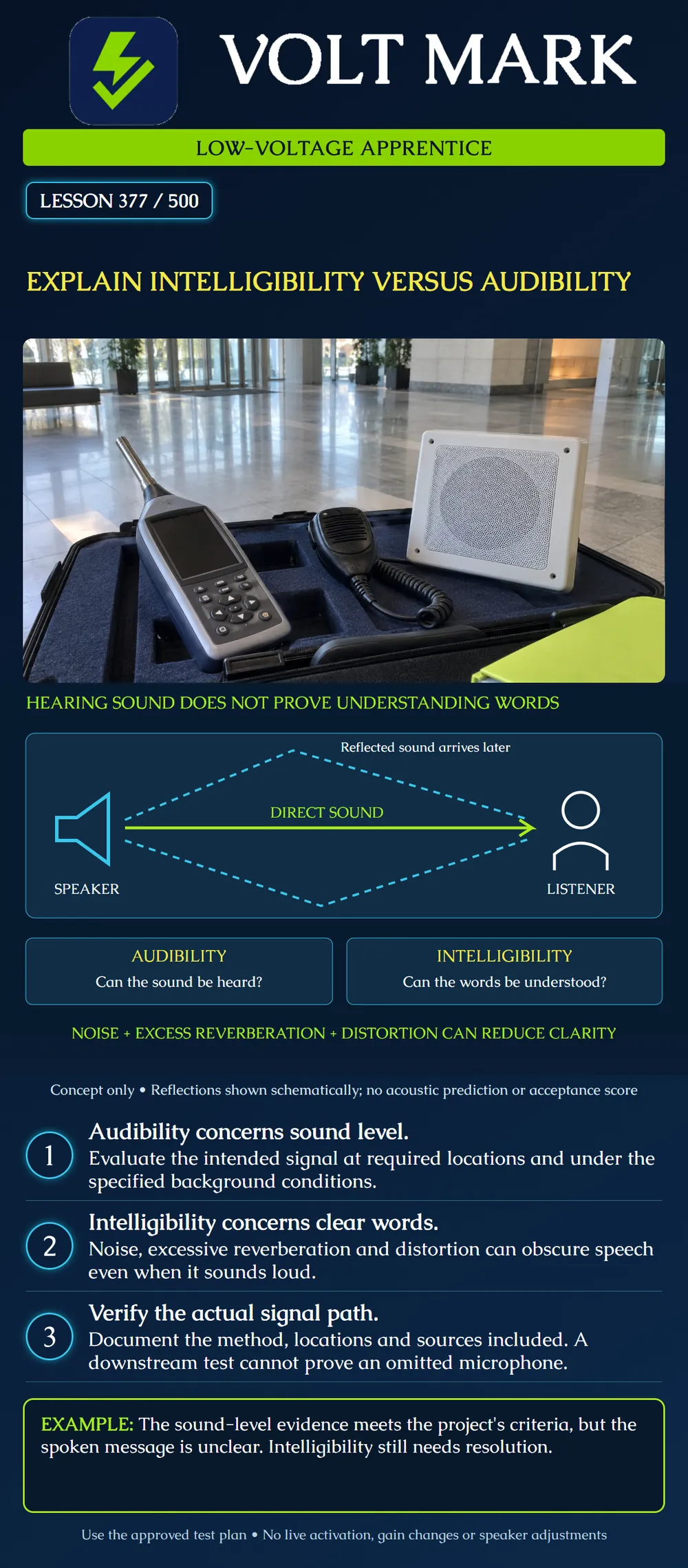
Distinguish sound that can be heard from speech that can be understood. Recognize why an emergency voice system needs evidence appropriate to both properties. Interpret a conceptual sound-path diagram without treating it as an acoustic prediction or installation design.
Audibility asks whether the intended sound is sufficiently perceptible at the relevant locations under the required conditions. Intelligibility asks whether spoken information can be understood. A sound-level result is not a substitute for a speech-intelligibility result. Conversely, clear words heard at one spot do not establish that all required locations receive the required level.
Voice notification involves a source, electronic equipment, loudspeakers, a room and listeners. Different parts can limit performance. An amplifier operating normally does not prove the words arriving at the listener are clear.
Background noise can mask speech. Reverberation can spread sound over time. Distortion or an unsuitable frequency response can alter speech information. These mechanisms can coexist. A large, hard-surfaced space may need a different design response from a small, furnished office.
The Honeywell/System Sensor guide discusses room acoustics, speaker coverage and intelligibility verification. Its discussion cautions that excessive level can worsen reverberant conditions. This does not mean apprentices should turn speakers down themselves; appropriate correction needs system-level assessment and authorized verification.
STI, the Speech Transmission Index, is an objective assessment framework for speech transmission. STIPA is a standardized test approach used for public-address applications. These are not alternate labels for a sound-level reading. The applicable project defines the method, criteria and required locations. This lesson supplies no universal passing score.
A result describes the path and conditions actually evaluated. An electronic test input downstream of a microphone cannot by itself establish the microphone's contribution. NTi Audio describes an acoustic source used at the talker's microphone to include that portion of the path in an end-to-end evaluation.
A prerecorded-message path and a live-microphone path may share downstream equipment while differing at the source. The authorized test plan must define its scope. Do not connect a generator, activate a voice system or bypass equipment as a classroom exercise.
Case A — High level, unclear words: A fictional report records adequate level under its project criteria, but listeners cannot distinguish the spoken instruction in a reverberant lobby. The level evidence does not close the intelligibility issue. Refer the discrepancy for acoustic/system investigation and documented verification.
Case B — Clear at the speaker: An observation was made directly beneath a speaker. The report then declares the entire hall acceptable. The conclusion exceeds the observation. Ask for evidence covering the locations and conditions required by the approved plan.
Case C — Quiet-room measurement: A report describes testing an empty room with equipment shut down. Normal use includes significant machinery noise. Determine whether the approved method accounted for the required background conditions; do not silently assume equivalence.
Case D — Microphone omitted: An electronic signal was introduced after the live microphone connection. The result may help characterize the tested downstream path, but it does not include the omitted microphone. Flag the scope mismatch if the required claim concerns the complete live-announcement path.
Case E — Wrong information, clear speech: Every word is understandable, but the message gives the wrong approved destination for the selected zone. Intelligibility alone does not verify message content, zoning or emergency strategy. Keep these separate acceptance questions.
Case F — New ceiling and walls: A renovation changes reflective surfaces and partitions. Previous measurements document the prior conditions. Request review of whether new verification is needed for the changed application.
For each required location or acoustically defined area, record:
Keep the measurement method beside its result. Do not compare an unqualified number with a threshold from an unrelated project, standard edition or instrument mode. A screenshot without location or method is incomplete evidence.
Original arithmetic exercise: an invented review scope contains five locations, each requiring two evidence entries, one for sound level and one for intelligibility. Ten entries are expected. Eight are present, leaving two missing. The two missing entries might concern one location or two; the count does not determine that. This is paperwork arithmetic, not a technical acceptance percentage or universal test plan.
Read two fictional notes: "The announcement was loud" and "The instruction was understandable at the rear desk under the stated conditions." Identify what each note establishes and what it leaves unknown. Neither note alone is a complete acceptance report. Then list the project references and missing evidence needed to support a broader conclusion.
Use discussion or printed records only. Do not demonstrate this lesson by sounding an installed alarm, changing speaker taps, altering amplifier gain or playing test signals through occupied-building equipment.
Mistake: Calling speech intelligible from a strong sound-level reading. Correction: Retain level and intelligibility results separately, with their methods, locations and project criteria.
Mistake: Applying a quiet-room result to normal noisy operation without checking the method. Correction: Verify how the approved evaluation accounts for the required background conditions and record any gap.
Mistake: Claiming the live-microphone path passed when the test signal entered downstream. Correction: Identify the omitted microphone and obtain evidence for the complete required path through the authorized test plan.
Actual requirements depend on adopted codes, the approved emergency-communications design and applicable test methods.
Texas journeyman, 15 questions, scored by topic against the 70% mark. No card, and no account needed to start.
Free study material for low-voltage apprentices. This is a national foundation course: requirements differ by state and by local jurisdiction, and a practice that is common in one place is not a rule everywhere. Nothing here is a licence, a certification, or authority to work unsupervised, and completing it does not count as apprenticeship hours or continuing-education credit. Check the codes adopted where you are working, the licensing authority for that work, and your employer's safety programme. VoltMark is not affiliated with, endorsed by, or sponsored by NFPA, OSHA, NICET, BICSI, FOA, or any state or local licensing authority.

Electrician licensing exam prep: practice questions, timed exam simulations, and step-by-step help finding every answer in the NEC.