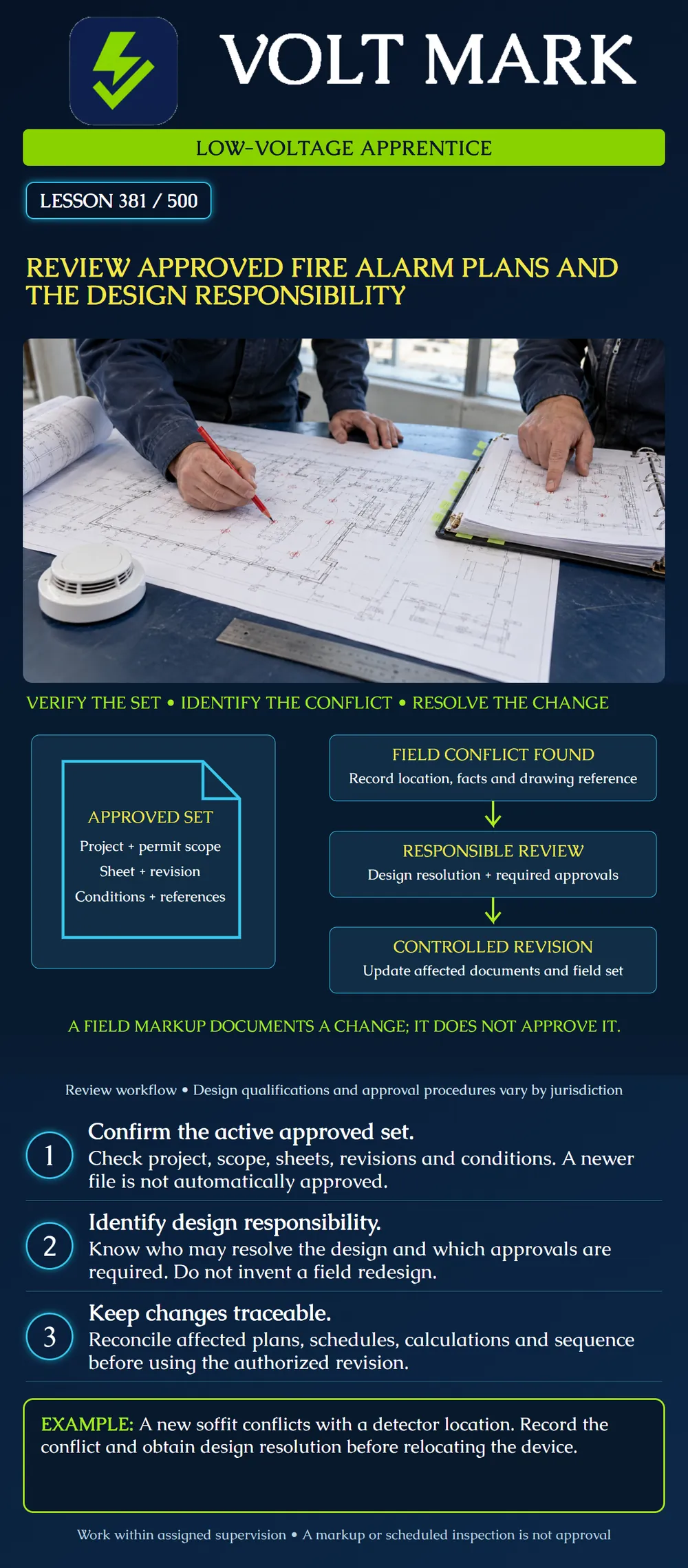
Recognize the approved project document set, identify who owns design decisions and route discrepancies through the required review process. Distinguish a field observation, a proposed change, approval and a record of completed work.
Begin with the project identity, address, permit or approval reference, scope, sheet index, revisions and review conditions. A stamped cover sheet is not enough to identify every applicable detail. Check that the sheets and related documents belong to the same approved package and that later authorized changes are included.
Approval is tied to a particular submission and scope. A pending revision does not automatically replace the current approved set. A newer file timestamp does not prove a document is approved. A subcontractor's internal review stamp may serve a different purpose from jurisdictional approval.
Design documents establish the intended system requirements. Shop drawings develop equipment and installation information within the assigned design scope. Schedules, calculations, specifications, manufacturer instructions and the sequence of operations support that information. Field markups record observations or changes for reconciliation. Record drawings document the resulting installation through the required closeout process.
These descriptions do not assign a universal legal role to a particular job title. Who may design, sign, seal, submit, install or approve work depends on applicable laws, project delivery arrangements and the authority having jurisdiction. Do not assume every state requires the same credential or that a permit applicant is automatically responsible for every design decision.
An apprentice can identify discrepancies, collect accurate observations and work within assigned supervision. Record the location, device identifier, relevant sheet and revision, actual condition and the specific unanswered question. Avoid replacing factual observations with a guessed redesign.
For example, "new duct conflicts with detector location on sheet FA-2 revision B" is a useful starting record. "I moved it because the ceiling looked crowded" conceals the unresolved design question. The responsible team must assess coverage, equipment suitability and affected documents before the change is treated as authorized.
Do not continue the affected installation on the basis of an unresolved assumption. Follow the project's process for clarifying the conflict and determining which independent work can proceed.
An installer, system designer, engineer, owner representative and authority having jurisdiction can have different responsibilities. Identify the actual responsible parties in the project documents and applicable requirements. Do not infer that one person's approval replaces every other required review.
A response to a request for information may clarify the design, but a substantive change may also require revised drawings, calculations or permit review. Determine the required process rather than treating any email response as blanket authorization.
Approval does not excuse an apparent conflict with equipment instructions or applicable requirements. Raise the conflict for documented resolution. Nor does approval establish that the eventual installed work has passed its required verification.
Fairfax County's official fire-alarm page describes plans, technical data and conditional calculation requirements, corrections/resubmission, permit issuance and later inspections. It demonstrates that submission, approval and acceptance are distinct steps. The page also warns that its general information does not cover every project condition.
This lesson does not export Fairfax's license categories, portal steps or permit rules to other jurisdictions. Use the responsible local authority's current requirements. The nationwide learning principle is to establish the applicable process and maintain traceable project information.
Case A — Two revisions in the gang box: An older printed layout and a newer unapproved draft show different device positions. Identify both document statuses and obtain the authorized field set. Do not choose solely by the latest date.
Case B — Substitute device: A supplier offers a similar model because the specified one is unavailable. Identify compatibility, performance, mounting, power and document impacts. Availability does not authorize the substitution.
Case C — Ceiling changed: A field team discovers a new soffit at the approved device position. Record the condition and request design resolution. Do not assume moving the device a short distance is inconsequential.
Case D — Markup labeled "as built": A handwritten change is added after installation. That records an asserted condition; it does not retroactively establish approval or compliance. Reconcile the deviation through the required review process.
Case E — Output sequence changed: A request adds an equipment-control function without updating the sequence or calculations. Determine the affected documents and required review before treating the added function as part of the approved installation.
Case F — Inspection scheduled: A calendar entry shows an upcoming inspection. It is not evidence that the inspection passed or that open conditions were resolved. Keep scheduled, performed and accepted statuses separate.
For a fictional discrepancy D-14, record: Project; location; affected device; drawing and revision; actual condition; question; proposed option if requested; responsible design reviewer; required jurisdictional review; affected schedules/calculations/sequence; documented resolution; authorized field revision; verification and closeout references.
Paper exercise: an approved index lists eight sheets. The field package contains seven distinct matching sheets. One indexed sheet is missing. Two extra copies of an existing sheet do not fill the gap. This is an original inventory exercise, not a prescribed drawing-package size.
Keep superseded revisions identifiable and separate from the active field set under the project's document-control process. Preserve the record of what changed and why instead of silently overwriting the evidence.
Mistake: Selecting a field drawing by its newest file date. Correction: Match the sheet and revision to the approved index and authorized changes before using its device positions.
Mistake: Treating an as-built markup as approval for a relocation. Correction: Record the actual condition separately and obtain the required design disposition and revised supporting documents.
Mistake: Accepting a substitute because it has the same appearance. Correction: Submit the exact model and its coverage, compatibility and calculation impacts to the responsible design reviewer.
Texas journeyman, 15 questions, scored by topic against the 70% mark. No card, and no account needed to start.
Free study material for low-voltage apprentices. This is a national foundation course: requirements differ by state and by local jurisdiction, and a practice that is common in one place is not a rule everywhere. Nothing here is a licence, a certification, or authority to work unsupervised, and completing it does not count as apprenticeship hours or continuing-education credit. Check the codes adopted where you are working, the licensing authority for that work, and your employer's safety programme. VoltMark is not affiliated with, endorsed by, or sponsored by NFPA, OSHA, NICET, BICSI, FOA, or any state or local licensing authority.

Electrician licensing exam prep: practice questions, timed exam simulations, and step-by-step help finding every answer in the NEC.