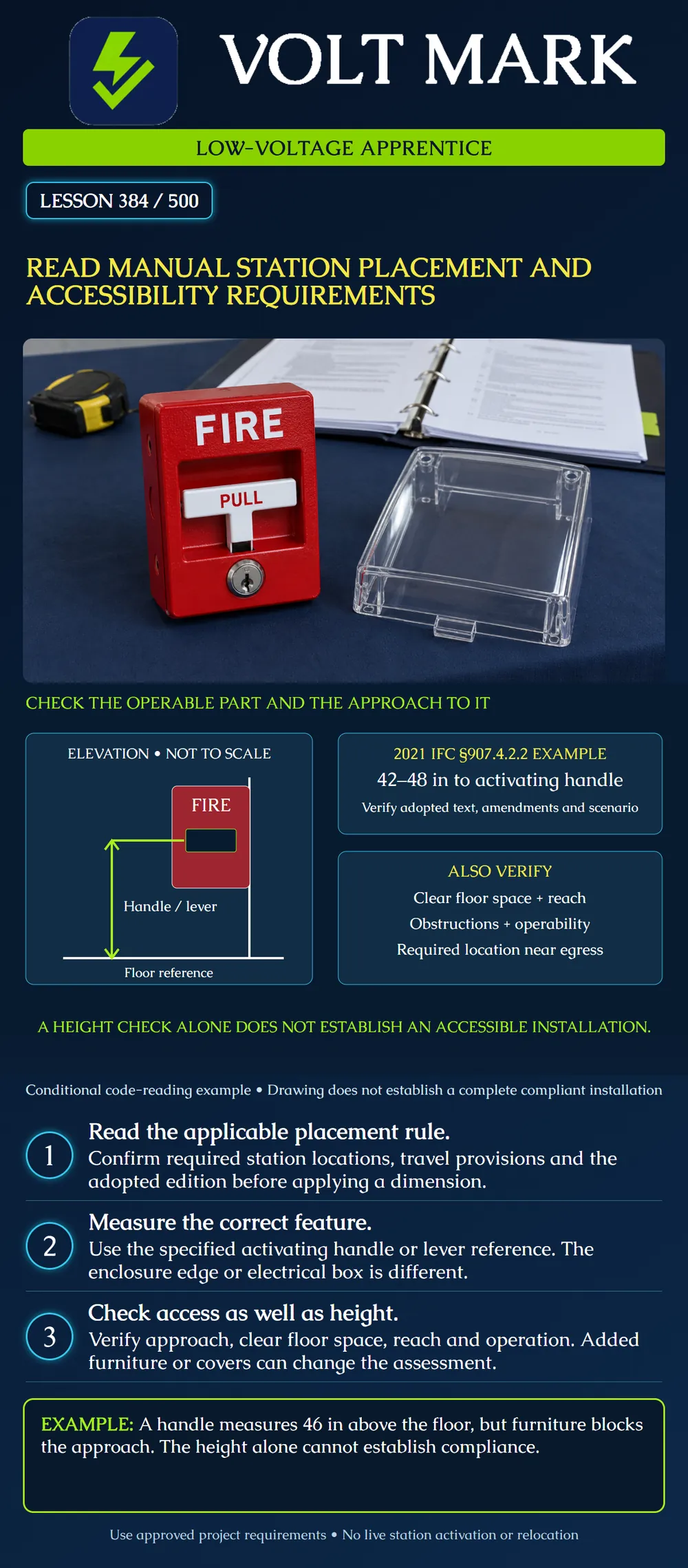
Identify the correct measurement reference for a manual fire alarm station and distinguish placement, mounting height and accessibility. Read a conditional code example without claiming that one dimension completes the installation review.
Use the adopted fire/building requirements, accessibility provisions, approved project design and exact equipment instructions together. Determine the required station locations and relevant egress/travel provisions. Do not copy the position of a station in another building as the design basis.
This lesson includes a specifically identified 2021 International Fire Code example. It does not establish that this edition is adopted in every state or county, nor that it applies unchanged to every existing installation. Verify applicable amendments and project scope.
ICC's official errata for 2021 IFC Section907.4.2.2 reproduces a height range of42 through48 inches measured vertically from floor level to the activating handle or lever. The correction also fixes the metric equivalent of48 inches to1219mm. The example's dimension concerns the activating part, not the top of the enclosure or the electrical box center.
In the poster, the lime vertical dimension ends at the depicted handle. The sketch is not to scale and does not define a preferred mounting height. Apply the precise reference required by the governing text and equipment details.
The U.S. Access Board's ADA guide identifies alarm pulls as operable parts. Its guidance addresses clear floor space, approach, reach and operation. The general unobstructed reach range is15 through48 inches; obstructions can change the limits. That broad reach range is not itself a fire-alarm station mounting range.
Covered operable parts must support one-hand use without tight grasping, pinching or wrist twisting, with operating force no greater than5lbf. Read the actual applicable provisions, including scoping and approach conditions. A product's operability claim does not establish that its surrounding installation is accessible.
Do not reuse a historical54-inch side-reach statement from an old product brochure as a general current rule for alarm pulls. Resolve discrepancies using the applicable standards and responsible project review.
A height check cannot establish that the station is at the required location, visible, reachable or usable. Conversely, a convenient approach cannot justify a location that conflicts with the approved placement requirements.
A protective cover or surrounding cabinet may affect the complete operating arrangement. Furniture or displays can obstruct the approach after installation. Record the installed condition, model and accessories rather than inspecting only the bare station's catalog drawing.
For a fictional paper review that explicitly applies the cited42–48-inch criterion, the activating handle is46 inches above the stated floor reference. It is4 inches above the lower bound and2 inches below the upper bound.
That establishes only the comparison with the stated height range. It does not approve the location, reach conditions, operation, product compatibility or complete installation. If a cabinet obstructs approach, the height comparison does not resolve the obstruction.
Conversion exercise:48 inches ×25.4mm/inch =1219.2mm, commonly expressed as1219mm in the cited code example. The incorrect1372mm value from the corrected printing would describe a materially different height. Never resolve inconsistent dimensions by silently choosing the more convenient unit.
Case A — Box center measured: A field note gives electrical-box center height but does not identify the activating handle's position. Request the correct reference measurement and product information. Do not assume the two features coincide.
Case B — Enclosure top compared: The top of a station is above the cited maximum, and a reviewer immediately rejects it. Determine where the activating part lies and what the applicable text measures. Non-operable enclosure portions and operating parts are different references.
Case C — Correct handle height, blocked approach: A display fixture occupies the approach area. Record the obstruction and route it for responsible correction. A passing height entry is not a complete accessibility conclusion.
Case D — Old brochure cited: A contractor relies on an old54-inch side-reach statement. Identify the document's age, applicable standard and current project requirements. Obtain documented resolution rather than importing obsolete guidance.
Case E — Added cover: A protective cover is proposed after approval. Review the exact accessory and its effect on operation, visibility and approach through the responsible process. Do not infer suitability from physical fit.
Case F — Different doorway: A relocation keeps the same height but changes the station's relationship to the approved egress location. The old height record does not approve the new location. Reconcile placement and accessibility together.
Case G — Unverified force: A learner suggests activating an occupied building's station to check operating force. This lesson does not authorize that test. Use the responsible verification process and exact product documentation.
Record the project and adopted requirements; station identifier; required placement reference; exact model and accessories; floor reference; activating-part reference; vertical measurement; approach type; clear floor space; obstructions; applicable reach criterion; operability evidence; unresolved issues and responsible reviewer.
Distinguish measured facts from inferred compliance. Write "handle46in above stated floor reference" before writing any conclusion. If required conditions are unknown, retain them as open items rather than extending a narrow result into a complete pass.
Mistake: Comparing box-center height with a requirement for the activating handle. Correction: Identify the required operable-part reference and obtain that measurement from the stated floor reference.
Mistake: Passing the installation because the handle is within the stated range. Correction: Check placement, approach, clear space and operability as separate requirements.
Mistake: Applying an old side-reach brochure to every manual station. Correction: Identify the applicable accessibility provisions and project conditions before choosing a reach criterion.
Texas journeyman, 15 questions, scored by topic against the 70% mark. No card, and no account needed to start.
Free study material for low-voltage apprentices. This is a national foundation course: requirements differ by state and by local jurisdiction, and a practice that is common in one place is not a rule everywhere. Nothing here is a licence, a certification, or authority to work unsupervised, and completing it does not count as apprenticeship hours or continuing-education credit. Check the codes adopted where you are working, the licensing authority for that work, and your employer's safety programme. VoltMark is not affiliated with, endorsed by, or sponsored by NFPA, OSHA, NICET, BICSI, FOA, or any state or local licensing authority.

Electrician licensing exam prep: practice questions, timed exam simulations, and step-by-step help finding every answer in the NEC.