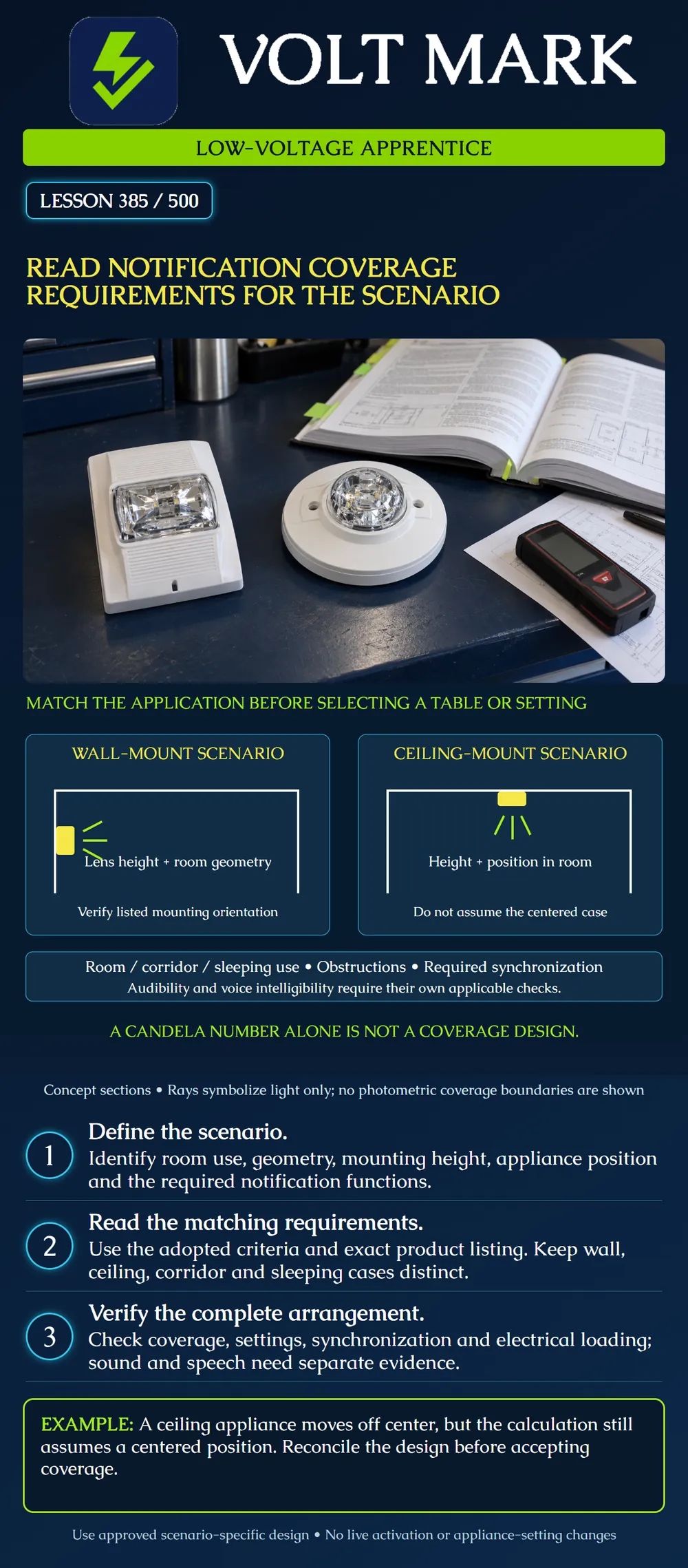
Select the correct notification-coverage scenario before reading a table or appliance setting. Distinguish visible coverage, audible performance and voice intelligibility, and recognize when changed conditions invalidate an earlier design assumption.
Record the required notification functions and the area to be served. Determine whether the applicable criteria address a room, corridor, sleeping area or another condition. Establish actual dimensions, mounting height, appliance position and obstructions.
The poster compares wall and ceiling mounting as separate examples. Its short lime rays represent light symbolically; they are not coverage boundaries or photometric predictions. Neither drawing establishes an acceptable installation.
A table heading, row, notes and referenced section are part of the requirement. Do not take a candela number without its room geometry, mounting arrangement and other conditions. Verify the adopted edition and amendments, the approved design and exact equipment documentation.
System Sensor's AV reference guide distinguishes wall, ceiling, corridor and sleeping applications. It also discusses how an off-center ceiling position changes the geometry used in its referenced method. These distinctions explain why the scenario matters. The guide contains historical code references and inconsistent summary material; this lesson does not reproduce its tables as current universal requirements.
If two sources appear to conflict, preserve both references and obtain responsible resolution. Do not silently choose the lower setting or assume a recently indexed PDF contains the latest code.
Candela describes luminous intensity. It is not sound level, room area or a count of occupants. A candela setting does not by itself establish the spatial distribution or required coverage of the installed appliance.
A visible appliance can operate while the audible or voice function remains inadequate. Sound must meet its applicable criteria at the required locations. Spoken information must meet the required intelligibility criteria. A combination appliance does not merge these into one test result.
The U.S. Access Board's ADA communication provisions separately address audible and visible fire alarms and incorporate referenced standards. Their scoping and referenced editions must be read with the actual project requirements, not replaced with a product brochure.
Verify whether the exact model is listed for the intended wall or ceiling orientation. Similar-looking appliances may have different optical distributions or installation requirements. Moving an appliance can alter the scenario even when the same output setting is retained.
For a ceiling application, record the appliance's actual position rather than assuming it is centered. For wall applications, use the measurement reference specified by the applicable criterion. A dimension to the electrical box is not automatically a dimension to the lens or other required reference.
Determine required synchronization and compatible equipment for the actual arrangement. Electrical current demand, voltage at the appliance and supply capacity must also be reconciled with the approved design. Increasing an output setting can have electrical consequences; it is not a stand-alone remedy.
For voice systems, room acoustics and background conditions remain relevant. The voice application guide explains that intelligibility requires more than a nearby loudness impression. Lesson377 provides the separate audibility/intelligibility foundation.
Case A — Ceiling appliance moved: A device is shifted away from the center to avoid another service. The calculation still identifies the centered condition. Record the mismatch and obtain revised analysis before accepting coverage.
Case B — Corridor shortcut: A reviewer applies a corridor rule to a broad meeting room because both areas are on the same floor. Confirm which scenario actually applies; physical proximity does not make their criteria interchangeable.
Case C — Bedroom treated as office: A sleeping room is evaluated using a non-sleeping-room example. Identify the incorrect assumption and obtain the applicable notification criteria and approved arrangement.
Case D — Same candela, different mounting: A proposed ceiling appliance has the same nominal intensity as the scheduled wall appliance. That number does not establish equivalent mounting, distribution, compatibility or coverage.
Case E — Setting raised: Someone proposes a higher setting without revisiting circuit loading. Flag both the coverage question and affected electrical calculations. Do not adjust the installed device as part of this lesson.
Case F — Partition added: A new room divider changes the previously open layout. An earlier report supports the old arrangement only to its documented scope. Determine whether the new geometry requires design changes and further verification.
Case G — Flashing observed: A record says "all strobes flashed" but provides no coverage or synchronization evidence. Retain the observation without promoting it into a complete acceptance conclusion.
A fictional room is24ft wide. Its center is12ft from either side wall. A proposed ceiling device shifts4ft toward one side: the two distances become8ft and16ft, while their sum remains24ft.
These values establish a changed position, not a candela selection. No mounting height, applicable coverage criterion, product or permitted arrangement has been supplied. Do not choose an intensity from this arithmetic alone. The example demonstrates why a worksheet that still says "centered" is inaccurate.
Write down the actual distances and the original assumption. Then identify which approved calculation or reference needs review. Do not multiply or combine device intensities as if simple arithmetic established coverage.
Record area identifier, room use, required functions, geometry, ceiling height, appliance model, mounting orientation, location, selected output, applicable source and edition, synchronization method, electrical calculation reference, verification scope and unresolved changes.
Keep the design calculation separate from field verification. A correct calculation based on incorrect field assumptions is not sufficient evidence. A working appliance does not validate a mismatched calculation.
Mistake: Keeping a centered-ceiling calculation after shifting the appliance. Correction: Record the actual wall distances and obtain the appropriate coverage analysis for the new position.
Mistake: Substituting a wall appliance for a ceiling appliance solely because candela matches. Correction: Verify mounting orientation, model suitability and applicable coverage method with the responsible designer.
Mistake: Increasing candela without revising electrical calculations. Correction: Carry the proposed setting and its documented demand into loading and voltage checks before authorization.
Texas journeyman, 15 questions, scored by topic against the 70% mark. No card, and no account needed to start.
Free study material for low-voltage apprentices. This is a national foundation course: requirements differ by state and by local jurisdiction, and a practice that is common in one place is not a rule everywhere. Nothing here is a licence, a certification, or authority to work unsupervised, and completing it does not count as apprenticeship hours or continuing-education credit. Check the codes adopted where you are working, the licensing authority for that work, and your employer's safety programme. VoltMark is not affiliated with, endorsed by, or sponsored by NFPA, OSHA, NICET, BICSI, FOA, or any state or local licensing authority.

Electrician licensing exam prep: practice questions, timed exam simulations, and step-by-step help finding every answer in the NEC.