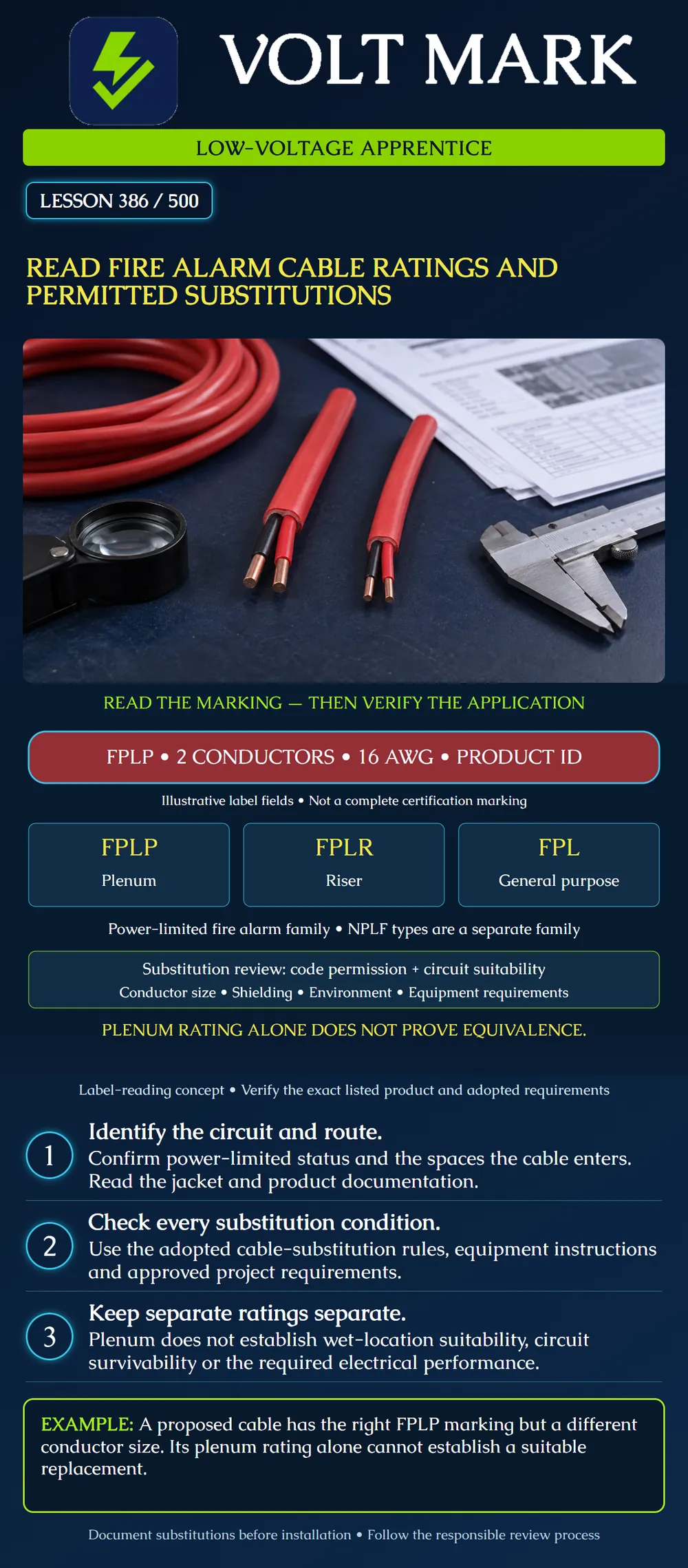
Read a cable identification record and explain why a permitted cable-type substitution is only one part of accepting a replacement. This is a document-reading lesson, not authorization to alter an installed life-safety circuit.
Start with the approved circuit designation, equipment documentation, cable schedule and actual route. Record the specified manufacturer and part number before comparing a proposed alternate. A purchase description such as “fire wire” cannot carry all these requirements.
UL 1424 distinguishes FPLP for plenum applications, FPLR for riser applications and FPL for other general applications. Its scope excludes non-power-limited fire-alarm cable. UL 1425 covers that separate family, including NPLFP, NPLFR and NPLF. Do not classify a circuit solely from its measured voltage or jacket color.
Record the installation spaces rather than assuming the whole route has the same conditions. A path may cross several environments. An environmental-air space, shaft and outside segment pose different questions. Verify the applicable adopted requirements and the precise product listing for the actual conditions.
First locate the required cable type. Then find which substitute types the applicable table permits in its place. Reversing those columns reverses the question.
Historical NFPA development material and Belden's older chart show FPLP in place of FPLR, and FPLR in place of FPL, within the power-limited fire-alarm family. This illustrates directionality, not a universal current installation approval. A proposed FPLR replacement for specified FPLP is not justified by reversing that relationship. Other cable families require their own exact permitted-substitution conditions; this lesson intentionally does not publish a cross-family shortcut chart.
Before applying any entry, verify the adopted NEC edition, local amendments, applicable circuit provisions and any limitations accompanying the table. Section numbering changes across editions: the UL 1424 scope consulted references 722.135 for relevant installation provisions while also identifying Article 760 circuit use. An older 760.154 reference should not be assumed to identify the current table in every edition.
Use a side-by-side record: original part, alternate part, requirement, supporting document and disposition. Include conductor number and gauge; solid or stranded construction; shielding and twisting where required; resistance and capacitance limits; permitted length; termination compatibility; and environmental conditions. Resolve differences through the responsible project review process.
Belden 6220UL provides a concrete reading exercise. Its March 3, 2026 data sheet identifies two 16 AWG solid bare-copper conductors and FPLP classification. It separately lists electrical characteristics, bend radius, pulling tension and indoor environmental suitability. These separate fields explain why matching one type designation is not the same as matching a complete cable specification. The data sheet is not permission to connect this cable to every fire-alarm product.
The plenum designation addresses a cable fire-performance classification; it does not by itself establish suitability for water exposure, direct burial or sunlight. Likewise, do not infer a fire-resistive circuit-survivability assembly from an FPLP marking. A requirement for continued operation during fire must be evaluated on its own documented basis.
An imaginary project cable schedule specifies a particular 16 AWG FPLP cable. A proposed alternate is also FPLP but is 18 AWG. The submittal includes no revised electrical evaluation. Can the apprentice mark it “equivalent”? No. Matching the type designation leaves a conductor-size difference unresolved. Identify the discrepancy, retain the supporting documents and route the proposal for the responsible technical review. Do not invent a voltage-drop result without the necessary circuit inputs.
A second proposal matches conductor size but lacks documentation for an outdoor portion of the route. The missing environmental evidence remains an open item. A favorable electrical comparison does not answer that separate question.
Use four comparison categories for this exercise:
Write the document name, revision and page for every supported category. Record “not established” where evidence is absent. Keep the original specification alongside the proposal so that later reviewers can understand exactly what changed.
Primary sources consulted October 1, 2026: UL 1424, public scope, revision March 19, 2025; opened: https://www.shopulstandards.com/ProductDetail.aspx?UniqueKey=48049 UL 1425, public scope, revision January 14, 2022; opened: https://www.shopulstandards.com/ProductDetail.aspx?productId=UL1425 Belden 6220UL technical data sheet, revision 0.580, March 3, 2026; opened: https://catalog.belden.com/techdata/EN/6220UL_techdata.pdf NFPA code-development report, December 2021, indexed table excerpt only; not an adopted-code determination: https://www.nfpa.org/api/files?path=%2Ffiles%2FAboutTheCodes%2F70%2F70_A2022_NEC_P03_SD_SRStatements.pdf Belden historical substitution chart labeled “Per 2005 NEC,” indexed excerpt only; direct open failed: https://catalog.belden.com/prodimgs/AllAssets-approved/std.lang.all/58/75/175875.pdf
The exercises and comparison worksheet are original teaching examples. No universal cross-family substitution table is asserted. This is nationwide foundational instruction, not a finding that every jurisdiction adopted the same rules.
Mistake: Reading a substitution table backward to replace FPLP with FPLR. Correction: Start from the required type and read only the substitutions permitted for it in the applicable requirements.
Mistake: Accepting two FPLP cables as equivalent despite a gauge change. Correction: Compare conductor size and electrical characteristics against the equipment and calculation basis before accepting the alternate.
Mistake: Treating a plenum marking as proof of outdoor or wet-location suitability. Correction: Check the exact product's environmental ratings against every part of the documented route.
Texas journeyman, 15 questions, scored by topic against the 70% mark. No card, and no account needed to start.
Free study material for low-voltage apprentices. This is a national foundation course: requirements differ by state and by local jurisdiction, and a practice that is common in one place is not a rule everywhere. Nothing here is a licence, a certification, or authority to work unsupervised, and completing it does not count as apprenticeship hours or continuing-education credit. Check the codes adopted where you are working, the licensing authority for that work, and your employer's safety programme. VoltMark is not affiliated with, endorsed by, or sponsored by NFPA, OSHA, NICET, BICSI, FOA, or any state or local licensing authority.

Electrician licensing exam prep: practice questions, timed exam simulations, and step-by-step help finding every answer in the NEC.