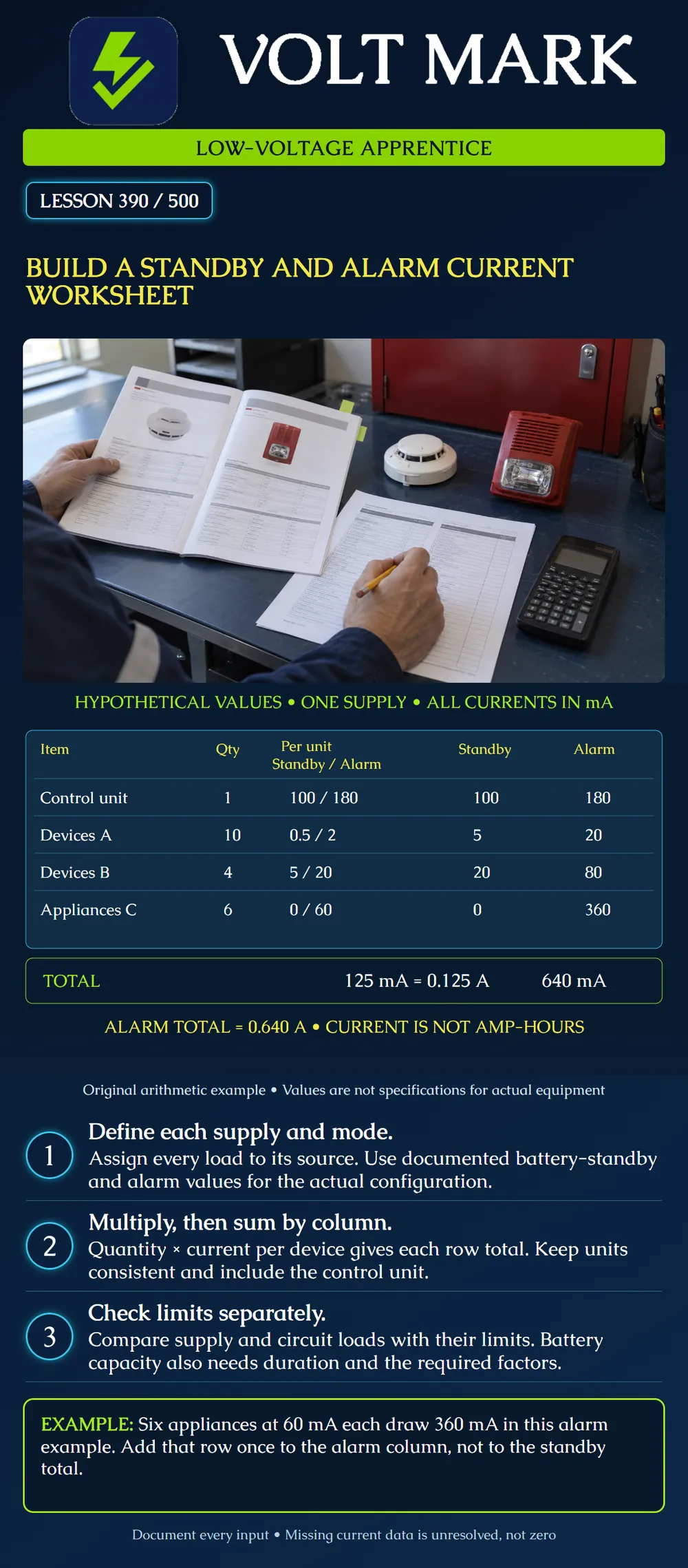
Build separate standby and alarm current totals using quantities and documented per-device currents. Keep the supply boundary, operating mode and units visible so the worksheet can be checked.
The Honeywell 5496 manual uses a separate worksheet for each power module, includes the module's own demand, and directs the reader to device documentation for auxiliary and notification loads. It compares the resulting alarm load with the equipment limit before proceeding to battery requirements. Those are useful worksheet principles; this lesson does not reuse that product's numerical limits.
The IFP-300 manual illustrates why operating mode matters: its described door-holder arrangement removes power in alarm/battery standby while still requiring its normal-operation load to be considered. Do not generalize that exclusion to every door holder or system. The actual configuration must support any omission.
Write the supply identifier, equipment model, drawing revision and worksheet purpose at the top. List the loads actually supplied by that source. A remote supply may need its own worksheet; do not put its output loads into a panel total simply because the panel communicates with it.
For each item, record the model, quantity, settings, data source and applicable voltage/current basis. A product table may offer several currents for different settings or operating conditions. Use the one required by the exact calculation method. Document whether the figure is a maximum value or another specified basis.
Check whether a control-unit figure already includes certain internal parts or loads. Avoid adding the same demand twice. Conversely, do not assume external accessories are included merely because they connect to the panel.
Original example values, all in mA: Control unit: quantity 1; standby 100 each; alarm 180 each. Devices A: quantity 10; standby 0.5 each; alarm 2 each. Devices B: quantity 4; standby 5 each; alarm 20 each. Appliances C: quantity 6; standby 0 each; alarm 60 each.
Standby extensions: 1 x 100 = 100 mA. 10 x 0.5 = 5 mA. 4 x 5 = 20 mA. 6 x 0 = 0 mA.
Alarm extensions: 1 x 180 = 180 mA. 10 x 2 = 20 mA. 4 x 20 = 80 mA. 6 x 60 = 360 mA.
The alarm figures here are complete per-item currents in alarm, not extra increments to add on top of standby. If a real document instead specifies an additional increment, follow and label that convention explicitly.
Standby: 100 + 5 + 20 + 0 = 125 mA = 0.125 A. Alarm: 180 + 20 + 80 + 360 = 640 mA = 0.640 A.
Do not add 125 and 640 to obtain a supposed alarm current. They describe two different conditions in this example. The worksheet carries both totals forward to the appropriate next calculation.
Use consistent units before adding. One ampere is 1,000 milliamperes; one milliampere is 1,000 microamperes. As an independent conversion check, 500 microamperes is 0.5 mA, not 500 mA. A unit error can overwhelm otherwise correct multiplication.
A total supply current does not prove that each individual circuit is within its rating. Maintain the circuit allocations needed for those checks. Likewise, current alone does not establish acceptable voltage at the last device; that is a separate electrical evaluation.
Battery capacity is expressed in amp-hours. Multiplying amperes by hours produces an amp-hour quantity; simply relabeling an ampere total as amp-hours does not. Required durations, margins and battery/equipment limitations are addressed in the next lesson. This worksheet does not select a battery or establish a universally required runtime.
A revised classroom schedule adds two more appliances C while keeping every other assumption unchanged. New appliance quantity: 6 + 2 = 8. New appliance alarm row: 8 x 60 = 480 mA. Increase: 480 - 360 = 120 mA. New alarm total: 640 + 120 = 760 mA = 0.760 A. Standby remains 125 mA under the stated zero-standby assumption for C.
Record the revision and recalculate affected circuit allocations. The exercise establishes arithmetic only; it does not show that any actual power source can support the revised load.
Match quantities to the current schedule. Confirm units, column headings and the per-unit versus extended distinction. Check the source reference for every nonzero value and every zero. Retain unresolved inputs visibly. Have the responsible technical reviewer reconcile limits and operating assumptions before using the worksheet as installation evidence.
Consulted October 1, 2026; both opened: Honeywell 5496 Intelligent Power Module Manual, 151276-L8:F2, February 15, 2022, section 2.4 and Table 2.2: https://prod-edam.honeywell.com/content/dam/honeywell-edam/hbt/en-us/documents/manuals-and-guides/installation-guides/hbt-fire-151276-L8-F2-5496-installation-manual.pdf?download=false Honeywell IFP-300 Series Manual, LS10145-001SK-E:D, August 29, 2022, section 3.5 worksheet notes: https://prod-edam.honeywell.com/content/dam/honeywell-edam/hbt/en-us/documents/manuals-and-guides/installation-guides/Hbt-Fire-Hbt-Fire-Ls10145-001sk-E-D-Ifp-300.pdf
Historical product worksheets provide context; their numerical equipment limits and runtime tables are not generalized. All poster values and calculations are original hypothetical examples. Verify current instructions and adopted requirements.
Mistake: Adding standby total to an alarm total that already represents complete alarm demand. Correction: Label the current convention and sum each operating mode separately.
Mistake: Entering zero when a device's standby current is missing. Correction: Keep the input unresolved and obtain the correct model and mode data.
Mistake: Putting a remote supply's output loads into the panel worksheet merely because it communicates with the panel. Correction: Trace the actual power boundary and prepare the separate supply worksheet required by the equipment method.
Texas journeyman, 15 questions, scored by topic against the 70% mark. No card, and no account needed to start.
Free study material for low-voltage apprentices. This is a national foundation course: requirements differ by state and by local jurisdiction, and a practice that is common in one place is not a rule everywhere. Nothing here is a licence, a certification, or authority to work unsupervised, and completing it does not count as apprenticeship hours or continuing-education credit. Check the codes adopted where you are working, the licensing authority for that work, and your employer's safety programme. VoltMark is not affiliated with, endorsed by, or sponsored by NFPA, OSHA, NICET, BICSI, FOA, or any state or local licensing authority.

Electrician licensing exam prep: practice questions, timed exam simulations, and step-by-step help finding every answer in the NEC.