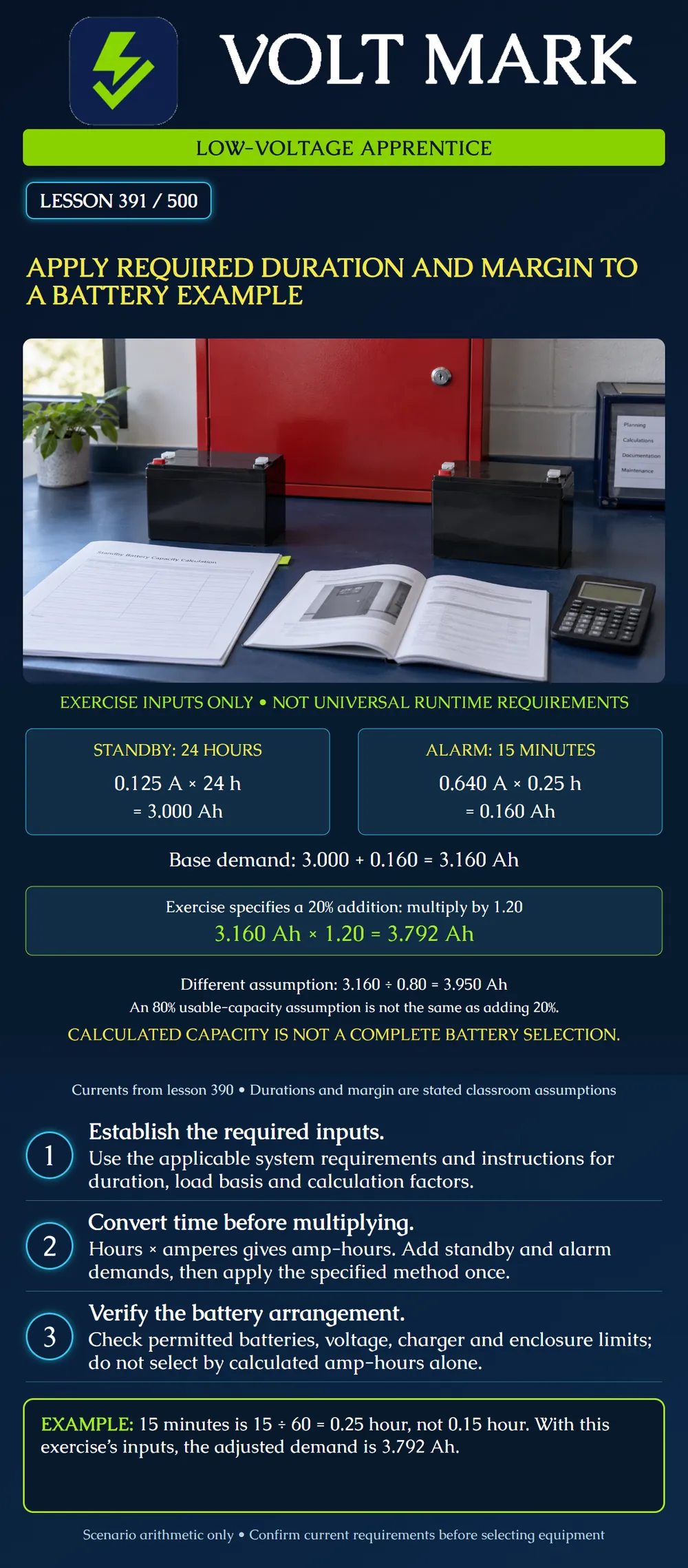
Convert the standby and alarm currents from a worksheet into an amp-hour demand using explicitly stated durations. Apply the specified margin method and distinguish the result from a completed battery selection.
Use the original lesson 390 totals, not its later revision: Standby current: 125 mA = 0.125 A. Alarm current: 640 mA = 0.640 A.
For this classroom exercise only, the stated requirements are 24 hours of standby followed by 15 minutes of alarm, with a 20 percent addition to the combined amp-hour demand. These are assigned inputs for arithmetic. They do not establish the required runtime or factor for every fire-alarm installation, jurisdiction, occupancy or equipment type.
Assume the currents already represent the relevant battery load basis for this simplified calculation. Real worksheets must establish that basis and account for any required conversion or equipment-specific method.
For a project, identify the system type, applicable adopted requirements, approved design and manufacturer instructions. Record where each runtime and calculation factor comes from. If two documents appear to conflict, resolve the conflict through the responsible review process; do not quietly choose the smaller result.
Honeywell's historical FCPS-24FS manual illustrates a worksheet that multiplies standby and alarm current by the corresponding times, adds the amp-hours and then applies its specified factor. Its Table 6.4 distinguishes different application factors. That is evidence to read the exact method, not authority to apply one number everywhere.
Do not copy that manual's older general runtime statements into a nationwide rule. This lesson uses its own clearly declared durations and exact minute-to-hour conversion. It does not use the manual's rounded minute entries as exact mathematical identities.
15 minutes / 60 minutes per hour = 0.25 hour. The number 0.15 hour represents 9 minutes, because 0.15 x 60 = 9.
This check catches a common decimal mistake before it reaches the capacity calculation. Keep both the entered minutes and the converted hours in the record so the reviewer can see the basis.
Standby demand: 0.125 A x 24 h = 3.000 Ah.
Alarm demand: 0.640 A x 0.25 h = 0.160 Ah.
Combined base demand: 3.000 Ah + 0.160 Ah = 3.160 Ah.
The alarm current is the total current during the alarm condition in this exercise. Do not add standby current to it again. The two time periods are sequential: 24 hours of standby, then the stated alarm period.
The exercise says to add 20 percent of the base demand. Twenty percent of 3.160 Ah is 0.632 Ah. 3.160 + 0.632 = 3.792 Ah. Equivalently, 3.160 x 1.20 = 3.792 Ah.
Keep sufficient precision through the calculation. A display rounded to two decimal places would show 3.79 Ah, but rounding a display downward does not authorize choosing equipment below the actual requirement.
Suppose a different exercise instead says only 80 percent of nominal capacity is usable. Let C be the nominal capacity: 0.80 x C = 3.160 Ah. C = 3.160 / 0.80 = 3.950 Ah.
That is 0.158 Ah greater than 3.792 Ah. Multiplying by 1.20 and dividing by 0.80 are not interchangeable. The second operation is equivalent to multiplying by 1.25.
Do not apply both factors simply because both appear on a teaching poster. Use the actual prescribed method and document factors already incorporated in a manufacturer's worksheet or selection table. Avoid both omissions and duplicate adjustments.
An arithmetic result is one input to selection. The actual arrangement must meet the equipment's permitted battery type and voltage, charging capability, enclosure provisions and other relevant instructions. The historical FCPS manual itself distinguishes chargeable capacity from the capacity that fits in its cabinet. The numerical ranges belong to that product and are not generalized here.
Power-Sonic's battery-connection guidance explains that series connection adds voltage while retaining the amp-hour rating of matched batteries. As a separate concept example, two matched 12 V, 7 Ah batteries in series form a nominal 24 V, 7 Ah arrangement, not 24 V, 14 Ah. This is not authorization to connect batteries to a fire-alarm panel; follow the panel's listed arrangement and installation process.
Verify performance under the required conditions using the applicable battery and equipment data. A printed nominal capacity is not a substitute for documented suitability.
Keep the same currents, 24-hour standby and 1.20 factor, but change the classroom alarm duration to 30 minutes: 30 / 60 = 0.5 h. Alarm demand = 0.640 x 0.5 = 0.320 Ah. Base demand = 3.000 + 0.320 = 3.320 Ah. Adjusted demand = 3.320 x 1.20 = 3.984 Ah.
The duration change raises adjusted demand by 3.984 - 3.792 = 0.192 Ah. This shows why a copied runtime can change the outcome even when every device quantity remains the same.
Consulted October 1, 2026: Honeywell FCPS-24FS Series Installation Manual, 51883-L8:J2, July 11, 2014, section 6.4/Table 6.4; opened: https://prod-edam.honeywell.com/content/dam/honeywell-edam/hbt/en-us/documents/manuals-and-guides/user-manuals/51883.pdf?download=false Power-Sonic, How to Connect Batteries in Series and Parallel; opened: https://www.power-sonic.com/how-to-connect-batteries-in-series-and-parallel/ An older Power-Sonic technical-manual PDF link redirected to its home page and is not treated as an opened manual.
All worked values are original classroom calculations, not a current jurisdictional determination.
Mistake: Entering 15 minutes as 0.15 hour. Correction: Divide minutes by 60 and retain 0.25 hour in this worksheet.
Mistake: Treating a 20 percent addition as the same method as 80 percent usable capacity. Correction: Apply the specified wording: multiply the base by 1.20 for the assigned addition; divide by 0.80 only for the alternate usable-capacity case.
Mistake: Doubling amp-hours when two matched batteries are connected in series. Correction: Keep the series arrangement's amp-hour rating unchanged while adding nominal voltages, then verify the equipment's permitted arrangement.
Texas journeyman, 15 questions, scored by topic against the 70% mark. No card, and no account needed to start.
Free study material for low-voltage apprentices. This is a national foundation course: requirements differ by state and by local jurisdiction, and a practice that is common in one place is not a rule everywhere. Nothing here is a licence, a certification, or authority to work unsupervised, and completing it does not count as apprenticeship hours or continuing-education credit. Check the codes adopted where you are working, the licensing authority for that work, and your employer's safety programme. VoltMark is not affiliated with, endorsed by, or sponsored by NFPA, OSHA, NICET, BICSI, FOA, or any state or local licensing authority.

Electrician licensing exam prep: practice questions, timed exam simulations, and step-by-step help finding every answer in the NEC.