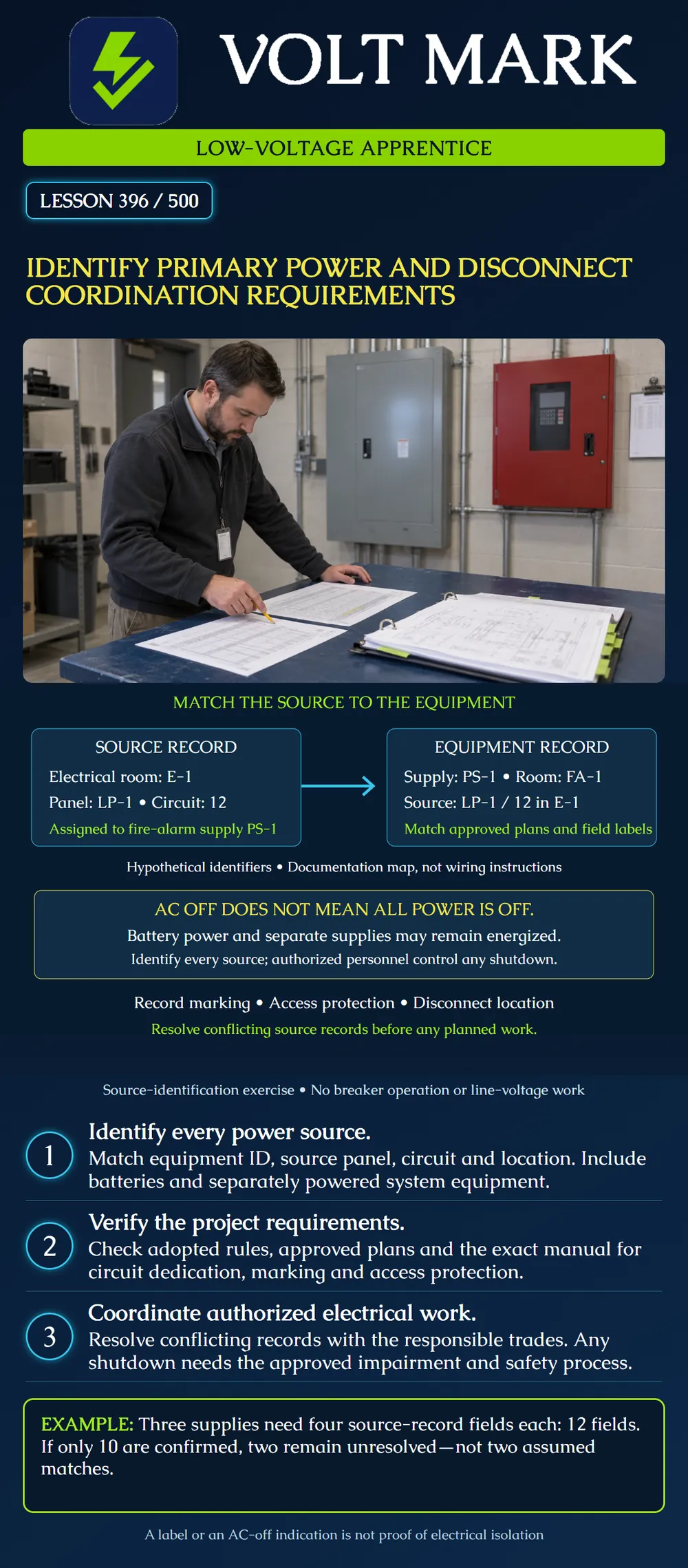
Build a reliable power-source record for fire-alarm equipment and recognize what must be coordinated with the responsible electrical contractor, fire-alarm specialist and project authority. This is a documentation lesson at the low-voltage interface. It does not qualify an apprentice to install mains wiring, open electrical enclosures, operate a breaker or disconnect batteries.
A fire-alarm installation can contain a control unit, remote notification supplies, voice equipment and other separately powered equipment. Knowing where the main control unit gets power does not identify every source in the system. A record should connect each equipment identifier to its source and location. The poster illustrates that relationship without showing terminals or prescribing an electrical installation.
Use the approved drawings, equipment schedule, applicable code editions and local amendments, and the exact manufacturer's instructions. Identify the equipment model and manual revision. Record which document establishes each requirement. Requirements concerning dedicated circuits, identification, disconnect arrangements and protection against unauthorized interruption must be resolved for the particular installation; a photograph of another job is not the design basis.
Manufacturer example: Altronix's AL602ULADA installation guide, revision 111519, page 4, specifies a separate unswitched 120 VAC, 60 Hz circuit dedicated to the fire-alarm system. The guide calls for qualified service personnel and conformance to applicable local codes. This is evidence about that product, not a universal input-voltage specification or a breaker-size instruction.
Jurisdiction example: Rhode Island's published Life Safety Code, added section 9.6.10.9, addresses dedicated primary-power/charger circuits, red identification, authorized access and fire-alarm identification. It specifies a listed breaker lock when the disconnect is a breaker in a distribution panel and permanent disconnect-location identification inside the control unit. This is an example of explicit jurisdictional requirements. Do not copy it into a nationwide checklist as though every state has adopted identical wording. Verify the applicable edition, amendments, installation scope and authority requirements.
For this original classroom exercise, source panel LP-1 is in electrical room E-1. Circuit 12 is assigned to supply PS-1 in room FA-1. The source record names PS-1, and the equipment record identifies LP-1 / 12 in E-1. These invented names are not field directions or required naming conventions.
A usable record includes the served equipment, source panel and circuit identifier, physical source location, and verification evidence. Also retain applicable input rating, approved identification wording, access/protection arrangement, other power sources, responsible trade and drawing reference. Use the project's approved schedule format. Do not invent a missing circuit number from the nearest label.
Suppose the drawing says LP-1 / 12 but the equipment record says LP-2 / 12. Even though both entries contain a circuit number, the evidence conflicts. Record the discrepancy and send it through the project's resolution process. Do not choose the more convenient answer. No live tracing, breaker trial, enclosure opening or interruption is part of this desk exercise.
Visible observations made within an authorized scope can support a record, but they do not prove circuit routing, conductor condition or electrical isolation. A qualified person's verified record should identify the verifier, date and evidence. Preserve earlier revisions so another worker can understand what changed and why.
Fire-Lite's ECC manual, LS10001-000FL-E:H dated January 8, 2018, installation precautions and operating-power section, warns that multiple power sources can be connected and that servicing requires attention to all sources. Its operating-power requirements are equipment-specific. An AC-off indication does not establish that batteries, external supplies or all affected circuits are de-energized.
In a planning meeting, identify which equipment the proposed work affects, who controls the electrical work, who controls fire-alarm impairment coordination, and who confirms restoration. Required notifications, protective arrangements, testing and restoration must follow the approved site process. This poster supplies no shutdown sequence and authorizes no impairment.
Keep the purpose of each device clear. A measure intended to prevent accidental interruption during normal operation is not evidence that equipment has been isolated for servicing. Electrical safety procedures and verification belong to appropriately qualified personnel under the applicable program. Do not remove or defeat access protection to investigate a questionable label.
Three hypothetical supplies each need four classroom fields:
Required field count: 3 × 4 = 12. Confirmed fields: PS-1 has 4, PS-2 has 3, PS-3 has 3. Total confirmed: 4 + 3 + 3 = 10. Unresolved fields: 12 − 10 = 2.
This count is an administrative completeness check only. Twelve populated fields can still contain an error, and additional project requirements remain. If PS-2 lacks its circuit identifier and PS-3 lacks its source location, identify both gaps separately. A copied answer is not confirmation.
Q1. Does a low-voltage output rating make the equipment's mains-input work low-voltage apprentice work?
Q2. May you assume every remote supply is disconnected with the main control unit?
Q3. Does an AC-fail indication prove the cabinet is electrically isolated?
Q4. Is the Rhode Island example a uniform rule for all 50 states?
Q5. What follows from 10 confirmed fields out of 12?
NFPA development proposals found in search were not treated as adopted code. Classroom identifiers and arithmetic are original. Manufacturer examples retain their product/revision limits. Source access does not establish this lesson's suitability for a specific installation.
Mistake: Assuming the main panel's source record covers every remote supply. Correction: Create a separate equipment-to-source record for each supply and reconcile both ends.
Mistake: Choosing between conflicting source-panel labels by proximity. Correction: Record both identifiers and obtain authorized verification instead of operating breakers to guess.
Mistake: Using an AC-fail display as evidence of electrical isolation. Correction: Identify batteries and other sources in the qualified person's energy-control plan; a display state does not resolve them.
Texas journeyman, 15 questions, scored by topic against the 70% mark. No card, and no account needed to start.
Free study material for low-voltage apprentices. This is a national foundation course: requirements differ by state and by local jurisdiction, and a practice that is common in one place is not a rule everywhere. Nothing here is a licence, a certification, or authority to work unsupervised, and completing it does not count as apprenticeship hours or continuing-education credit. Check the codes adopted where you are working, the licensing authority for that work, and your employer's safety programme. VoltMark is not affiliated with, endorsed by, or sponsored by NFPA, OSHA, NICET, BICSI, FOA, or any state or local licensing authority.

Electrician licensing exam prep: practice questions, timed exam simulations, and step-by-step help finding every answer in the NEC.