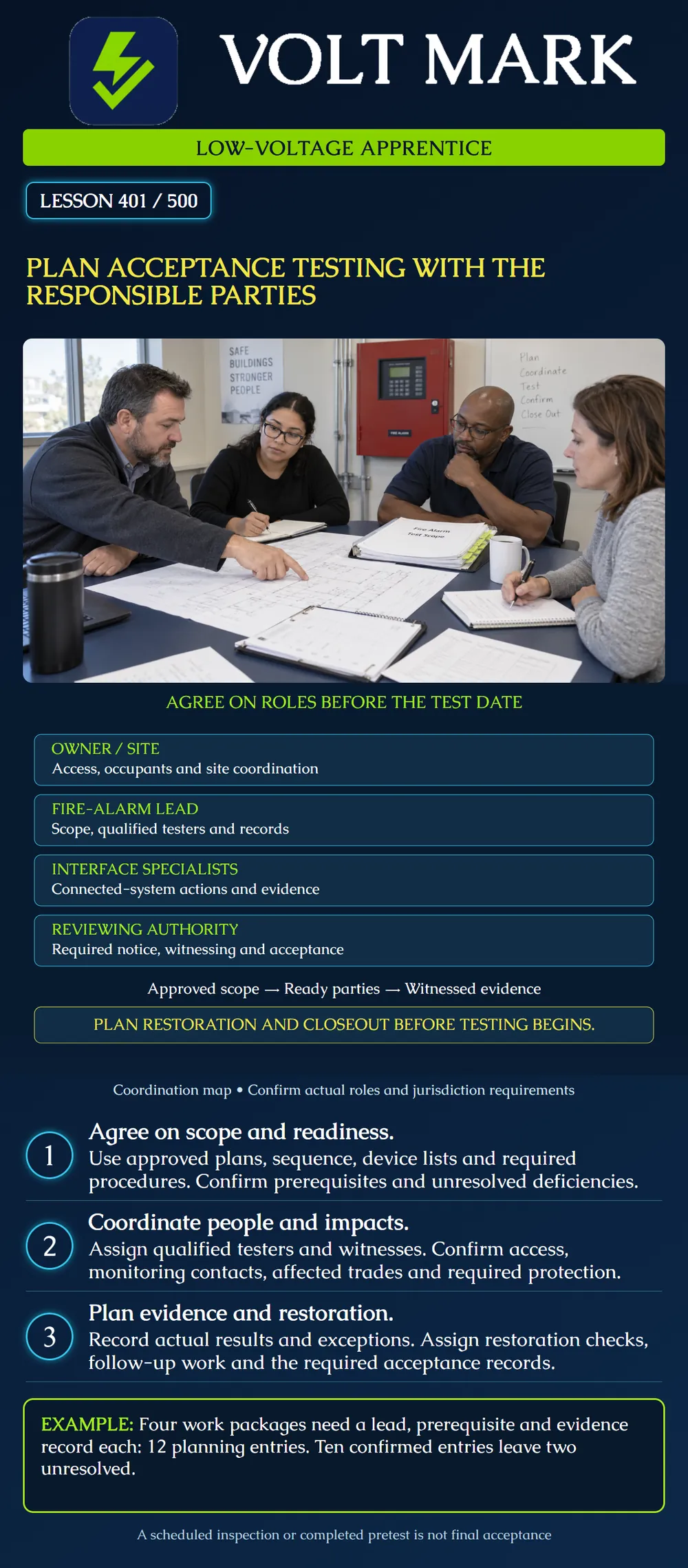
Prepare an acceptance-test coordination plan that identifies the scope, responsible people, prerequisites, evidence and closeout process. This is a planning exercise, not a procedure for activating a system or impairing protection.
A fire-alarm system can interact with monitoring, sprinklers, doors, elevators, mechanical systems and emergency communications. The fire-alarm technician may be able to verify an interface command while a specialist is needed to verify the connected system's actual action. A calendar invitation alone does not establish that the required people, equipment and evidence will be available.
Begin with the approved scope, drawings, device list, cause-and-effect matrix, manufacturer instructions and applicable acceptance requirements. Establish the exact revision being tested. Identify what is new, what is modified and which connected functions require coordination. Document exclusions and obtain the responsible decision about them rather than silently omitting difficult items.
Rhode Island's published Life Safety Code, added sections 9.6.11.1–9.6.11.3, specifies participants for pre-acceptance and final testing and documentation for the owner and authority. It distinguishes pretesting from final acceptance. This is a jurisdiction-specific example, not an assertion that every county requires the same attendance or forms.
The Fire-Lite ES-200X manual, LS10131-000FL-E:F, May 23, 2022, includes reacceptance precautions after changes and a monitoring-notification instruction in its operating sheet. Those provisions illustrate why the plan must consider the actual work and connected services. Use the installed product's instructions and applicable approved procedure; this lesson does not reproduce a live-test sequence.
Owner or designated site representative: coordinate access, occupancy impacts, operational constraints and site contacts. Identify who is authorized to make site decisions. The owner representative is not automatically qualified to test every technical interface.
Fire-alarm lead: coordinate the defined test scope, qualified personnel, current documents, required equipment and result records. Confirm readiness and unresolved deficiencies before requesting the required inspection or witnessing.
Interface specialists: identify the appropriate parties for each connected function. Examples may include elevator, sprinkler, mechanical, door-control or monitoring specialists, depending on scope. Document where one party's responsibility ends and another's begins.
Reviewing authority and required witnesses: confirm the applicable notification, scheduling, witnessing and acceptance arrangements. A witness requirement must come from the project and applicable authority, not from a generic poster. Identify any designer, manufacturer representative or other required participant separately.
For each planned group of checks, identify:
Do not treat an output command as proof that a connected device performed its required function. The plan should say what evidence demonstrates the required result, who obtains it and how it is associated with the tested condition.
A fictional project groups its coordination work into four packages:
For this desk exercise, each package needs three planning entries: a named responsible lead, a prerequisite record and an evidence-record reference. The deliberately simplified checklist is not the full testing scope.
Required entries: 4 packages × 3 entries = 12. Confirmed entries: A has 3, B has 3, C has 2, D has 2. Total confirmed: 3 + 3 + 2 + 2 = 10. Unresolved entries: 12 − 10 = 2.
Suppose C lacks the interface specialist's readiness confirmation and D lacks an agreed evidence-record reference. Record both gaps explicitly. A statement that the plan is “mostly complete” does not resolve them. The exercise counts planning entries, not tested devices or accepted systems.
Confirm required installation completion and pretest records, approved documents, device inventories and access arrangements. Identify outstanding deficiencies and how they affect readiness. Confirm whether the required inspection or witness appointment has actually been accepted, rather than assuming a request is a booking.
A pretest record should describe what was performed and any exceptions. It should not claim that an authority witnessed work that the authority did not attend. Similarly, a plan should not mark future observations as passed. Keep planned, performed, corrected, retested and accepted statuses distinct.
Identify required contacts for occupants, site management, monitoring and affected services. Assign who provides notices and records acknowledgments under the approved process. A sent message is not necessarily confirmation that the intended party received and acted on it.
Any impairment or temporary protective arrangement must follow the applicable authorized process. Do not assume that placing a monitoring account on test, silencing notification or disabling an output are interchangeable actions. This planning lesson authorizes none of them. Lesson 402 addresses impairment coordination in more detail.
Agree in advance how the team handles an unexpected actual alarm, loss of communications, unsafe condition or unplanned equipment response. The site emergency procedure remains controlling; participants must not dismiss a real event simply because testing was scheduled.
Name the party responsible for verifying normal service and documenting all affected functions after the authorized work. Include required communication with the site and monitoring contacts, records of unresolved conditions, corrective actions and any follow-up testing. Do not assume the task ends when the last test signal is generated.
A normal panel display alone does not show that every external system, reporting arrangement or temporary measure has returned to its required condition. Restoration evidence should match the scope actually affected.
Q1. Is a scheduled inspection final acceptance?
Q2. Who verifies the actual action of a connected system?
Q3. How many planning entries remain unresolved in the example?
Q4. May expected results be copied into the observed-results column before testing?
Q5. When should restoration responsibilities be decided?
Rhode Island Department of State, RI Life Safety Code, added9.6.11.1–9.6.11.3: https://rules.sos.ri.gov/regulations/part/450-00-00-8 Fire-Lite ES-200X Series Manual, LS10131-000FL-E:F, installation precautions and operating instructions: https://prod-edam.honeywell.com/content/dam/honeywell-edam/hbt/en-us/documents/manuals-and-guides/installation-guides/ba-fire-ES-200X-Manual-LS10131-000FL-E-F.pdf
Seattle pages were found in search but returned403 when opened; they were not used to impose local rules. NFPA development materials found in search were not treated as adopted requirements. Role assignments and the planning exercise are original educational guidance.
Mistake: Treating a requested inspection date as confirmation that all required witnesses will attend. Correction: Track the accepted appointment and each specialist's readiness separately from the request.
Mistake: Planning to verify a connected system only at the fire-alarm output. Correction: Assign the qualified observer and evidence for the actual connected-equipment response.
Mistake: Waiting until the end of testing to decide who restores interfaces. Correction: Assign restoration owners and their required evidence in each work package before the test.
Texas journeyman, 15 questions, scored by topic against the 70% mark. No card, and no account needed to start.
Free study material for low-voltage apprentices. This is a national foundation course: requirements differ by state and by local jurisdiction, and a practice that is common in one place is not a rule everywhere. Nothing here is a licence, a certification, or authority to work unsupervised, and completing it does not count as apprenticeship hours or continuing-education credit. Check the codes adopted where you are working, the licensing authority for that work, and your employer's safety programme. VoltMark is not affiliated with, endorsed by, or sponsored by NFPA, OSHA, NICET, BICSI, FOA, or any state or local licensing authority.

Electrician licensing exam prep: practice questions, timed exam simulations, and step-by-step help finding every answer in the NEC.