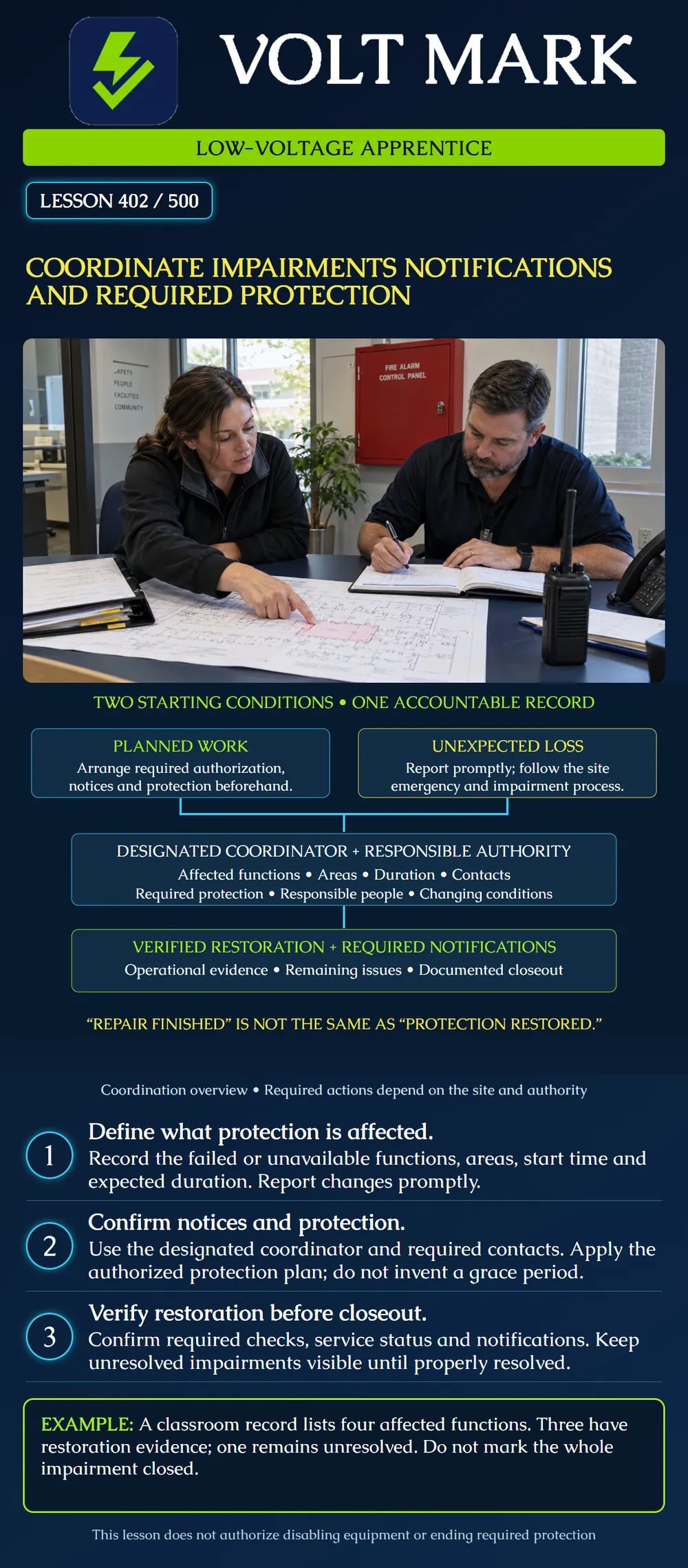
Recognize the difference between planned work and an unexpected loss of protection, assemble an impairment coordination record, and distinguish repair completion from verified restoration. No live system is operated or disabled in this lesson. WHAT IS AFFECTED? An impairment can involve part of a system rather than an entirely dark control panel. Detection, occupant notification, signal transmission or a connected function may be unavailable while other functions remain. Record the actual affected equipment, areas and capabilities rather than using only “alarm down.” Do not diagnose an unfamiliar indication by guesswork or silence it simply to remove the symptom. Report the observed condition, location and time through the site process. If there is an actual emergency, follow the emergency action plan; scheduled work or a suspected fault is not a reason to dismiss evidence of fire.
Eugene and Springfield's published impairment process identifies owner/coordinator responsibilities, planned and emergency impairments, required notices, protective measures directed by the fire code official, and restoration checks and notices. Its specific deadlines, contact channels and tagging details are local requirements. This national lesson does not export them to every jurisdiction.
OSHA 29 CFR1910.165(c)(2) addresses prompt restoration of covered employee alarm systems after tests or alarms. Paragraph(d)(3) addresses backup means of alarm while such systems are out of service, and(d)(5) addresses trained service/testing personnel. Its scope is employee alarm systems; it is not a complete fire-code impairment program or an automatic authorization for any particular backup arrangement.
NIST's impairment-program page explains that defined responsibilities are needed because loss of fire/life-safety functions increases risk. That program applies to its facilities. Its organizational titles and processes are not universal county requirements.
For planned work, the designated coordinator and responsible parties establish the affected scope, anticipated period, required authorization, notices and temporary protection before the work begins. Identify who is qualified and authorized to perform the work. A technician's access credential or a scheduled appointment does not itself approve an impairment.
Use the applicable adopted requirements and site procedure to identify the necessary contacts. These may include site management, affected occupants, the fire department or fire code official, monitoring service, insurer and interface specialists as applicable. Record who is responsible for each notification and any required confirmation.
An unplanned failure requires prompt reporting and the site's emergency/impairment response. Do not wait for the next convenient maintenance window or assume that a short expected repair creates an exemption. Record what is known and distinguish estimates from verified facts.
If the extent of the failure is uncertain, say so. Update the coordinator as evidence changes. Avoid expanding the affected scope through unauthorized troubleshooting. The responsible parties determine the applicable protection and work arrangements.
Depending on the governing requirements and circumstances, measures can include an approved fire watch, evacuation, restrictions or other authorized arrangements. The apprentice does not choose among these based on convenience. Do not assume that having someone nearby, carrying a phone or notifying monitoring automatically satisfies all requirements.
A required fire watch is an assigned protective duty with defined personnel, coverage, communication and records. Obtain the actual instructions from the responsible authority/site process. This lesson specifies no universal patrol interval, hours-before-action threshold or staffing ratio.
Temporary arrangements do not make the original impairment disappear. Track the affected functions until appropriate restoration is verified. A monitoring account's administrative status, a silenced output and a disabled device are different conditions; record what actually applies.
Use the approved site format. A useful record identifies:
An estimate that work will finish at noon is not an authorization to continue indefinitely. Escalate changes through the applicable process. Preserve the history rather than replacing the original estimate as though it was always correct.
A fictional record lists four affected functions: detection in Area A, notification in Area A, off-site reporting, and one documented interface function. After repair, evidence is available for three of the four. The off-site-reporting verification remains unresolved.
Four required function records minus three verified records equals one unresolved record. This is an administrative exercise, not a test result from a real system.
Do not mark the entire impairment closed because the contractor finished replacing a component. Clearly identify the unresolved function and maintain the required coordination and protection until the responsible process resolves it. Do not claim the other three checks demonstrate the fourth.
Qualified responsible personnel perform the required checks and document what is operational. Confirm affected functions, applicable monitoring/service status and any connected-system conditions. A normal panel display alone cannot substantiate every item in a restoration record.
Required restoration notifications, removal of impairment indications or tags, and termination of temporary protection occur through the authorized process. Do not end a protective arrangement merely because a scheduled time has elapsed. Record remaining deficiencies separately and ensure they are not hidden by a general “complete” status.
Create a fictional record with one planned notification, one confirmed notice, one protection requirement and one unresolved restoration item. Explain why each has a different status. No phone calls, notices, account changes, disablements or tests are part of this exercise.
Q1. Can one impaired function matter while the rest of the panel appears normal?
Q2. Does a short estimated repair time create a universal grace period?
Q3. Does a monitoring notice authorize every system change?
Q4. In the example, how many restoration items remain unresolved?
Q5. Is component replacement proof of complete restoration?
Eugene/Springfield, Impairment Notification: https://www.eugene-or.gov/5090/Impairment-Notification OSHA,29 CFR1910.165: https://www.osha.gov/laws-regs/regulations/standardnumber/1910/1910.165 NIST, Impairment of Fire Protection and Life Safety Systems Program: https://www.nist.gov/oshe/safety-programs/impairment-fire-protection-and-life-safety-systems-program
All three primary pages opened. No local deadline or fire-watch threshold is presented as nationwide. Diagram and restoration exercise are original educational examples.
Mistake: Describing a partial reporting failure only as 'alarm down'. Correction: Identify the affected function, area and remaining capabilities in the impairment record.
Mistake: Assuming a short repair estimate removes the need for required protection. Correction: Refer the actual impairment to the designated coordinator and follow the applicable protection decision.
Mistake: Closing the impairment when the component has been replaced. Correction: Reconcile verification for every affected function, including off-site reporting, before authorized closeout.
Texas journeyman, 15 questions, scored by topic against the 70% mark. No card, and no account needed to start.
Free study material for low-voltage apprentices. This is a national foundation course: requirements differ by state and by local jurisdiction, and a practice that is common in one place is not a rule everywhere. Nothing here is a licence, a certification, or authority to work unsupervised, and completing it does not count as apprenticeship hours or continuing-education credit. Check the codes adopted where you are working, the licensing authority for that work, and your employer's safety programme. VoltMark is not affiliated with, endorsed by, or sponsored by NFPA, OSHA, NICET, BICSI, FOA, or any state or local licensing authority.
Electrician licensing exam prep: practice questions, timed exam simulations, and step-by-step help finding every answer in the NEC.