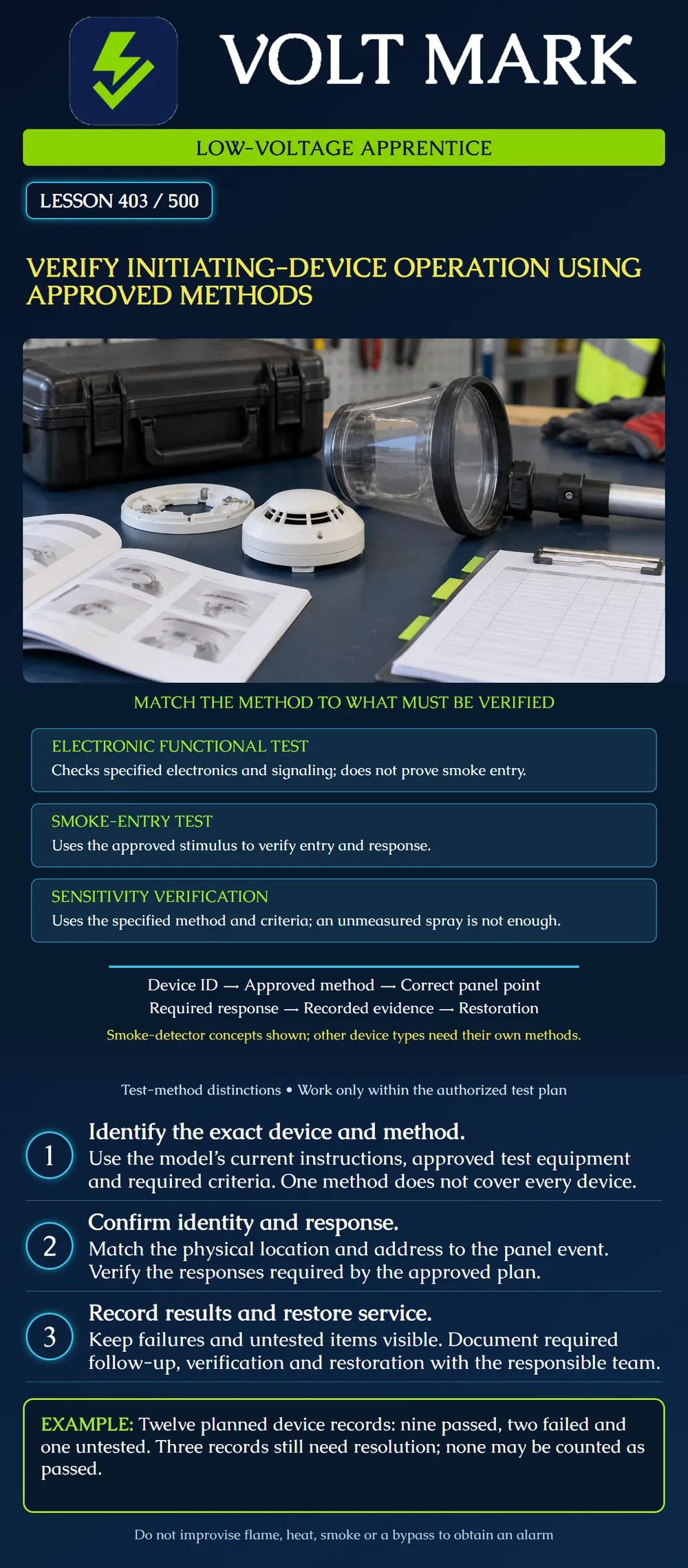
Distinguish the purpose of an initiating-device test, identify the correct device and expected response, and prepare an accurate evidence record under an authorized test plan. This lesson explains verification logic; it does not direct a live alarm activation.
Confirm the equipment model, physical location, address, device type and drawing reference. The method must match the actual product and application. A spot smoke detector, duct detector, heat detector, manual station and monitored switch do not all have the same test method or acceptance criteria.
Use the applicable current manufacturer instructions, approved test plan and governing requirements. Identify the required test equipment and stimulus. Record the instruction revision. If the device or permitted method cannot be confirmed, treat that as an unresolved preparation item rather than improvising a test.
An electronic functional test asks whether specified electronic functions and signaling respond. A smoke-entry test asks whether the approved stimulus enters the detector and produces the required response. Sensitivity verification asks whether the detector's sensitivity meets the specified criteria using the appropriate method. These questions overlap in purpose but are not interchangeable.
Manufacturer example: Fire-Lite's SD365/SD365-IV instruction I56-6523-001 describes a magnet test as an electronic simulation and separately discusses smoke entry and panel-provided sensitivity readings. The copy opened is dated September23,2019 and marked Preliminary. It supports this conceptual distinction; it must not be substituted for the current approved instructions for an installed device. The poster does not specify magnet placement, aerosol product or application duration.
System Sensor's System Smoke Detectors Application Guide explains that an unmeasured aerosol concentration does not establish detector sensitivity. Its discussion distinguishes smoke-entry response from sensitivity measurement. Use the appropriate supported method and criteria; a quick spray that produces an alarm is not a numerical sensitivity result.
The responsible team establishes required notices, site access, coordination with monitoring and affected systems, protective arrangements, qualified personnel and restoration duties. Refer to lessons401–402 for planning and impairment coordination. Do not assume that a training exercise or a planned inspection grants permission to operate a real system.
Confirm what responses the test plan intends to observe. A controlled test mode may change output behavior. If the method checks an initiating point but does not exercise every downstream function, record that scope honestly. Do not count unobserved outputs or remote reporting as verified merely because the panel displayed an event.
The physical device being tested must correspond to the displayed or logged point. Compare address, location description and event classification with the approved record. A response from another location is a discrepancy, even if the system sounded an alarm.
Keep device indication, panel response, required interface actions and remote reporting evidence distinct. A local LED alone does not establish correct point mapping or all intended system functions. A panel event alone does not establish that every notification or control action occurred.
Use the actual procedure's acceptance criteria for timing and response. This lesson supplies no universal number of seconds. Different devices, applications and configured functions have different valid behavior; unexplained delays or mismatches require investigation through the responsible team.
For manual stations, identify the correct approved operating and restoration method for the model. For heat detectors, determine the element type and specified method before considering any stimulus. For monitored switches, identify the real monitored function and the approved way to verify it. Duct detection may require additional application-specific checks beyond testing the sensing head alone.
Do not transfer the smoke-detector diagram into a universal test recipe. Do not use open flame, improvised smoke, excessive heat or electrical shorts to force a response. Do not damage or replace a device's required testing process with a convenient bypass. The qualified tester follows the exact applicable instructions.
A useful record includes:
Separate “planned” from “performed.” Keep a failed result visible even if a later retest passes; link the corrective action and new evidence rather than rewriting the history. An inaccessible or untested device is not a passing device.
A fictional authorized plan lists12 device records. Nine show passing results with the assigned evidence, two show failed results, and one device was not tested.
9 + 2 + 1 = 12 planned records accounted for. 2 + 1 = 3 records still need resolution. Nine passed does not mean the entire scope passed.
The failed devices need the responsible corrective/retest process. The untested item needs a documented reason and an authorized plan for resolution. It must not be changed to “pass” because another similar device responded. This count says nothing about the adequacy of the original scope or the actual performance of any real installation.
The responsible team verifies required restoration, including any affected functions and notifications under the approved process. A test that produces the expected event is not complete closeout if the system remains in an unintended mode or an affected service is unresolved.
Record which functions were verified and what remains open. Continue required coordination and protective measures until their termination is authorized. This lesson performs no tests and claims no restoration.
Q1. Does an electronic simulation prove smoke entered a chamber?
Q2. Does an unmeasured aerosol alarm response establish sensitivity?
Q3. What if the wrong point appears on the panel?
Q4. How many example records remain unresolved?
Q5. Can one smoke-detector method be used for all initiating devices?
Fire-Lite SD365/SD365-IV instructions,I56-6523-001,September23,2019,copy marked Preliminary: https://prod-edam.honeywell.com/content/dam/honeywell-edam/hbt/en-us/documents/manuals-and-guides/user-manuals/I56-6523.pdf?download=false System Sensor, System Smoke Detectors Application Guide, testing/sensitivity discussion: https://buildings.honeywell.com/content/dam/hbtbt/en/documents/document-lists/system-sensor/application-guide/System-Smoke-Detectors-AppGuide-SPAG91.pdf
Both manufacturer sources opened. The dated preliminary copy is disclosed and used only for conceptual distinctions. The diagram, record example and arithmetic are original. No obsolete consumable list, numerical sensitivity threshold or universal test interval is prescribed.
Mistake: Reporting an electronic simulation as proof of smoke entry. Correction: State the actual method and record smoke-entry evidence separately when required.
Mistake: Calling an unmeasured aerosol response a sensitivity measurement. Correction: Use the supported sensitivity method and criteria; an alarm response alone supplies no measured sensitivity.
Mistake: Marking an inaccessible device passed because nearby devices passed. Correction: Retain its not-tested status and assign the missing verification through the approved plan.
Texas journeyman, 15 questions, scored by topic against the 70% mark. No card, and no account needed to start.
Free study material for low-voltage apprentices. This is a national foundation course: requirements differ by state and by local jurisdiction, and a practice that is common in one place is not a rule everywhere. Nothing here is a licence, a certification, or authority to work unsupervised, and completing it does not count as apprenticeship hours or continuing-education credit. Check the codes adopted where you are working, the licensing authority for that work, and your employer's safety programme. VoltMark is not affiliated with, endorsed by, or sponsored by NFPA, OSHA, NICET, BICSI, FOA, or any state or local licensing authority.

Electrician licensing exam prep: practice questions, timed exam simulations, and step-by-step help finding every answer in the NEC.