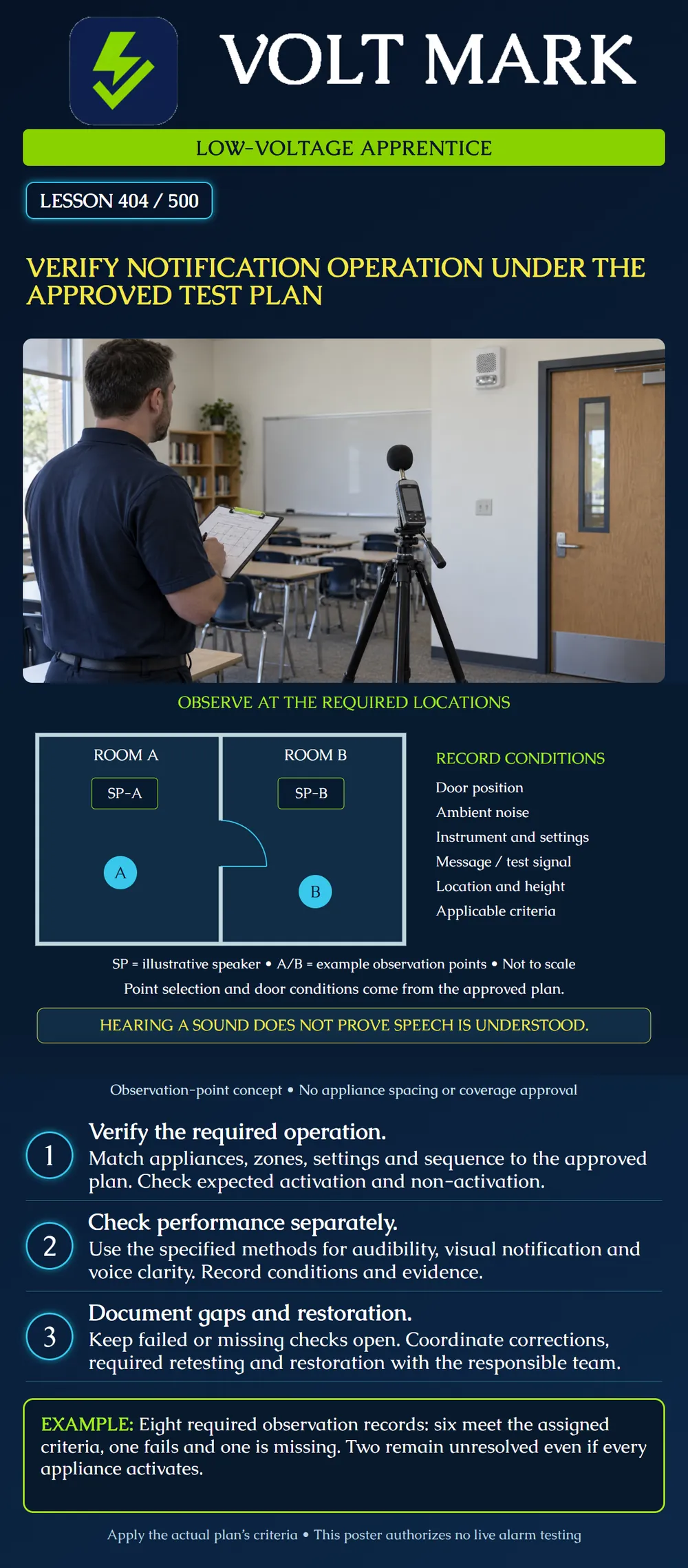
Separate notification-appliance operation from required performance verification. Prepare records that connect the approved sequence, actual appliance settings, observation locations and evidence. No alarm is activated in this lesson.
A horn sounding, speaker producing audio or strobe flashing demonstrates an observed action. It does not by itself prove the required performance throughout the intended area. Correct activation, correct zone selection and acceptable notification performance are related but distinct checks.
Review the approved notification plan, device schedule, circuit assignments, cause-and-effect matrix and applicable equipment instructions. Identify the exact appliance models, selected settings and required behavior. A setting shown on a drawing must agree with the installed configuration and the calculations; do not quietly change it to improve a test result.
System Sensor's Voice Evacuation Systems Applications Guide distinguishes audibility from intelligibility and discusses acoustics, ambient noise and intelligibility measurement. Its testing discussion links observations to occupant locations and the chosen signal path. Use the project's applicable criteria and test method; the guide is not a substitute for adopted requirements.
The manufacturer's AV Appliance Applications Guide discusses audible and visible notification and how appliance ratings and placement relate to their application. These are different performance questions. This lesson deliberately supplies no universal sound-level, candela, spacing or intelligibility threshold.
The poster shows two imaginary rooms, two speakers and example observation points A and B. It is not to scale. It is not a speaker layout recommendation and does not establish coverage. The door symbol identifies a condition that must be documented, not an instruction to hold the door open during testing.
For an actual test, the approved plan establishes the relevant locations, measurement heights, door states, environmental conditions and criteria. A favorable reading beside an appliance cannot automatically stand in for a required observation elsewhere. Similarly, a corridor observation cannot automatically stand in for a room observation.
Document the method, instrument identity, applicable calibration/verification information, measurement settings and locations. Record the ambient conditions required by the procedure and the notification result. Compare results with the actual criteria for the occupancy and application.
Do not make a compliance decision from “it sounded loud.” Do not replace missing measurements with a phone recording or an unqualified estimate. This lesson does not claim that any particular app or general-purpose microphone is suitable for the required measurement.
Confirm the required message, zone and signal path. A spoken message can be audible yet difficult to understand. Reverberation, competing sound and the path through the system can affect the result. Use the specified intelligibility-verification method in the required areas.
Record whether the test covers the intended live-microphone path, prerecorded-message path or another approved method. A result from one path must not be represented as proof of an untested path. Do not adjust speaker taps or amplifier levels without the responsible approval and review of related load and performance requirements.
Record the appliance model, approved setting, location and installation conditions against the plan. Check operation and required synchronization under the applicable approved method. A person seeing one flash from one point does not establish all coverage requirements.
Keep observed activation separate from evidence supporting layout and settings. Do not use a phone video's apparent flash timing as unquestioned proof; a recording method may introduce its own artifacts. Use the prescribed observation or test method and document what was actually verified.
Use the approved matrix to identify expected active and inactive areas for the tested condition. Include applicable behavior under silence, reset, subsequent events and other required states through the authorized test plan. Do not assume every visual and audible appliance must behave identically.
If an appliance activates in a zone that should remain inactive, record it as a discrepancy. If an expected appliance does not activate, do the same. Avoid treating widespread activation as automatically correct. Test mode settings may limit which functions are exercised; document those limitations.
The fictional plan requires eight observation records. Six meet the assigned criteria with evidence. One fails, and one has no observation. All appliance indicators were reported active.
Six passing records plus one failed record plus one missing record account for eight required records. One failed plus one missing equals two unresolved records.
The appliance activation report does not convert either unresolved record to a pass. Identify the failed location, its observed result and the applicable criterion. Identify why the missing observation was not obtained and who will resolve it. No real test results are represented here.
Include the plan revision, circuit or zone, appliance/location identifier, selected settings, expected behavior, method and instrument information. Record the actual result, relevant environmental conditions, observer, date and evidence reference.
For deficiencies, preserve the original observation and link any corrective work and retest. Changes to settings or layout may affect calculations, compatibility, synchronization or performance elsewhere. The responsible team determines the required retest scope instead of checking only the most convenient point.
Notification testing can affect occupants and connected services. Follow the authorized coordination, notification and protection process before actual work. Required hearing protection and site controls belong in that plan. Do not activate or disable equipment merely to complete this classroom exercise.
At closeout, the responsible team verifies restoration of affected functions and required notifications. Record remaining exceptions. A normal display is not a substitute for evidence that every required notification check was completed.
Q1. Does appliance activation prove coverage everywhere?
Q2. Can speech be audible but unclear?
Q3. Why record door and ambient conditions?
Q4. How many example records remain unresolved?
Q5. Does the diagram prescribe two speakers for every two-room space?
System Sensor, Voice Evacuation Systems Applications Guide, sections7–8: https://prod-edam.honeywell.com/content/dam/honeywell-edam/hbt/en-us/documents/manuals-and-guides/reference-guides/hbt-fire-VoiceEvacuationSystems_AppGuide_AVAG497.pdf System Sensor, AV Appliance Applications Guide: https://prod-edam.honeywell.com/content/dam/honeywell-edam/hbt/en-us/documents/manuals-and-guides/reference-guides/hbt-fire-AV_Appliance_AppGuide_AVAG266.pdf
Both manufacturer guides opened. Historic code tables and generalized numeric rules from the guides were not used as current nationwide requirements. The room diagram, record exercise and counts are original.
Mistake: Reporting all appliances active as proof of coverage. Correction: Match each required location and criterion to its performance evidence, retaining failed or missing observations.
Mistake: Using a loud message as proof of intelligibility. Correction: Apply the specified speech-verification method in the required listening areas and signal path.
Mistake: Reusing a favorable corridor reading for a room with a closed door. Correction: Record the actual observation point, door state and ambient conditions required by the test plan.
Texas journeyman, 15 questions, scored by topic against the 70% mark. No card, and no account needed to start.
Free study material for low-voltage apprentices. This is a national foundation course: requirements differ by state and by local jurisdiction, and a practice that is common in one place is not a rule everywhere. Nothing here is a licence, a certification, or authority to work unsupervised, and completing it does not count as apprenticeship hours or continuing-education credit. Check the codes adopted where you are working, the licensing authority for that work, and your employer's safety programme. VoltMark is not affiliated with, endorsed by, or sponsored by NFPA, OSHA, NICET, BICSI, FOA, or any state or local licensing authority.
Electrician licensing exam prep: practice questions, timed exam simulations, and step-by-step help finding every answer in the NEC.