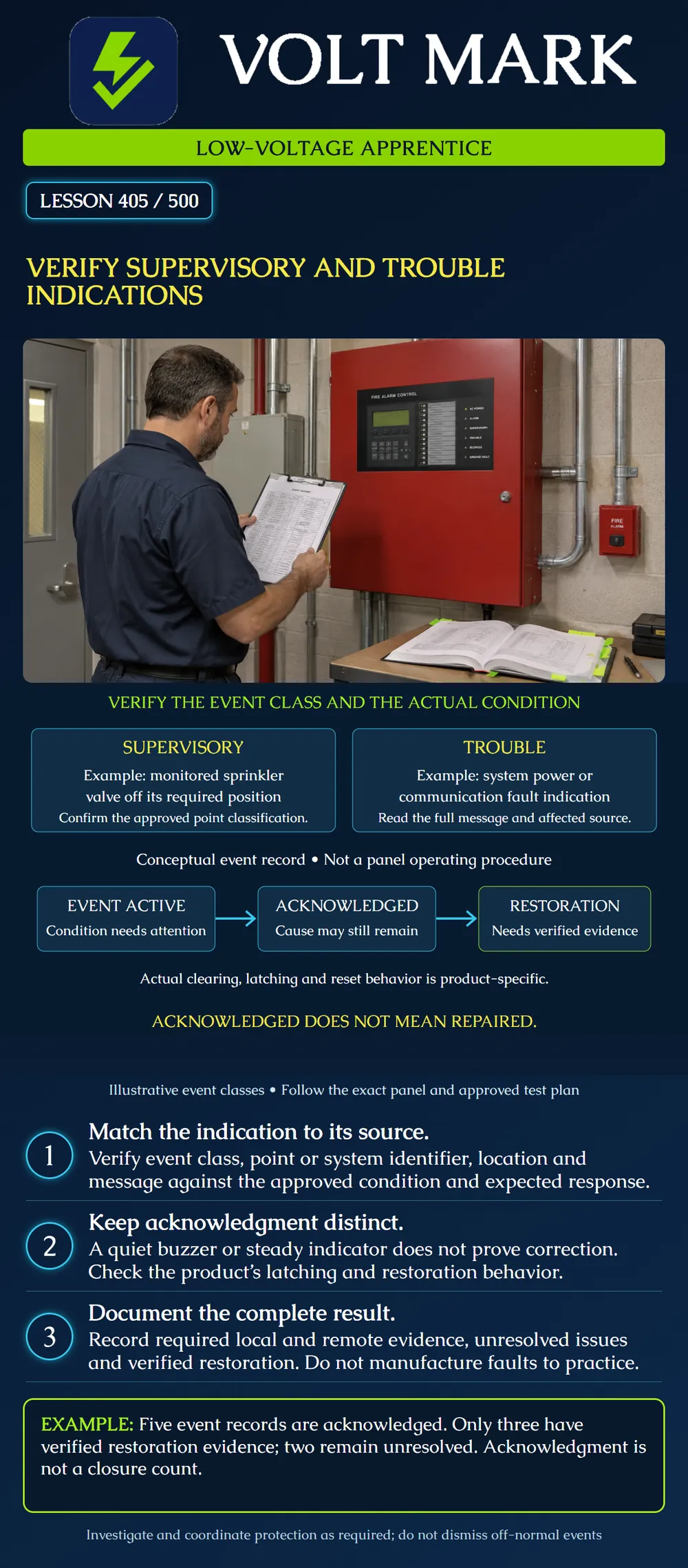
Distinguish supervisory and trouble indications, verify their identity and expected behavior under the approved plan, and separate acknowledgment from correction and restoration. This lesson is a record-reading exercise; it does not instruct you to create a fault or move a sprinkler valve.
A supervisory indication commonly concerns an off-normal condition in monitored fire-protection equipment that requires attention. A trouble indication concerns a fault or abnormal system condition requiring investigation. Neither category is interchangeable with a fire-alarm indication. The actual point classification, indication and required response depend on the approved design and equipment.
A generic statement such as “yellow light” loses essential information. Read the event class, point or system identifier, location, detailed message and time. Do not decide the cause from a color or buzzer pattern alone. Some events concern a system resource rather than an individually addressed field device.
Fire-Lite's ES-200X manual, LS10131-000FL-E:F, May23,2022, sections4.2,4.4 and4.7 distinguish supervisory and trouble indications, messages and reporting. Its examples include sprinkler-valve supervisory conditions and power/communication troubles. Acknowledgment can change audible/visual indications while the condition remains. The manual also distinguishes clearing and latching behavior; its programmed tamper and supervisory types do not all behave identically. These are product-specific examples, not universal panel operations.
Acknowledgment records or indicates that an operator has recognized an event. Depending on the product, it may silence a local sounder or change a flashing indication. It does not repair wiring, restore power, correct valve position or prove remote receipt.
The poster's active-to-acknowledged-to-restoration path is conceptual. It is not a mandatory button sequence, and some conditions can clear without acknowledgment. Latching, automatic restoration and reset requirements must be taken from the exact platform and configuration. Do not repeatedly reset equipment in an attempt to make an unresolved condition disappear.
A silenced condition and a restored condition should have distinct records. Preserve the evidence of the original event and any action taken by authorized personnel. A change in display behavior is not proof that the underlying defect has been corrected.
Before a real verification activity, confirm scope, notifications, affected systems, required protection, qualified personnel and restoration responsibilities. Use only the approved method for the intended condition. Do not disconnect conductors, remove batteries, short terminals or manipulate fire-protection equipment as an improvised training method.
Compare the observed event with the expected classification and identifier. Confirm required annunciation and associated actions under the approved sequence. Where remote reporting is required, obtain the appropriate separate evidence; a local history entry does not prove the receiving service recorded the correct message.
Keep the condition being evaluated clear. A supervisory input and a circuit fault on its wiring are different scenarios. They may involve the same physical device yet require different indications and evidence. The responsible test plan specifies the method and expected response for each applicable scenario.
A fictional log has five acknowledged events: S-1: restoration verified. T-1: restoration verified. S-2: restoration verified. T-2: restoration evidence unresolved. T-3: restoration evidence unresolved.
Acknowledged records:5. Verified restorations:3. Unresolved restorations:5−3=2.
All five acknowledgments can be correctly recorded while two conditions remain unresolved. Do not report “five cleared” based on the acknowledgment count. These identifiers are classroom record names, not manufacturer event codes or real installation results.
If a record is incomplete, state what evidence is missing. For T-2, for example, an authorized repair note may exist while required reporting/restoration evidence is absent. That is different from proving the fault is still physically present. Mark the status accurately without inventing either a pass or a diagnosis.
Retain the system and point identity, actual message, expected classification, method/procedure reference, relevant times and observed response. Include acknowledgment information separately from correction and restoration.
Record the responsible personnel, evidence references, unresolved issues and required follow-up. Link the restoration to the original event so another reviewer can tell which condition was resolved. Retain the original failed or discrepant observation when a later retest succeeds.
Supervisory and trouble do not mean “safe to ignore.” Assess the affected function through the responsible site process and apply required coordination or protection. If an actual emergency occurs, follow the emergency action plan rather than assuming every signal is part of testing.
The responsible team verifies required restoration and communications. Confirm applicable local and remote records and any remaining conditions. Do not close the entire scope because one message disappeared or the panel returned to a preferred screen.
Q1. Does acknowledgment prove a condition is repaired?
Q2. Is every supervisory event cleared in the same way?
Q3. Can a local event log prove remote receipt?
Q4. How many example records lack verified restoration evidence?
Q5. Should an apprentice create an improvised wiring fault to learn the indication?
Fire-Lite ES-200X Series Manual,LS10131-000FL-E:F,May23,2022; sections4.1–4.7 and monitor-module type table: https://prod-edam.honeywell.com/content/dam/honeywell-edam/hbt/en-us/documents/manuals-and-guides/installation-guides/ba-fire-ES-200X-Manual-LS10131-000FL-E-F.pdf
Product-specific lamp timing, reset sequences and report codes are not prescribed as national rules. The diagram and five-record example are original.
Mistake: Counting acknowledged events as cleared conditions. Correction: Link each original event to separate correction and restoration evidence.
Mistake: Diagnosing a failed component from a generic trouble light. Correction: Record the exact event class, message and identifier before qualified investigation.
Mistake: Treating a supervisory input and a fault on its wiring as the same test. Correction: Keep separate expected indications and procedures for the monitored condition and circuit fault.
Texas journeyman, 15 questions, scored by topic against the 70% mark. No card, and no account needed to start.
Free study material for low-voltage apprentices. This is a national foundation course: requirements differ by state and by local jurisdiction, and a practice that is common in one place is not a rule everywhere. Nothing here is a licence, a certification, or authority to work unsupervised, and completing it does not count as apprenticeship hours or continuing-education credit. Check the codes adopted where you are working, the licensing authority for that work, and your employer's safety programme. VoltMark is not affiliated with, endorsed by, or sponsored by NFPA, OSHA, NICET, BICSI, FOA, or any state or local licensing authority.

Electrician licensing exam prep: practice questions, timed exam simulations, and step-by-step help finding every answer in the NEC.