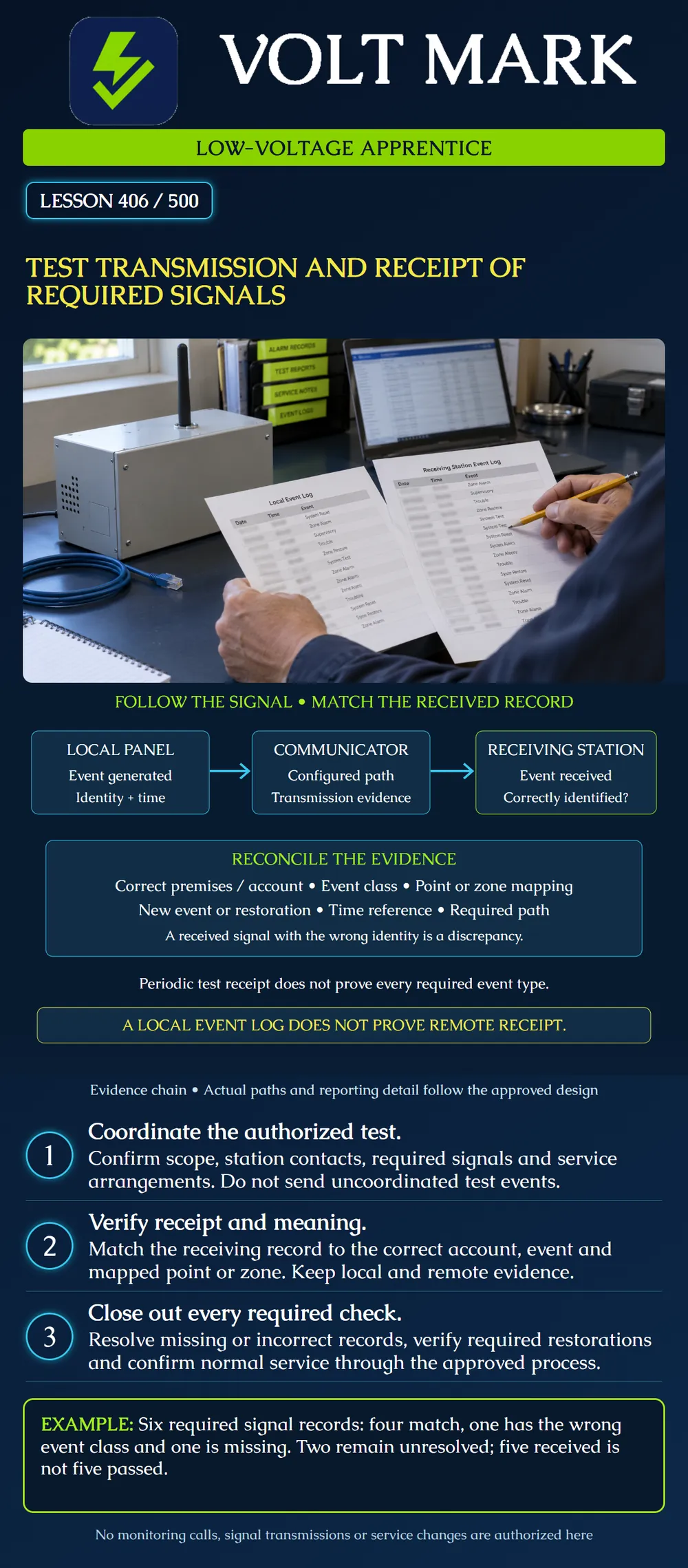
Prepare a coordinated signal-verification record that distinguishes local event generation, transmission evidence and correct receipt at the intended receiving station. This is a desk exercise; no real signal, call or account change is performed.
A local panel event shows that the panel recorded a condition. Communicator evidence concerns the reporting equipment and path. A receiving-station record establishes what the receiving side actually recorded. Do not substitute one claim for another.
The diagram is a simplified evidence chain. A real reporting arrangement may involve additional networks, services or receivers. Record the actual approved architecture and the path under evaluation. Do not assume the diagram represents every installed communications system.
Fire-Lite's ES-200X manual, LS10131-000FL-E:F, May23,2022, describes station-provided account information and separate communications options. AppendixF describes ContactID message fields, including account identity, event qualifier/code and group/point information. It also distinguishes test reports from other event categories. These product/protocol examples show why receipt must be checked for meaning, not merely counted. They do not establish a universal reporting format, test interval or permissible network configuration.
The responsible team establishes the approved test scope, required signals, qualified personnel and receiving-station coordination. Confirm the correct premises/account through the authorized process. Identify required notices, protections and restoration arrangements. Do not create an alarm simply to see whether someone calls.
Administrative test arrangements at a monitoring service are not proof that the local system is safe to operate or that every downstream action is inhibited. Conversely, a local test mode may not exercise all required reporting functions. Define exactly what the selected procedure covers.
Required signals can include alarm, supervisory, trouble, restoration and other messages as applicable. The approved design and requirements determine the scope. A periodic communications test report is one type of record; its receipt does not automatically verify every event class, point mapping or reporting path.
Compare the receiving record with the expected premises/account and event class. Confirm the required point, zone or group mapping for that reporting arrangement. The receiving text may not reproduce the panel's descriptor character for character, but it must correctly represent the approved mapping and available reporting detail.
Distinguish a new event from its restoration where applicable. Do not count a restoration record as the original alarm. Some report types have no corresponding restoration; use the actual protocol and configuration rather than inventing a restore message for every record.
Use stable identifiers and evidence references. Keep actual account data within the authorized project records rather than inserting it into public lesson material.
Record the local and receiving timestamps with their clock references or relevant offsets. A difference between two displayed times is not automatically transmission latency; the clocks may differ. Determine compliance with required timing through the approved measurement method and criteria.
If the plan requires verification of multiple paths or path-failure behavior, document each applicable check separately. Success on one path does not demonstrate another. Do not unplug network equipment, interrupt service or remove antennas to improvise a path test. Qualified personnel follow the approved method and coordination process.
A receiver acknowledgment may be useful transport evidence, but the complete verification record must also show that the correct event reached the intended account with the required meaning. Where downstream handling is part of the test scope, retain the required evidence for that handling separately. Receipt alone does not prove emergency dispatch or responder arrival.
A fictional plan requires six signal records, identified E1 through E6.
E5: a record was received, but its event class is incorrect. E6: no receiving record has been confirmed.
Received records:4+1=5. Correctly matched records:4. Unresolved records:1 incorrect+1 missing=2. Total planned records:4+1+1=6.
Reporting “five passed” because five messages arrived is wrong. The E5 mismatch needs investigation even though transport occurred. E6 needs evidence or a documented failure investigation; absence of an available record should not be replaced with a guessed pass.
For each discrepancy, state what was expected, what was observed and what remains unknown. Do not invent a cause such as “bad cellular service” from a missing record alone. The cause could involve identity, mapping, configuration, transport, retrieval or another issue requiring qualified investigation.
Include the plan revision, premises/account reference, local event identifier, expected event type, required mapping, path under evaluation, local evidence and receiving evidence. Record relevant times, responsible personnel and disposition.
A useful result field distinguishes passed, failed, not performed and evidence unresolved. Preserve the original discrepancy when corrective work and a later retest occur. Link the new result instead of overwriting history.
The team verifies required restoration messages and normal service arrangements under the approved process. Confirm that any authorized administrative test status or temporary arrangement has been resolved as required. Record remaining conditions and communicate them to the responsible parties.
An elapsed test window is not by itself evidence of verified closeout. A normal local display does not prove station-side records or service status. Use the actual required confirmations.
Create six fictional rows using the E1–E6 example. Give each row an expected class, local evidence reference, receiving evidence reference and result. Mark the incorrect and missing items explicitly. Do not contact a station or use live credentials to complete this exercise.
Q1. Does a local event log prove remote receipt?
Q2. Does a periodic test report verify every alarm and supervisory mapping?
Q3. How many example records passed the identity/event comparison?
Q4. Why is the incorrectly classified received message unresolved?
Q5. Does success on one path prove all paths?
Fire-Lite ES-200X Series Manual,LS10131-000FL-E:F,May23,2022; communications configuration and AppendixF: https://prod-edam.honeywell.com/content/dam/honeywell-edam/hbt/en-us/documents/manuals-and-guides/installation-guides/ba-fire-ES-200X-Manual-LS10131-000FL-E-F.pdf
Historic communications intervals and network requirements were not generalized as current nationwide rules. The evidence diagram and six-record example are original.
Mistake: Calling a local panel log proof of remote receipt. Correction: Obtain receiving-side evidence for the intended account and required event mapping.
Mistake: Passing every received message regardless of its event class. Correction: Match identity, event qualifier and required point detail before recording a successful comparison.
Mistake: Calling a difference between unsynchronized timestamps transmission delay. Correction: Record clock references and offsets, then use the approved timing method.
Texas journeyman, 15 questions, scored by topic against the 70% mark. No card, and no account needed to start.
Free study material for low-voltage apprentices. This is a national foundation course: requirements differ by state and by local jurisdiction, and a practice that is common in one place is not a rule everywhere. Nothing here is a licence, a certification, or authority to work unsupervised, and completing it does not count as apprenticeship hours or continuing-education credit. Check the codes adopted where you are working, the licensing authority for that work, and your employer's safety programme. VoltMark is not affiliated with, endorsed by, or sponsored by NFPA, OSHA, NICET, BICSI, FOA, or any state or local licensing authority.

Electrician licensing exam prep: practice questions, timed exam simulations, and step-by-step help finding every answer in the NEC.