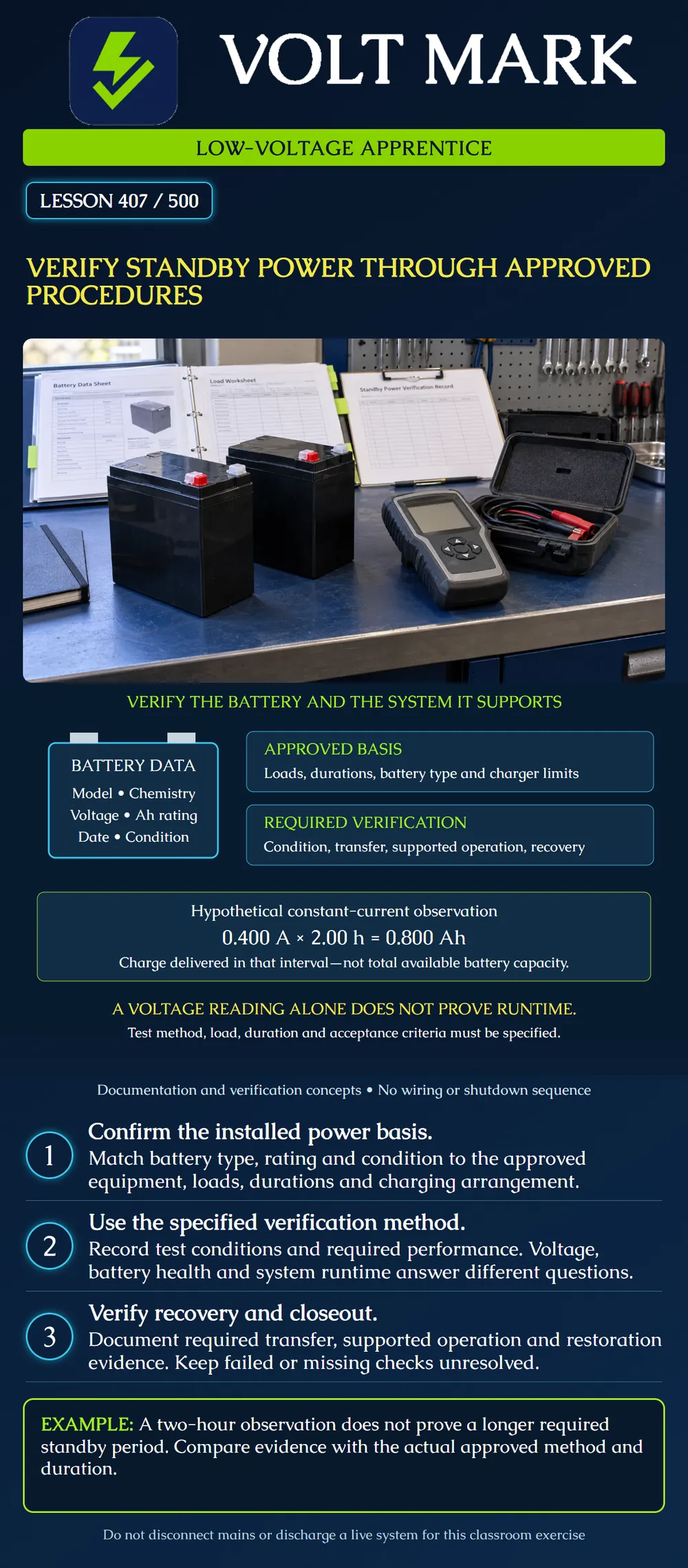
Distinguish a battery rating, a calculation, a condition measurement and evidence that a fire-alarm system meets its standby-power requirements. Prepare a traceable verification record under an approved procedure. This lesson contains no mains-disconnection or battery-discharge instructions.
Identify every power supply within the verification scope and the equipment it supports. A remote notification supply may have its own batteries and charger. Evidence from the main control unit does not automatically cover every remote supply.
Match the installed battery model, chemistry, nominal voltage and capacity with the approved equipment arrangement and current calculation. Record manufacture/service information where available, the source identifier and relevant environmental conditions. Confirm the applicable standby and alarm loads, required durations, allowances and charger limits. Do not assume that an enclosure's physical space establishes compatibility.
The PowerStrike Series Manual,LS10227-005GE-E:D,August3,2023,sections6–7, separates power/battery calculations from testing and maintenance and addresses compatible battery arrangements and charging. Its product-specific ratings, replacement provisions and durations are not universal rules for all supplies.
Power-Sonic's PS-12700 product page publishes capacity values under specified discharge conditions. This illustrates that an Ah rating is tied to conditions; it is not a promise of the same result at every load. The requested PS-1270 URL redirected to PS-12700, and no claim about a7Ah PS-1270 was taken from that redirected page. This source does not establish that PS-12700 is approved for any fire-alarm equipment.
GS Yuasa's industrial tester description distinguishes voltage and conductance measurements for battery-health assessment. Such a product description does not prove that a particular tester or result satisfies a particular project's required capacity or system-performance test.
Keep these records connected but distinct. A favorable result in one category does not fill every other category. A battery can have an apparently plausible voltage while other required evidence is missing. Do not convert a screening result into an unsupported statement that full standby capacity is verified.
The responsible qualified personnel select and perform the procedure required by the equipment instructions, applicable standards and approved plan. The plan must define the load, duration, initial conditions, measurement method, acceptance criteria and restoration requirements. This lesson gives no universal cutoff voltage, test time or replacement interval.
Record the test instrument and appropriate verification/calibration information, battery identity, observed values and conditions. Identify whether a result is a voltage reading, conductance-based assessment, capacity result or system-operating observation. Do not describe these different quantities with a vague “battery good” entry.
Do not substitute a full uncontrolled discharge for an approved test. Batteries can deliver substantial fault current, and the surrounding equipment may contain mains voltage. Any isolation, testing and restoration must remain within the authorized procedure and personnel's qualifications.
A supplied fictional record says a constant0.400A was delivered for2.00hours:
Charge delivered = current × time. 0.400A × 2.00h = 0.800Ah.
This is the charge delivered during the stated observation. It does not establish the battery's total available capacity because the record does not describe an approved capacity endpoint or full test conditions. It also does not show the alarm load after a required standby period.
If the required system verification covers a longer duration, this two-hour record cannot simply be extrapolated as proof. Likewise, dividing a nominal Ah label by a current produces an idealized estimate, not a verified field runtime. Actual battery behavior and system limits must be accounted for through the required method.
A separate illustrative load history has0.400A for1.00hour and0.600A for0.50hour: 0.400 × 1.00 + 0.600 × 0.50 = 0.700Ah. This arithmetic integrates two constant-current intervals. It is not a discharge recipe or an acceptance criterion.
Under the authorized plan, identify evidence for required source transfer, continued operation of supported functions, applicable trouble/reporting behavior, and operation under the required load conditions. Keep supply-level observations linked to the circuits and functions they cover.
An indicator that AC power is absent does not prove adequate battery capacity. Conversely, the presence of batteries does not prove a charger or transfer arrangement is working. Do not assume that a generator or upstream UPS replaces the required local secondary-power arrangement unless the approved design establishes that relationship.
The responsible team confirms required return to normal service and recovery/charging behavior. Document the final status and outstanding issues. Do not declare full readiness solely because primary power has returned; the approved procedure may require additional checks or recovery provisions.
Maintain required site protection and notifications until the responsible process permits closeout. Record unresolved faults, depleted or failed batteries and required corrective work. Do not conceal a failed result by recording only a later no-load voltage.
For each source, reconcile battery identity, design calculation, inspection/condition evidence, required operational verification and restoration evidence. Identify the exact missing item. “Calculation present; required performance evidence absent” is more useful than either “pass” or an invented failure diagnosis.
No physical measurements or power changes are necessary for this exercise. Use fictional records or authorized training data.
Q1. Does a nominal Ah label prove present capacity?
Q2. What does0.400A for2.00hours establish arithmetically? A.0.800Ah delivered during that interval.
Q3. Does that arithmetic prove the complete standby requirement?
Q4. Does a main-panel result cover every remote supply?
Q5. Is restoration only the return of AC?
PowerStrike Series Manual,LS10227-005GE-E:D,August3,2023: https://prod-edam.honeywell.com/content/dam/honeywell-edam/hbt/en-us/documents/manuals-and-guides/installation-guides/hon-ba-ps-series-ls10227-005ge-e-d-manual.pdf?download=false Power-Sonic PS-12700 product data: https://www.power-sonic.com/product/ps-12700/?preview=true GS Yuasa industrial VRLA conductance-tester description,July13,2022: https://www.gs-yuasa.eu/uk/info-hub/gs-yuasas-popular-vrla-battery-conductance-tester-gets-a-brand-new-look
No product recommendation, equipment compatibility or universal numeric test requirement is asserted. Diagram and arithmetic examples are original.
Mistake: Using a plausible resting voltage as proof of required runtime. Correction: Identify what the measurement establishes and obtain the separate required capacity or system-performance evidence.
Mistake: Extrapolating the two-hour example into a complete standby test. Correction: Report 0.800 Ah delivered during that interval only; verify the prescribed conditions, duration and endpoint separately.
Mistake: Extending the main panel's battery result to all remote supplies. Correction: Reconcile each source's battery, calculation, performance and restoration records.
Texas journeyman, 15 questions, scored by topic against the 70% mark. No card, and no account needed to start.
Free study material for low-voltage apprentices. This is a national foundation course: requirements differ by state and by local jurisdiction, and a practice that is common in one place is not a rule everywhere. Nothing here is a licence, a certification, or authority to work unsupervised, and completing it does not count as apprenticeship hours or continuing-education credit. Check the codes adopted where you are working, the licensing authority for that work, and your employer's safety programme. VoltMark is not affiliated with, endorsed by, or sponsored by NFPA, OSHA, NICET, BICSI, FOA, or any state or local licensing authority.

Electrician licensing exam prep: practice questions, timed exam simulations, and step-by-step help finding every answer in the NEC.