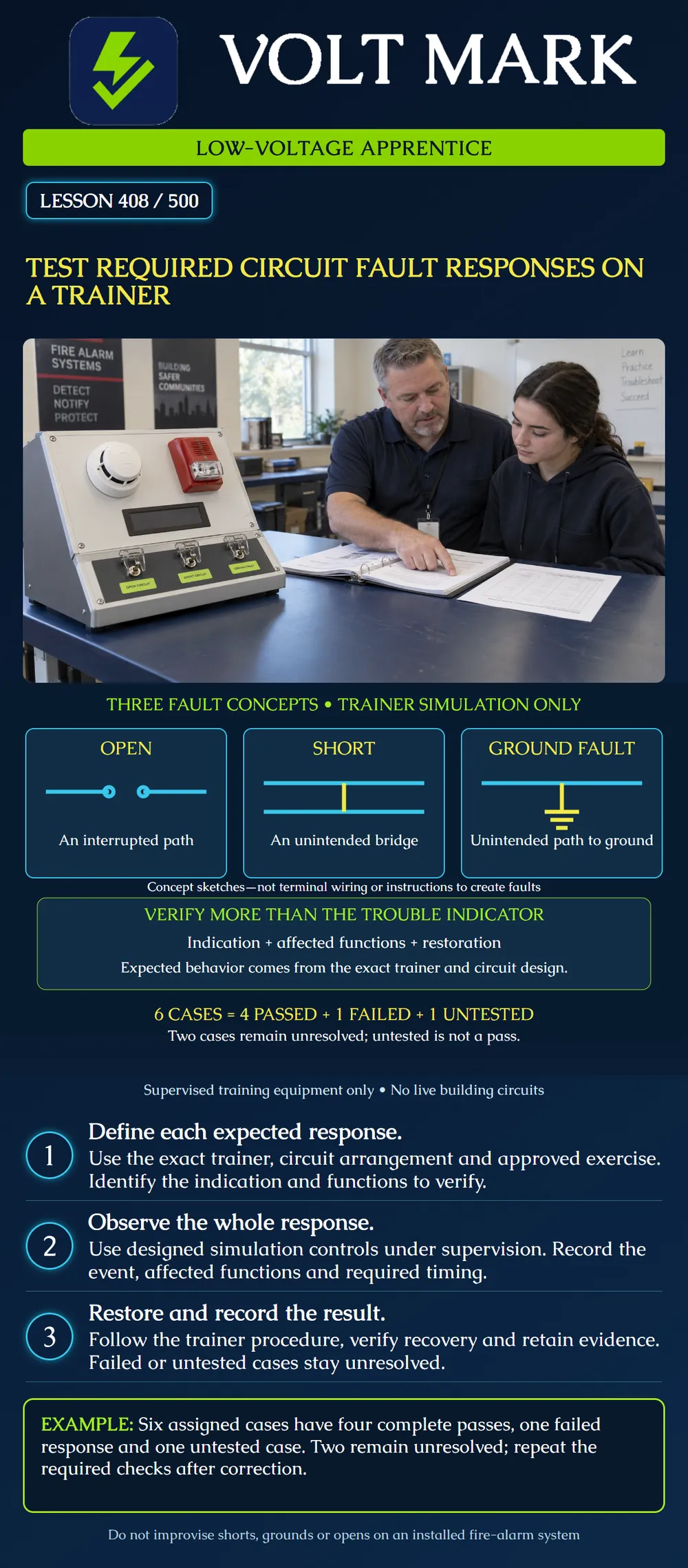
Recognize open, short and ground-fault concepts, compare a trainer's observed response with its documented expectation, and keep complete records of fault indication, functional behavior and restoration. This is an instructor-led training exercise, not permission to create faults on a building system.
Use a purpose-built trainer or approved simulation with documented controls. The instructor confirms its supply arrangement, safeguards, operating instructions and permitted exercise. A panel sitting on a bench is not automatically a safe trainer: it may contain mains voltage, batteries and outputs capable of operating external equipment.
Confirm that the exercise cannot call a monitoring station, release a door, start equipment or impair an occupied building. If the training setup or its connections are uncertain, use the desk exercise below until the instructor resolves the uncertainty. Do not improvise a jumper, cut a conductor, remove a termination or connect a circuit to ground.
An open interrupts a conductive path. A short creates an unintended low-resistance connection between points. A ground fault creates an unintended conductive path from a circuit to ground. These are simplified concepts, not a complete model of every possible wiring defect.
The poster sketches omit terminals, component values and power sources deliberately. They teach the difference between conditions without providing a fault-insertion wiring plan. A missing addressable device, a communication fault and a wiring open are not interchangeable diagnoses simply because each may produce a trouble indication.
The Fire-Lite ES-200X Series Manual, LS10131-000FL-E:F, May 23, 2022, Appendix I, provides terminal-specific earth-fault detection values and separate NAC open/short trip and restoration values. This demonstrates why a single generic resistance threshold or a single restoration assumption cannot be applied to all circuits. Use the exact equipment manual and approved trainer instructions; this lesson does not prescribe those product-specific values as national rules.
For each assigned case, identify the trainer model, configuration revision, circuit identifier, simulated condition and its designated simulation control. Write the expected displayed event, applicable indicator or local audible response, required reporting evidence, functions expected to remain available, functions expected to be affected, and the required restoration evidence.
The expected functional effect depends on circuit arrangement, fault location, equipment and isolation provisions. Do not assume that every open disables every device, or that a trouble lamp proves all other functions still operate. If an expected behavior cannot be established from the approved exercise, mark that expectation unresolved before attempting the case.
The instructor uses or authorizes only the trainer's designed controls according to its procedure. Observe one defined case at a time unless a documented exercise specifically calls for combined conditions. Record the initial normal state and any pre-existing condition so it is not mistakenly credited to the new simulation.
Record the actual message and circuit or point identity, the observable response and any specified timing. A time entry needs a defined starting event and ending event. This lesson supplies no universal response-time limit.
Verify the functions identified in the exercise separately from the fault indication. A trouble event shows that something was detected; it does not alone prove the intended scope of detection, isolation or continuing operation. Record what was actually demonstrated, rather than copying the expected result into the observed-result column.
After the instructor follows the documented restoration procedure, confirm the required normal state and recovery of affected functions. Acknowledging a buzzer does not remove a wiring condition. Do not erase an unexpected event from the exercise record by writing only the final normal display.
If the response differs from the approved expectation, retain the discrepancy and stop that case for instructor review. Do not alter programming, bypass supervision or change component values merely to obtain a pass. Any authorized correction and repeat verification need their own record.
A fictional worksheet contains six assigned cases. Cases A through D each have matching indication, required functional observations and restoration evidence. Case E has an observed response that does not meet its documented expectation. Case F has not been performed.
Passed: 4. Failed: 1. Untested: 1. Total: 4 + 1 + 1 = 6. Unresolved: 1 + 1 = 2.
Five attempted cases do not equal five passes. An untested case is not an observed failure, but it prevents completion of the assigned set. A later correction to Case E does not make Case F complete. Retain the original discrepancy, correction record and repeat result instead of overwriting the original observation.
Include case ID; trainer and configuration; circuit; approved procedure reference; expected response; initial condition; observed indication and functions; required timing evidence; restoration evidence; pass/fail/not-tested status; discrepancy; instructor review; and repeat-test reference. This is a training record, not a certificate of acceptance for installed equipment.
Q1. Does a trouble indication establish that every required function was checked?
Fire-Lite ES-200X Series Manual, LS10131-000FL-E:F, May 23, 2022, Appendix I: https://prod-edam.honeywell.com/content/dam/honeywell-edam/hbt/en-us/documents/manuals-and-guides/installation-guides/ba-fire-ES-200X-Manual-LS10131-000FL-E-F.pdf Product-specific thresholds are not generalized. Concept drawings, worksheet and arithmetic are original instructional material.
Mistake: Treating a bench-mounted panel as a safe isolated trainer. Correction: Have the instructor confirm power sources, safeguards and absence of building or monitoring connections before any exercise.
Mistake: Using the trouble lamp as proof of all required fault behavior. Correction: Record the indication, affected functions, continuing functions and restoration required for the particular case.
Mistake: Counting five attempted cases as five passes. Correction: Keep Case E failed and Case F untested until each receives its own documented resolution.
Texas journeyman, 15 questions, scored by topic against the 70% mark. No card, and no account needed to start.
Free study material for low-voltage apprentices. This is a national foundation course: requirements differ by state and by local jurisdiction, and a practice that is common in one place is not a rule everywhere. Nothing here is a licence, a certification, or authority to work unsupervised, and completing it does not count as apprenticeship hours or continuing-education credit. Check the codes adopted where you are working, the licensing authority for that work, and your employer's safety programme. VoltMark is not affiliated with, endorsed by, or sponsored by NFPA, OSHA, NICET, BICSI, FOA, or any state or local licensing authority.

Electrician licensing exam prep: practice questions, timed exam simulations, and step-by-step help finding every answer in the NEC.