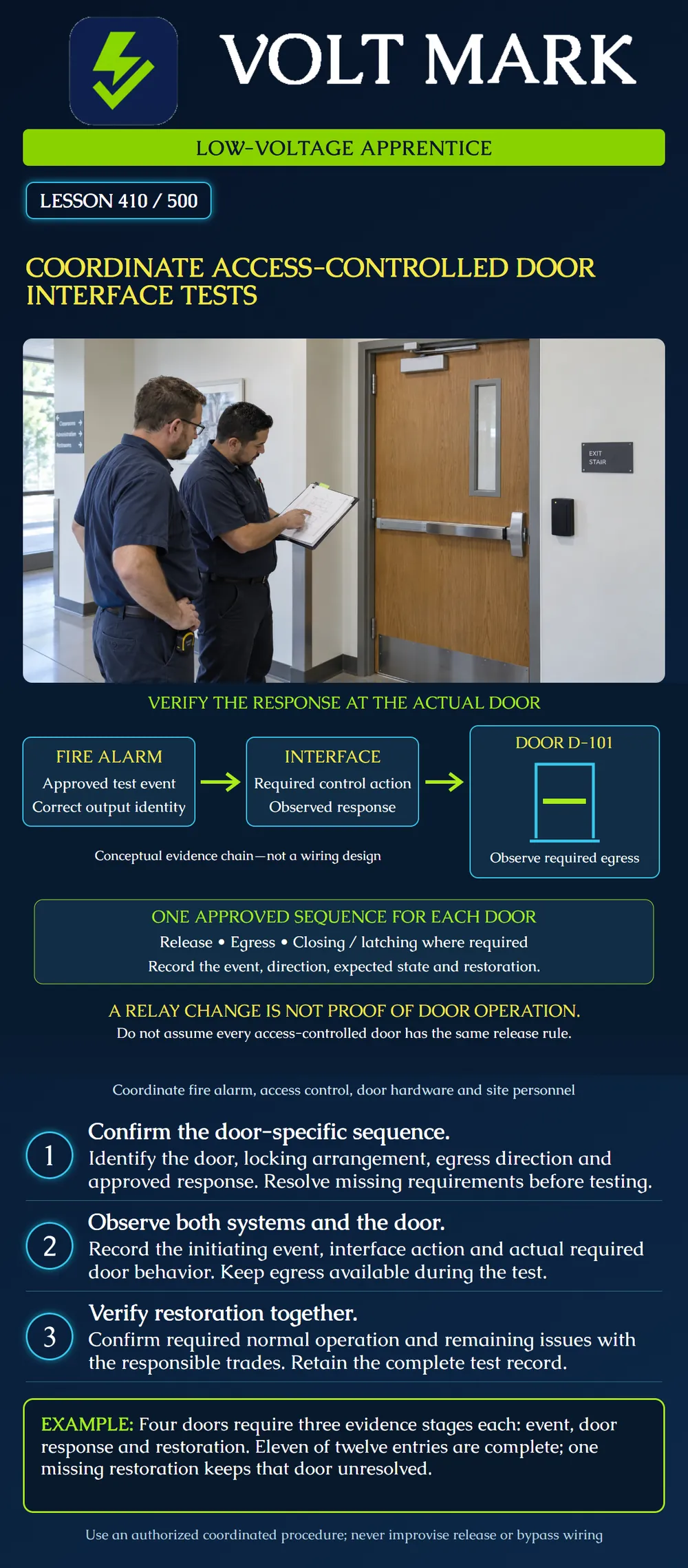
Coordinate a door-specific test record across fire alarm, access control, door hardware and site operations. Distinguish the commanded response from actual required egress and door behavior. This lesson is a planning and evidence exercise, not a procedure for bypassing locks or activating an installed fire-alarm system.
Identify each opening by the approved door identifier and location. Record which side is the egress side, the locking and releasing arrangement, relevant door rating and the approved sequence. Entry security and the ability to leave are different functions. A credential reader or a magnetic lock does not, by itself, identify all the requirements that apply.
The approved documents and responsible design authority must establish the expected response for this opening under the applicable adopted code and local amendments. Do not assume that a model-code edition is adopted everywhere, or that every access-controlled door must unlock on every alarm event.
ICC's electrical-locking overview distinguishes several locking arrangements, including sensor release, door-hardware release, delayed egress and controlled egress. Its discussion uses the 2018 IBC and should not be treated as a current adoption map.
Allegion's July 2022 electromagnetic-lock FAQ distinguishes sensor-release from door-hardware-release arrangements and explains that their model-code fire-alarm release provisions differ. It directs readers to adopted codes and local requirements. This supports identifying the actual arrangement rather than applying one rule to every lock.
UL Solutions describes access/egress configurations and the importance of certification scope and intended application. A component's marking alone does not establish that a complete installed opening meets its required arrangement.
The responsible team identifies who controls the fire-alarm test event, who observes the output/interface, who verifies access-control behavior, and who checks door hardware and actual egress. The owner or site representative coordinates occupancy, security and access needs. Include required witnesses and the authority having jurisdiction when the approved plan calls for them.
Choose a shared event identifier and a way for observers to report readiness, observations and a stop condition. Agree on the restoration owner before starting. A fire-alarm technician should not assume the access-control technician will restore a setting, or vice versa.
Define the authorized test window, notifications and any required protective measures. Maintain safe passage and prevent a person being trapped during testing. The exercise must not rely on an apprentice improvising a jumper, disconnecting a lock supply or changing a program.
For each door and each applicable test condition, record the approved initiating event, intended fire-alarm output, interface function, expected lock/egress state, applicable closing or latching behavior, required timing and reset/restoration conditions. Include required power-loss or other release checks only through their separately authorized procedure and scope.
Closing, latching and unlocking are different actions. A fire door may need to close and latch while still allowing the required egress operation. A hold-open release is not interchangeable with releasing an access-control lock. Avoid ambiguous entries such as “door released” when the required physical result has not been identified.
Identify any special occupancy or locking arrangement needing further review. This lesson does not supply delayed-egress timing, controlled-egress criteria or a universal reset order. If a door's expected sequence is missing or contradictory, resolve it with the responsible parties before evaluating a test.
The poster's arrows represent evidence, not a wiring architecture. The actual design may involve a listed interface, power-control arrangement, monitored circuits and other components not shown.
First, establish the correct approved test event and output identity. Next, observe the required interface action. Finally, verify the physical door behavior from the required direction under the approved procedure. A relay changing state, a software icon saying unlocked or an access-control log entry does not independently demonstrate that a person can use the door as required.
Record the observations at each stage separately. If the relay changes but the required door response does not occur, preserve that result as a discrepancy. Do not repeatedly reset or adjust equipment merely to obtain a successful-looking log.
Follow the approved restoration sequence with all responsible trades. Confirm required normal fire-alarm and access-control conditions, hardware operation, any required closing/latching and the intended security state without compromising egress. Remove only authorized temporary test measures through the responsible procedure.
Do not assume that resetting the alarm automatically proves the lock, controller and door returned correctly. Keep unresolved issues visible and coordinate any required protection or follow-up. Record correction and repeat-test evidence rather than overwriting the original failure.
A fictional assignment covers four doors. For this simplified exercise, each has three evidence stages: the initiating event, actual required door response and verified restoration.
4 doors × 3 stages = 12 required entries. 11 entries are complete. 12 - 11 = 1 entry is missing.
The missing entry is restoration for Door D-104. The other three door records are complete, but D-104 remains unresolved. Eleven entries do not prove all four doors passed. This arithmetic is a record-completeness exercise, not a prescribed test matrix or code minimum.
If D-104 is later restored and checked by the responsible team, add the dated observation and reviewer reference. A statement that someone “probably reset it” is not evidence. Likewise, a complete worksheet containing a failed observation still does not constitute a pass.
Q1. Does every access-controlled door have the same fire-alarm release requirement?
ICC, Doors in the means of egress: Electrical locking systems permitted by the codes: https://www.iccsafe.org/building-safety-journal/bsj-technical/doors-in-the-means-of-egress-electrical-locking-systems-permitted-by-the-codes/ Allegion, FAQs About Electromagnetic Locks, July 7, 2022: https://idighardware.com/2022/07/faqs-about-electromagnetic-locks/ UL Solutions, Locking Configurations for Access and Egress Control: https://www.ul.com/thecodeauthority/knowledge/locking-configurations-access-and-egress-control
ICC's 2024 online code chapter returned 403 and was not treated as fully reviewed. Reader comments on the Allegion page were not used as authority. Model-code references do not establish local adoption. Diagram and record exercise are original.
Mistake: Assuming every access-controlled door has the same alarm-release sequence. Correction: Identify the opening's approved locking arrangement and applicable release conditions before writing expectations.
Mistake: Passing a door because the interface relay changed state. Correction: Record the required physical door and egress behavior with the responsible hardware/access-control observers.
Mistake: Closing the test when the fire-alarm panel resets. Correction: Obtain the separate door and access-control restoration evidence, including D-104's missing entry.
Texas journeyman, 15 questions, scored by topic against the 70% mark. No card, and no account needed to start.
Free study material for low-voltage apprentices. This is a national foundation course: requirements differ by state and by local jurisdiction, and a practice that is common in one place is not a rule everywhere. Nothing here is a licence, a certification, or authority to work unsupervised, and completing it does not count as apprenticeship hours or continuing-education credit. Check the codes adopted where you are working, the licensing authority for that work, and your employer's safety programme. VoltMark is not affiliated with, endorsed by, or sponsored by NFPA, OSHA, NICET, BICSI, FOA, or any state or local licensing authority.

Electrician licensing exam prep: practice questions, timed exam simulations, and step-by-step help finding every answer in the NEC.