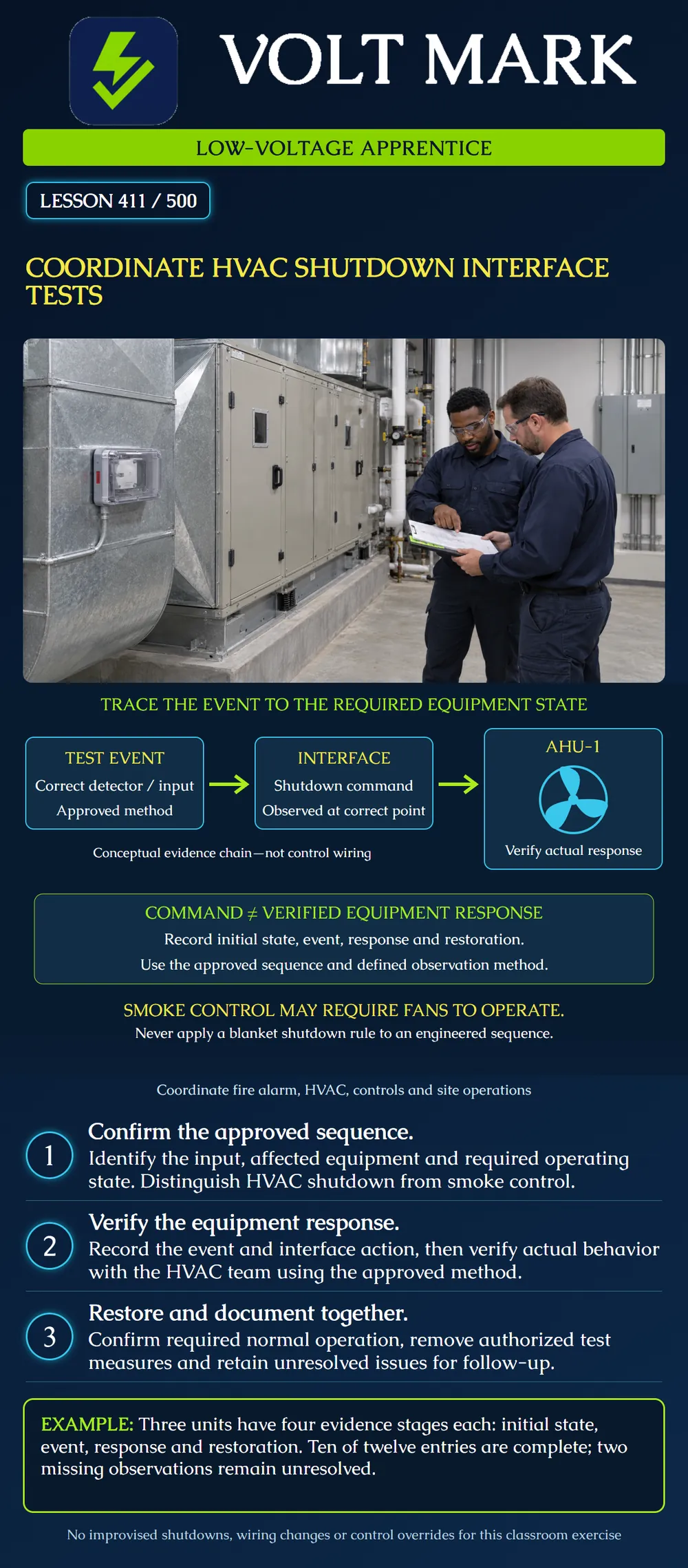
Plan coordinated verification of an HVAC shutdown interface and distinguish a control command from the required equipment response. Record the initial condition, initiating event, response and restoration without assuming that every ventilation or smoke-control system must stop on every alarm.
Start with equipment identifiers, the approved sequence of operations, relevant drawings and the test plan. Identify which detector or other input initiates the assigned action, which outputs and interfaces participate, and which equipment must respond. Match the mechanical label to the fire-alarm and controls records.
Do not infer the sequence from a device name alone. A duct detector, an area detector and a manual command may participate in different sequences. Interconnected equipment can extend the effect beyond the unit nearest the detector. Resolve unclear associations before the responsible team performs a test.
System Sensor's D4120/D4P120/D4S instructions, I56-2967-008R, include verification of intended auxiliary functions such as fan shutdown and damper control in section 12.5.1. The manual also separates alarm, smoke-response and airflow-related checks. These distinctions support verifying the intended interface function rather than treating a detector indicator as proof of every required result. Product-specific test methods, terminals and timing are not prescribed here for other equipment.
ICC's August 2023 CodeNotes on fire and smoke dampers, based on the 2021 I-Codes, distinguishes static and dynamic applications and discusses smoke dampers in systems designed to operate during a fire. This supports separating ordinary HVAC shutdown from engineered smoke-control operation. It does not establish which code edition a particular jurisdiction has adopted.
The fire-alarm representative manages the authorized initiating event and fire-alarm observations. The HVAC/mechanical representative verifies the affected equipment's physical behavior. The controls representative interprets required controller states, interlocks and relevant feedback. The owner or site representative coordinates the operational impact, access and required notifications.
Include smoke-control specialists and required witnesses when the test affects that scope. Identify a test leader, readiness communication and stop criteria. Agree on who is responsible for restoration, including clearing authorized test measures and verifying the final condition.
Testing may affect occupied spaces, pressure relationships or equipment serving sensitive processes. The responsible team determines the authorized window and required protection. An apprentice does not disable a safety, force a control point or switch a unit into a different mode to make the test pass.
An approved HVAC shutdown sequence and an engineered smoke-control sequence are not interchangeable. Depending on the actual design, smoke control may require specific fans to run, particular dampers to move, and actions to occur in a defined order.
Do not issue a blanket “all fans off” rule or invent an order for opening and closing dampers. The design and approved test procedure establish equipment states, interlocks, observation methods and acceptance criteria. If the scope crosses into smoke control, identify that boundary and involve the responsible specialists.
Document the assigned equipment identity and operating state before the event. If the unit was already stopped, a later stopped indication does not by itself demonstrate that the shutdown function caused it to stop. The team must establish the initial condition required by the approved test.
A controller command, a status contact and physical operation can represent different information. Identify what each observation actually measures. Do not label a software command as fan-speed proof or airflow proof without the applicable evidence.
The poster shows a conceptual chain: approved event, required interface action and observed equipment response. It is not a requirement that all installations use a particular fire-alarm-to-controller wiring path.
The authorized team uses the specified initiating method. Record the actual input identity and related event evidence. Observe the assigned interface action, then verify the required equipment behavior using the approved mechanical/controls method. Keep any damper or associated-equipment observations linked to their own identifiers.
Timing records require a defined starting event and ending observation. A motor may coast after a command changes, so do not confuse command time with the time of the required physical state. This lesson supplies no universal stopping-time limit; compare observations with the applicable procedure and criteria.
A successful local detector test does not automatically prove smoke entry, sampling performance, sensitivity and every interface response. State which test was performed and what it establishes. Preserve the other required checks as separate evidence.
After the test, the responsible parties verify the required return to normal service and equipment operation. Resetting a fire-alarm event does not alone prove HVAC recovery. Conversely, seeing a fan run does not prove the fire-alarm and controls systems have no remaining fault or authorized test condition.
Do not force a restart or bypass an interlock to clear a record. Document discrepancies and the responsible corrective action. Retain original failed observations, correction references and the required repeat verification. Close notifications and protective measures only through the responsible site's procedure.
A fictional assignment covers AHU-1, AHU-2 and AHU-3. The simplified worksheet requires four evidence stages per unit: initial state, initiating event, required equipment response and restoration.
3 units × 4 stages = 12 entries. 10 entries are complete. 12 - 10 = 2 entries remain missing.
AHU-2 lacks an actual-response observation. AHU-3 lacks restoration evidence. Both unit records remain unresolved. Ten completed entries do not establish that all three units passed.
If the missing response is later observed as a failure, the entry becomes documented but the test still does not pass. Completeness and successful performance are different questions. This worksheet is an original teaching example, not a code-prescribed minimum test schedule.
Q1. Does a shutdown command prove a fan achieved its required state?
System Sensor D4120/D4P120/D4S installation and maintenance instructions, I56-2967-008R, section 12 and related verification context: https://prod-edam.honeywell.com/content/dam/honeywell-edam/hbt/en-us/documents/manuals-and-guides/user-manuals/D4120_Manual_I56-2967.pdf?download=false ICC CodeNotes: Fire, Smoke, and Combination Fire/Smoke Damper Fundamentals in the I-Codes, August 17, 2023: https://www.iccsafe.org/building-safety-journal/bsj-technical/codenotes-fire-smoke-and-combination-fire-smoke-damper-fundamentals-in-the-i-codes/
ICC's 2024 IMC chapter could not be fetched and was not claimed reviewed. Code proposals and forum replies were not used as authority. Diagram and arithmetic are original; no nationwide adoption or universal shutdown threshold is asserted.
Mistake: Using an already-stopped fan to demonstrate a shutdown response. Correction: Establish the approved initial operating state and observe the transition required by the test.
Mistake: Treating an off command as proof that the equipment stopped. Correction: Distinguish the interface command, feedback and actual mechanical response, using the approved observation method.
Mistake: Applying an all-fans-off rule to an engineered smoke-control system. Correction: Use its approved sequence and specialist test scope; required fans or dampers may have different states.
Texas journeyman, 15 questions, scored by topic against the 70% mark. No card, and no account needed to start.
Free study material for low-voltage apprentices. This is a national foundation course: requirements differ by state and by local jurisdiction, and a practice that is common in one place is not a rule everywhere. Nothing here is a licence, a certification, or authority to work unsupervised, and completing it does not count as apprenticeship hours or continuing-education credit. Check the codes adopted where you are working, the licensing authority for that work, and your employer's safety programme. VoltMark is not affiliated with, endorsed by, or sponsored by NFPA, OSHA, NICET, BICSI, FOA, or any state or local licensing authority.

Electrician licensing exam prep: practice questions, timed exam simulations, and step-by-step help finding every answer in the NEC.