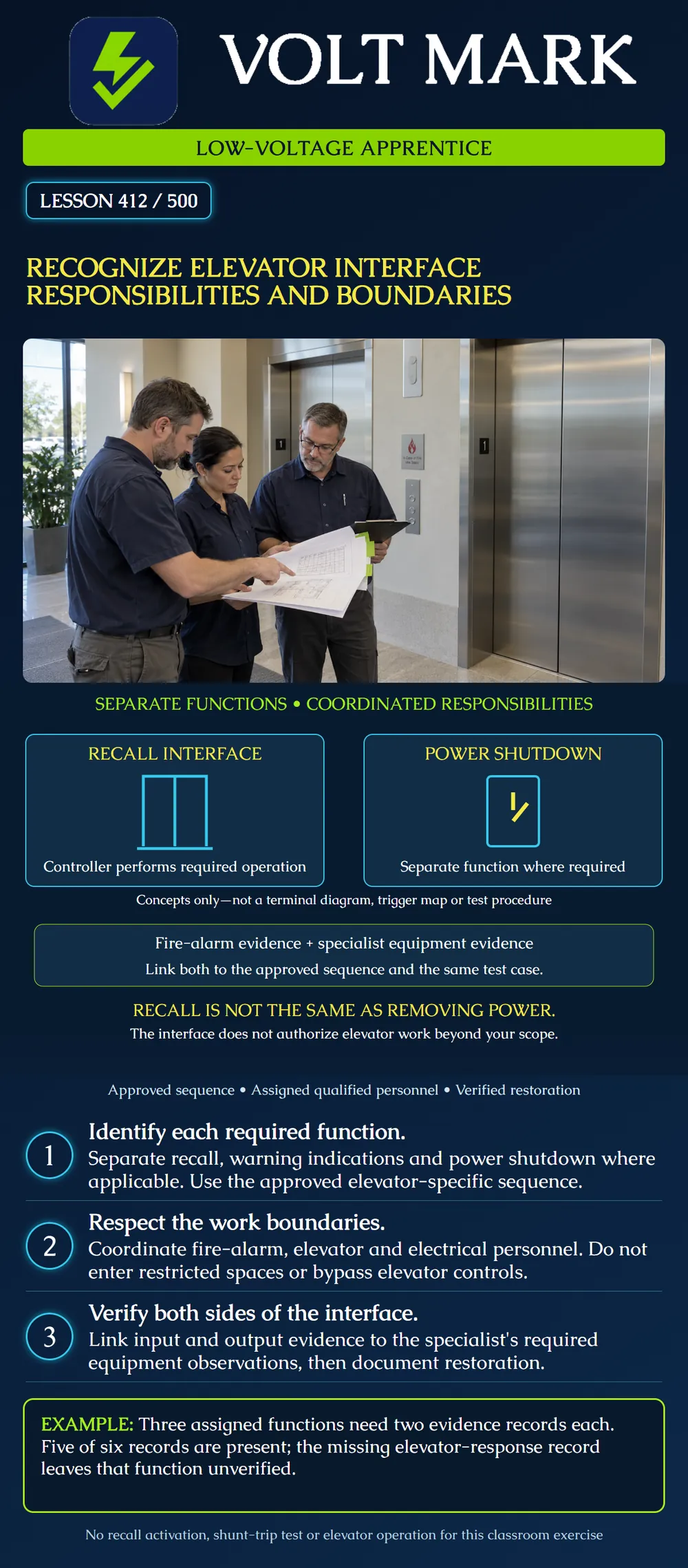
Recognize the distinct functions of elevator-related fire-alarm interfaces, identify the responsible participants and understand where an apprentice's work stops. Prepare a coordinated evidence record without operating an elevator, activating recall or initiating power shutdown.
The fire-alarm system may provide required signals associated with elevator emergency operation. The elevator controller and related equipment carry out their assigned functions. The connection between them does not make the fire-alarm technician responsible or qualified to perform every elevator or electrical task.
Identify the elevator or elevator group, relevant controller, approved sequence and interface documentation. Use consistent identifiers across drawings, point lists and test records. A generic label such as “elevator relay” is insufficient when several distinct functions are present.
Recall is associated with the elevator controller's required emergency return operation. Power shutdown is a separate function that removes the specified power through the approved arrangement where required. They are not interchangeable ways of achieving the same result.
Other required interfaces can include warning indications and additional functions specific to the elevator installation. Do not assume a universal number of relays, a universal recall floor or the same behavior for every elevator type. Special elevator arrangements require their own approved documentation and responsible specialists.
NFPA's A Guide to Fire Alarm Basics, Part 5 and its elevator illustration, distinguishes recall to designated or alternate levels, in-car warning and shunt-trip disconnect functions. It also illustrates an input/output matrix. These educational examples support keeping functions and expected outputs distinct; they are not this lesson's project design, wiring schedule or universal trigger map.
NYC311's Fire Alarm Inspection page requires the owner's representative, electrical contractor, fire-alarm vendor and other needed trades at the local inspection/test, along with documentation and sufficient resources. This is a local example of coordination, not a nationwide staffing or permit rule.
The applicable adopted elevator, building, electrical and fire requirements, approved design and manufacturer instructions govern the actual installation. This lesson does not determine whether a particular elevator requires power shutdown or specify how to accomplish it.
Identify the responsible design professional or authority for resolving sequence questions. The fire-alarm team documents its authorized initiating devices, event indications and assigned outputs. The elevator specialist controls elevator-side work and verifies the required elevator behavior. Qualified electrical personnel handle the assigned power/disconnect scope. Involve sprinkler personnel and other specialists when their systems are part of the approved test.
These are coordination categories, not a national licensing chart or automatic division of every terminal. The project documents and jurisdiction determine actual permitted scope. Each participant must know the interface handoff, the expected evidence and who is authorized to perform each action.
The owner/site representative coordinates affected occupants, access, operational needs and notifications. Required inspectors or witnesses participate according to the approved process. Appoint a test leader and agree on readiness communication, stop conditions and restoration responsibility before any field action.
An apprentice can review approved point lists, reconcile identifiers, prepare worksheets and assist an assigned qualified supervisor within authorized scope. Finding a discrepancy is valuable work; it does not create permission to correct elevator programming or power wiring.
Do not enter a hoistway, pit, car top or restricted machinery/control space without the required authorization, qualifications and procedures. Do not use an elevator key, jumper a safety circuit, alter a controller, energize a shunt-trip circuit or attempt a reset as an improvised diagnostic step. This lesson is a desk exercise and does not direct any of these actions.
No one should infer that a low-voltage interface makes adjacent equipment low hazard. Elevator spaces can contain moving equipment, multiple power sources and other hazards beyond the apprentice's assigned work.
For each function, identify the approved initiating condition, input identifier, required output/interface, affected elevator or group and expected equipment result. Add required timing, supervision and restoration criteria from the actual approved documents rather than inventing values.
Separate normal-operation observations from event observations. Record whether the fire-alarm output was verified and whether the elevator specialist verified the corresponding required response. A changed relay or a fire-alarm log entry does not independently prove travel, landing, door behavior, warning operation or the state of the required disconnect.
If documents conflict or a response differs from the approved expectation, preserve the discrepancy and escalate it to the responsible parties. Do not silently change the expected result to match what happened.
The responsible team restores systems through the approved procedure and confirms the final required conditions. A normal fire-alarm display alone does not establish that an elevator is ready for passenger service. Likewise, seeing a car move does not verify every fire-alarm interface or power-related function.
Keep any unresolved condition and required protection visible. Record who confirmed elevator-side readiness, fire-alarm status and any applicable electrical restoration. Retain correction and repeat-test references with the original observations.
A fictional worksheet contains three assigned interface functions. For this simplified exercise, each needs two linked evidence records: the fire-alarm interface observation and the corresponding specialist equipment observation.
3 functions × 2 records = 6 records. 5 records are present. 6 - 5 = 1 record is missing.
The missing record is the specialist's required elevator-response observation for one recall case. The fire-alarm output evidence is present, but that does not fill the missing equipment record. Mark the case unverified, not passed.
This example is a record-completeness exercise, not a prescribed number of functions or a complete acceptance checklist. Even six completed records could include a failed observation; documentation completeness and successful performance are separate questions.
Q1. Is recall the same as removing elevator power?
NFPA, A Guide to Fire Alarm Basics, Part 5 and elevator recall/shutdown illustration: https://www.nfpa.org/-/media/project/storefront/catalog/files/code-or-topic-fact-sheets/FireAlarmBasicsFactSheet.pdf NYC311, Fire Alarm Inspection: https://portal.311.nyc.gov/article/?kanumber=KA-01300
NFPA educational illustrations were not copied into a field procedure. NYC requirements are explicitly local examples. Seattle's construction-inspection page failed to open and was not relied on. Diagram, responsibility exercise and arithmetic are original.
Mistake: Treating recall and removal of elevator power as interchangeable actions. Correction: Keep their initiating conditions, interface identities and specialist evidence in separate matrix entries.
Mistake: Signing off recall from a fire-alarm relay observation alone. Correction: Link the output observation to the elevator specialist's required response record.
Mistake: Inferring passenger-service readiness from a normal fire-alarm display. Correction: Obtain the elevator-side and any electrical restoration confirmations required by the coordinated procedure.
Texas journeyman, 15 questions, scored by topic against the 70% mark. No card, and no account needed to start.
Free study material for low-voltage apprentices. This is a national foundation course: requirements differ by state and by local jurisdiction, and a practice that is common in one place is not a rule everywhere. Nothing here is a licence, a certification, or authority to work unsupervised, and completing it does not count as apprenticeship hours or continuing-education credit. Check the codes adopted where you are working, the licensing authority for that work, and your employer's safety programme. VoltMark is not affiliated with, endorsed by, or sponsored by NFPA, OSHA, NICET, BICSI, FOA, or any state or local licensing authority.
Electrician licensing exam prep: practice questions, timed exam simulations, and step-by-step help finding every answer in the NEC.