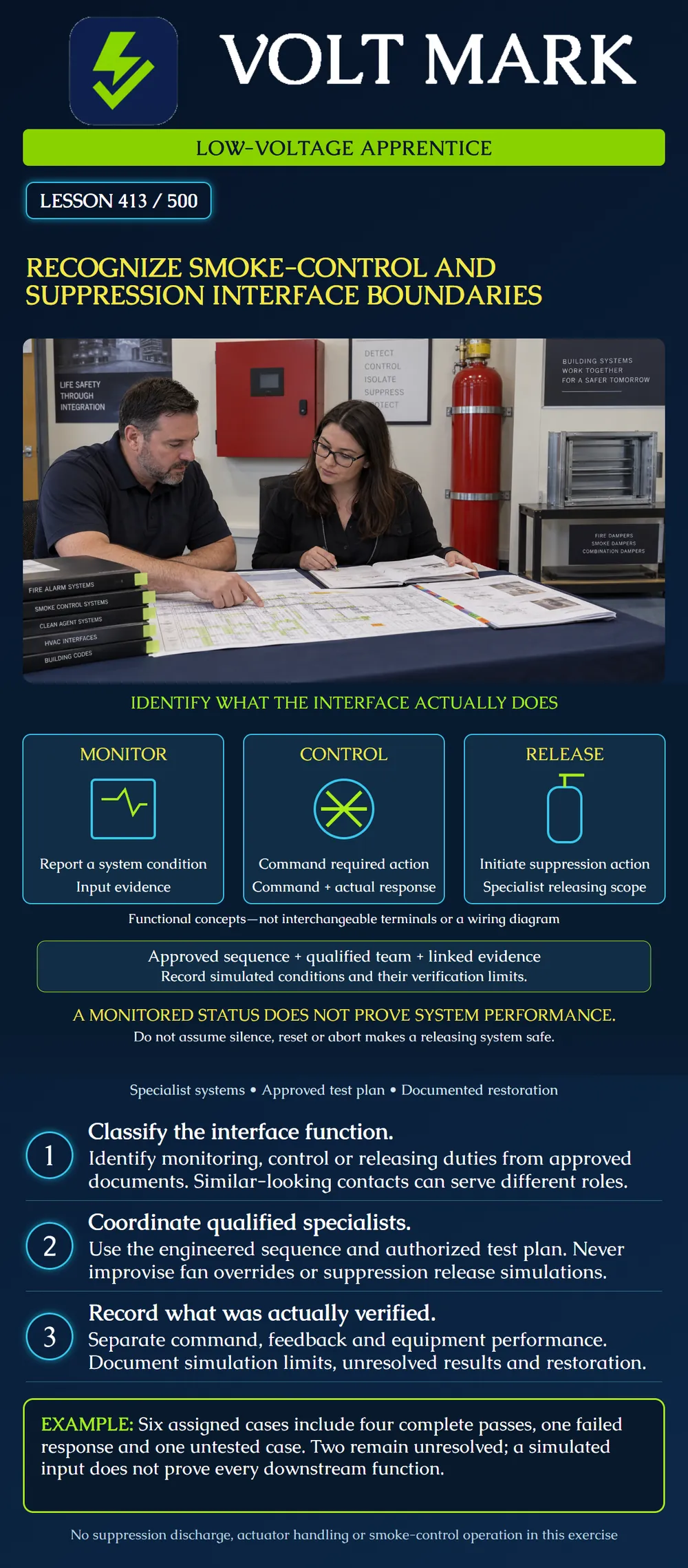
Distinguish monitoring, control and releasing functions at smoke-control and suppression interfaces. Identify the responsible specialists, the approved evidence needed and the limits of a low-voltage apprentice's work. This lesson is a desk exercise, not a procedure for activating or disabling a life-safety system.
Monitoring reports a condition from another system. A valve-status input, for example, communicates a defined state; it does not itself establish the performance of the complete suppression system.
Control commands an approved action. A smoke-control interface may participate in a specified fan or damper sequence. The command and the actual equipment result are different observations.
Releasing initiates suppression action through the applicable releasing equipment. It is not merely another notification output or a generic relay task. Some systems combine multiple functions within listed equipment, but their roles and requirements still need to be identified separately.
Do not infer purpose from terminal appearance, conductor color or a voltage label. Use the approved drawings, equipment documentation, input/output matrix and sequence of operations.
The Fire-Lite MRP-2002 manual, P/N 53049:E6, January 26, 2017, distinguishes notification/releasing outputs and programmable relays and directs users to compatible-device documentation. It also describes multiple abort configurations and circumstances in which manual release overrides abort. This supports treating releasing logic as equipment- and configuration-specific. No abort timing, programming choice or actuator wiring from that manual is prescribed here.
UCSF's January 2026 integrated-testing bulletin explains why individual system tests do not alone demonstrate interaction between systems. Its local process identifies a qualified test team, initiating events, expected responses and documentation of simulated conditions and discrepancies. The bulletin is a UCSF/California example, not a nationwide adoption statement or universal test interval.
Follow the approved engineered sequence for the particular zone, equipment and scenario. Do not substitute a general HVAC shutdown assumption. Required actions may involve equipment running, stopping or moving to defined positions, with specified interlocks and priorities.
The responsible smoke-control/mechanical specialist determines the necessary physical performance observations and measurement methods under the approved plan. A controller graphic, fan command or damper-position signal may be part of the evidence without proving required airflow, pressure or overall performance.
The apprentice can reconcile identifiers and document assigned observations under supervision. That role does not authorize forcing points, changing priorities, altering an engineered sequence or declaring the smoke-control system accepted.
Identify the suppression type, protected area, releasing equipment, relevant monitoring points and assigned interface scope. Distinguish an alarm or trouble report from a release command, and a release command from evidence that the complete suppression system meets its required performance.
The suppression specialist controls work involving releasing equipment and the suppression system under the applicable procedure. Do not handle actuators, disconnect release circuits, operate manual-release devices or assume a panel mode makes a discharge impossible.
Silence, reset and abort are not interchangeable safety functions. An abort control must not be assumed to cancel every possible release path or replace the specialist's approved test preparation. This lesson intentionally provides no field sequence for making a releasing system safe.
The responsible team identifies the source input, receiving system, required action, expected feedback, actual equipment result and final restoration for each case. Record which party is authorized to initiate the event, who observes each side and who decides whether the test can begin or continue.
Coordinate the owner/site representative, fire-alarm personnel, smoke-control or suppression specialists and any other required trades or witnesses. Resolve incomplete documents and conflicting expectations before the test. Assign the person responsible for each restoration item rather than relying on an informal “all clear.”
Keep occupant protection, notifications and impairment management within the site's approved process. The team must understand downstream consequences of an apparently small input change.
A simulation is useful when it is part of the approved method. Its record must identify the simulated condition and which real functions were and were not exercised.
For example, a fictional desk record may show that a simulated status input produced the expected annunciation. That can support the assigned annunciation observation. It does not establish real suppression discharge, distribution, enclosure performance or every smoke-control function.
Do not silently expand a limited result into a statement that the entire integrated system passed. If required downstream evidence is absent, mark it unresolved. Conversely, do not require an actual agent discharge merely because a limited simulation cannot prove every function; the responsible plan determines the required methods.
A fictional worksheet includes six assigned interface cases: Four have the required matching observations and restoration evidence. One has a documented response that fails its expected criterion. One has not been tested.
4 passed + 1 failed + 1 untested = 6 cases. 1 failed + 1 untested = 2 unresolved cases.
Five attempted cases are not five passes. The untested case is not an observed failure, but it prevents completion of the assignment. A simulated input that successfully produced an indication does not cure the failed equipment-response case.
Preserve the original result, correction record and authorized repeat verification. Do not overwrite a failure with a later normal display or use a dashboard status to fill a missing physical-performance observation.
The responsible specialists confirm the required final state of their systems and account for authorized temporary test measures. Fire-alarm normal status alone does not establish that releasing equipment is ready or that smoke control is fully restored.
Retain unresolved conditions and required protection through the site's process. The complete record links the initiating event, each system's observations, any simulation limits, discrepancies, correction and final responsible verification.
Q1. Does monitoring a valve condition prove suppression performance?
Fire-Lite MRP-2002 Instruction Manual, 53049:E6, January 26, 2017; product description, output specifications and abort configuration: https://prod-edam.honeywell.com/content/dam/honeywell-edam/hbt/en-us/documents/manuals-and-guides/user-manuals/53049.pdf UCSF Fire Prevention Design Bulletin #0003, revised January 2026: https://ehs.ucsf.edu/fire-prevention-design-bulletin-0003-integrated-fire-protection-and-life-safety-system-testing
A separate RP-2002 manual URL was inaccessible and was not treated as reviewed; MRP-2002 is the actual manufacturer manual used. No code-development proposals or forum replies were used as authority. Original diagram and exercise; no universal local-code or testing-frequency claim.
Mistake: Describing a simulated status input as a complete suppression performance test. Correction: Record the simulation boundary and leave unexercised physical functions outside the result claim.
Mistake: Assuming an abort control prevents every release path. Correction: Have the suppression specialist establish the approved test preparation; do not use abort as an improvised safeguard.
Mistake: Treating a fan or damper command as smoke-control performance evidence. Correction: Obtain the required equipment and physical-performance observations from the responsible smoke-control specialist.
Texas journeyman, 15 questions, scored by topic against the 70% mark. No card, and no account needed to start.
Free study material for low-voltage apprentices. This is a national foundation course: requirements differ by state and by local jurisdiction, and a practice that is common in one place is not a rule everywhere. Nothing here is a licence, a certification, or authority to work unsupervised, and completing it does not count as apprenticeship hours or continuing-education credit. Check the codes adopted where you are working, the licensing authority for that work, and your employer's safety programme. VoltMark is not affiliated with, endorsed by, or sponsored by NFPA, OSHA, NICET, BICSI, FOA, or any state or local licensing authority.
Electrician licensing exam prep: practice questions, timed exam simulations, and step-by-step help finding every answer in the NEC.