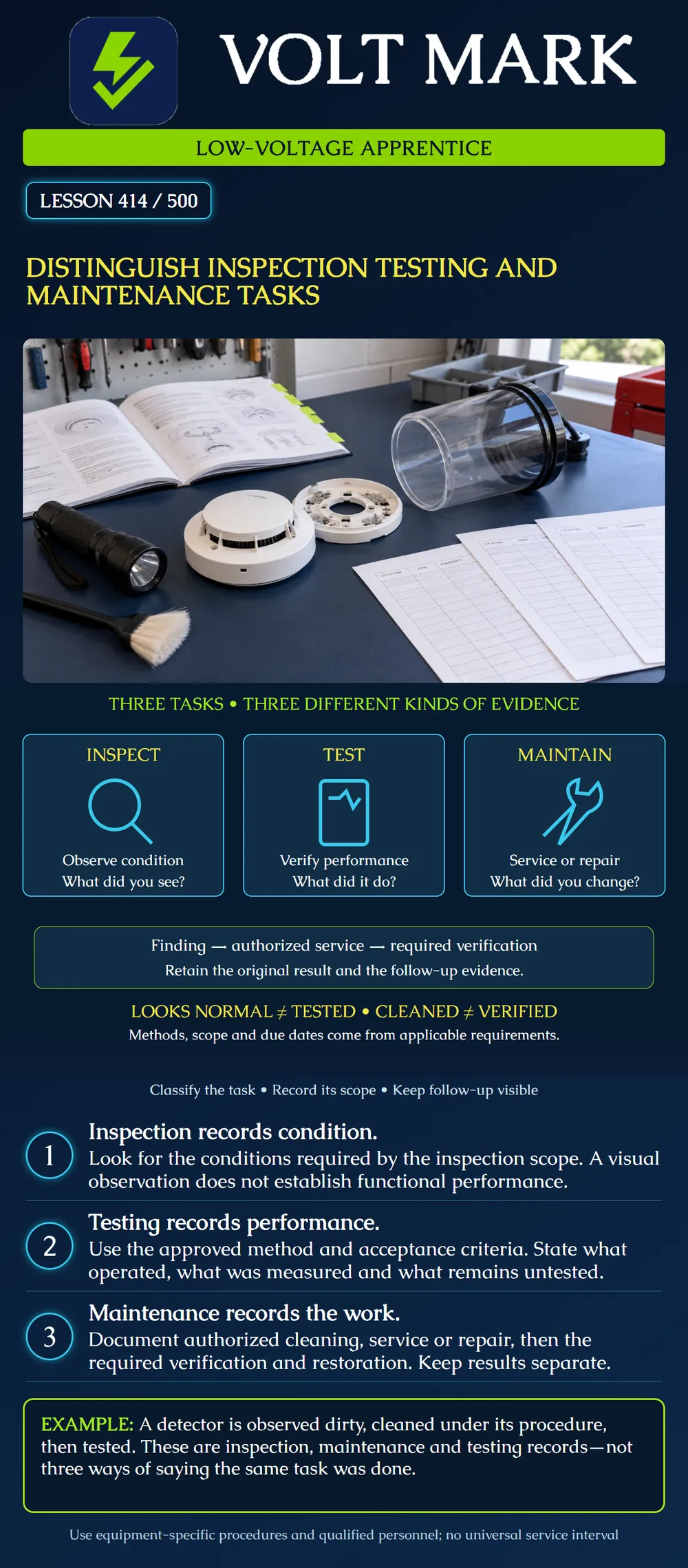
Explain the different purposes of inspection, testing and maintenance, classify common fire-alarm work accurately and connect findings to documented follow-up. A completed visit is not automatically proof that every required task was completed.
For this lesson, inspection means examining the conditions called for by the applicable inspection scope. Examples include observing physical damage, obstruction, contamination, missing identification or changes around equipment. Describe the actual condition and its location instead of writing only “checked.”
An intact enclosure or a normal indicator is evidence of what was observed at that time. It does not demonstrate every device function, circuit response, remote transmission or connected equipment action. Do not turn a visual observation into an unsupported functional-test result.
Use the correct equipment identifier. If an area cannot be accessed or the required observation cannot be made, record that limitation. A device hidden above an inaccessible ceiling is not automatically acceptable simply because no problem was seen.
Testing uses the applicable method to establish defined performance or operation. The record identifies the function being evaluated, the method, relevant conditions, expected result and actual observation or measurement.
Different test methods can answer different questions. A simulated input, an electronic functional check, a smoke-entry check and a sensitivity measurement are not interchangeable descriptions. State the evidence each method actually provides and retain other required checks as outstanding when they have not been performed.
A test can pass, fail or remain unperformed/incomplete. Performing a test is not the same as obtaining a passing result. Preserve failed readings and unexpected behavior; do not replace them with an eventual normal display.
Maintenance includes authorized work intended to preserve or restore the equipment's operating condition, such as manufacturer-directed cleaning or permitted service and repair. Record what work occurred, the affected equipment, the procedure and relevant parts or settings.
Maintenance does not prove that the equipment now meets every required criterion. Required post-service verification and restoration are separate evidence. Replacing a component or cleaning a detector should not be recorded as a functional pass without the applicable verification.
Do not improvise cleaning solvents, adjustment methods or substitute parts. Some devices are not field-adjustable or serviceable in the same way as others. The applicable instructions and the person's qualifications determine the permitted work.
OSHA 29 CFR 1910.164 applies to automatic fire detection systems installed to meet a particular OSHA standard. Within that scope, it addresses operable condition, testing and adjustment as needed, knowledgeable trained personnel, cleaning and restoration after tests or alarms. It does not provide this lesson with one numerical service interval for every fire-alarm installation.
System Sensor's D4120/D4P120/D4S instructions, I56-2967-008R, separate verification of operation from detector cleaning and sensor replacement. The reinstallation section calls for a detector check and notification of return to operation. This is a product-specific example of service followed by verification; its detailed methods and intervals are not generalized to all equipment.
Consider a fictional detector record: Inspection: visible contamination is observed and documented. Maintenance: the assigned qualified person performs approved cleaning. Testing: the required post-service method and observed result are recorded. Restoration: the responsible process confirms the final system state and closes applicable notifications.
These entries describe related but different work. They can occur during one visit without becoming one interchangeable checkbox. The observation remains part of the history even after successful corrective work.
An inspection finding may require investigation before a maintenance decision. A failed test may reveal a problem that is not cured by routine cleaning. Do not assume the next action without the equipment procedure and responsible review.
Classify each of these six fictional task records by its main purpose:
There are 2 inspection + 2 testing + 2 maintenance records = 6 records.
This classification does not say that all six tasks passed or that the complete system was evaluated. A and B are findings requiring responsible follow-up. E and F require their applicable verification and restoration evidence. A battery result must be interpreted against the specific method and criteria, not merely labeled “good.”
Connect each entry to the device or system identifier, task category, scope, procedure reference, date, person and actual result. For a test, include the measurement units and instrument information required by the method. For service, identify the work performed and relevant replacement information.
Link deficiencies, corrective action and repeat verification without overwriting earlier results. Record unperformed tasks and the reason separately from failures. A blank field is ambiguous; an explicit “not performed—access unavailable” entry tells the responsible party what remains.
The schedule must be derived from the applicable adopted requirements, equipment instructions and site conditions. Inspection and testing of the same component can have different due dates. Maintenance can also arise from a finding or event between planned visits.
The phrase “annual service” does not prove that every due inspection, test and maintenance item was covered. Lesson 415 addresses building the schedule; this lesson supplies no universal daily, monthly or annual rule.
Coordinate any required notifications and protective measures before authorized work. Afterward, verify the required final condition and identify any equipment still impaired or awaiting correction. A completed invoice or a clean device does not substitute for required restoration evidence.
This classroom exercise requires only classification of fictional records. It does not authorize system operation, removal of devices, cleaning or impairment.
Q1. Does a normal appearance prove a functional test passed?
OSHA 29 CFR 1910.164, scope, maintenance/testing and restoration: https://www.osha.gov/laws-regs/regulations/standardnumber/1910/1910.164 System Sensor D4120/D4P120/D4S instructions, I56-2967-008R, sections 12–14: https://prod-edam.honeywell.com/content/dam/honeywell-edam/hbt/en-us/documents/manuals-and-guides/user-manuals/D4120_Manual_I56-2967.pdf?download=false
OSHA scope is stated explicitly. Manufacturer-specific intervals and procedures are not represented as universal. NFPA committee-development material found in search was not used as adopted requirements. Diagram, classification examples and arithmetic are original.
Mistake: Recording an intact housing as a successful functional test. Correction: Label it as an inspection observation and retain the separate required test.
Mistake: Closing a cleaning or replacement entry without post-service verification. Correction: Link the authorized maintenance to the required test result and restoration evidence.
Mistake: Marking an inaccessible device acceptable because no damage was seen. Correction: Record the access limitation and unperformed inspection or test explicitly.
Texas journeyman, 15 questions, scored by topic against the 70% mark. No card, and no account needed to start.
Free study material for low-voltage apprentices. This is a national foundation course: requirements differ by state and by local jurisdiction, and a practice that is common in one place is not a rule everywhere. Nothing here is a licence, a certification, or authority to work unsupervised, and completing it does not count as apprenticeship hours or continuing-education credit. Check the codes adopted where you are working, the licensing authority for that work, and your employer's safety programme. VoltMark is not affiliated with, endorsed by, or sponsored by NFPA, OSHA, NICET, BICSI, FOA, or any state or local licensing authority.
Electrician licensing exam prep: practice questions, timed exam simulations, and step-by-step help finding every answer in the NEC.