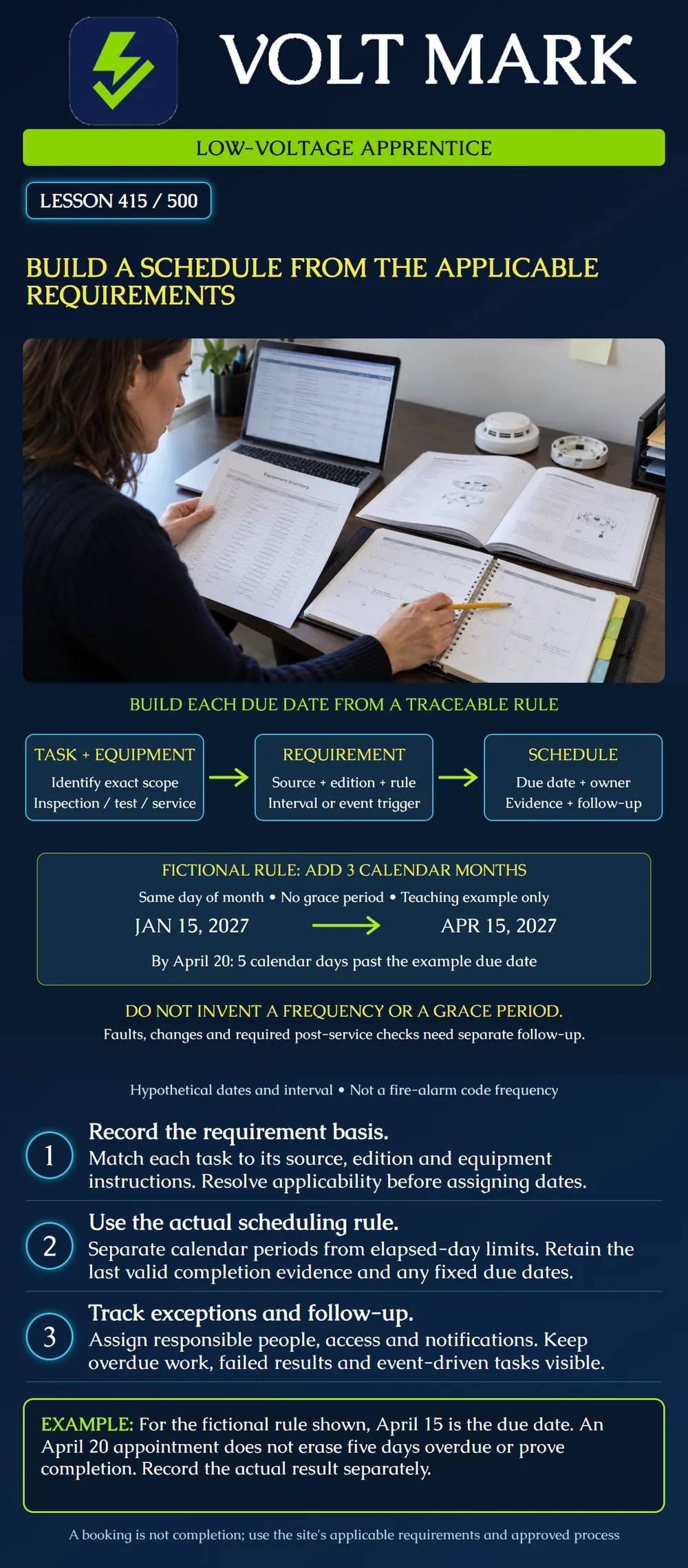
Build a traceable schedule for low-voltage fire-alarm inspection, testing and maintenance tasks. Connect each task to its applicable requirement, equipment scope, date rule, responsible person and completion evidence without inventing a universal frequency.
Identify the installed systems, components and interfaces included in the assignment. Use stable equipment identifiers and locations. Separate inspection, testing and maintenance tasks rather than giving every device one generic service date.
A single component may have multiple required activities with different methods and timing. An inspection entry does not automatically satisfy a functional test, and a service invoice does not prove all due tasks were performed. Link the schedule to the approved scope and the current inventory.
For each task, record the governing source, applicable edition or revision, section or table, equipment/model applicability, method and interval or event trigger. Identify the adopted requirements and local amendments that apply to the site, relevant manufacturer instructions and any applicable approved site provisions.
Do not copy a table from another state or from an unadopted edition and label it nationwide. A search result or a remembered frequency is not adequate evidence. Where sources overlap or appear to conflict, refer the applicability question to the responsible qualified person or authority and record the resolution. Do not assume that simply choosing the shortest number resolves different task scopes or methods.
OSHA 29 CFR 1910.164 addresses testing, maintenance and restoration for automatic fire detection systems installed to meet a particular OSHA standard. Within that scope, its reliability and cleaning provisions illustrate why a schedule must account for condition and needed work rather than only a single annual visit. This lesson does not extend that scope to every system.
System Sensor's D4120/D4P120/D4S instructions, I56-2967-008R, distinguish periodic visual inspection and functional testing and note that duct air quality can require more frequent attention. That is a product-specific example. The manual's numeric intervals are not presented here as a universal schedule for other equipment or as evidence of a jurisdiction's current code adoption.
Copy the actual wording of the applicable rule into the schedule record or link to it. Determine whether it uses a calendar period, a maximum elapsed interval, a fixed anniversary or an event-dependent requirement. Apply any permitted window only when it is supported by the applicable source and approved process.
Calendar months are not a fixed number of days. Three months and 90 days are not interchangeable. Rules concerning month ends, leap years, early completion or missed deadlines need an explicit basis; do not let scheduling software silently choose the rule.
Identify the valid reference date. It may be a documented completion date or another date specified by the governing requirement. If completion evidence is missing, mark the basis unresolved and escalate it. Do not invent a previous test date to make a calendar appear current.
For this fictional classroom exercise only, the rule says: Take a qualifying completion date and add three calendar months, keeping the same day of the month. There is no grace period.
The qualifying completion date is January 15, 2027. One calendar month later is February 15. Two calendar months later is March 15. Three calendar months later is April 15, 2027.
An appointment booked for April 20 is five calendar days after April 15. The appointment does not satisfy the fictional due date, and it does not prove that the task was completed successfully.
For comparison, the elapsed time from January 15 to April 15, 2027 is 90 days. That equality in this particular example does not establish a universal equivalence: April 15 to July 15, 2027 is 91 days. These are arithmetic examples, not required fire-alarm intervals.
Use separate fields for the required due date, planned appointment, actual performance date, result and evidence reference. A failed test is performed work with an unresolved deficiency; it is not a passing result. A postponed appointment is not a completed task.
Do not erase a missed deadline by moving the due date to the next available appointment. Preserve the original due date and record the delay, responsible escalation and actual work. Determine the next due date from the applicable rule, not automatically from whichever date makes the schedule look current.
Assign qualified personnel, access arrangements, required instruments, specialist attendance and notifications early enough to perform the work within its allowed timing. Identify interfaces that require coordinated testing and any approved impairment/protection process.
A reminder can be earlier than the due date without changing the due date. Booking multiple tasks together is useful only if each task's scope and timing remain satisfied. Record equipment that could not be accessed rather than treating the entire visit as complete.
A fault, repair, equipment replacement, programming change or environmental change can create a need for investigation or additional verification before the next periodic visit. Record the event and the applicable requirement for response.
Do not postpone an active deficiency merely because a routine appointment is months away. The responsible team determines the required action and protection under the applicable process. Link corrective work and repeat verification to the original issue and maintain any recurring schedule separately.
Reconcile additions, removals, changed equipment and revised requirements with the schedule. Record who approved a change and why. Preserve historical task results and prior requirements so earlier work remains understandable.
A useful row contains equipment ID, task, source/revision, applicable rule, reference date and evidence, due date, assigned person, planned date, actual date, result, open issue and next-date basis. The row is an original teaching structure, not a national form.
Q1. Does one service date cover every activity on a device?
OSHA 29 CFR 1910.164: https://www.osha.gov/laws-regs/regulations/standardnumber/1910/1910.164 System Sensor D4120/D4P120/D4S instructions, I56-2967-008R, page 1 periodic inspection/testing context: https://prod-edam.honeywell.com/content/dam/honeywell-edam/hbt/en-us/documents/manuals-and-guides/user-manuals/D4120_Manual_I56-2967.pdf?download=false
Product-specific frequencies and OSHA scope are not generalized. All dates, calendar arithmetic, row structure and the three-month rule are original hypothetical teaching material.
Mistake: Replacing the due date with a later booked appointment. Correction: Preserve due, planned and actual dates separately and escalate the missed requirement.
Mistake: Converting every three-calendar-month interval to 90 days. Correction: Apply the stated date rule; calendar-month lengths vary.
Mistake: Entering a guessed prior completion date to make the schedule current. Correction: Mark the reference-date evidence unresolved and obtain the qualifying record.
Texas journeyman, 15 questions, scored by topic against the 70% mark. No card, and no account needed to start.
Free study material for low-voltage apprentices. This is a national foundation course: requirements differ by state and by local jurisdiction, and a practice that is common in one place is not a rule everywhere. Nothing here is a licence, a certification, or authority to work unsupervised, and completing it does not count as apprenticeship hours or continuing-education credit. Check the codes adopted where you are working, the licensing authority for that work, and your employer's safety programme. VoltMark is not affiliated with, endorsed by, or sponsored by NFPA, OSHA, NICET, BICSI, FOA, or any state or local licensing authority.

Electrician licensing exam prep: practice questions, timed exam simulations, and step-by-step help finding every answer in the NEC.