Build a disciplined diagnosis from recorded events and authorized field evidence. Distinguish a symptom, an observation, a hypothesis and a supported cause. Preserve the original history and document verification after corrective work.
Record the exact displayed message, equipment identifier, point or circuit address and current state. Distinguish trouble from alarm and supervisory conditions; do not relabel an event simply because it repeats.
The message identifies what the system detected, not necessarily the underlying defective part. A communication-related indication can require investigation of more than the addressed device. A restored indication means the monitored condition met the equipment's restoration logic; it does not demonstrate that a permanent repair occurred.
The Fire-Lite ES-200X Series Manual, LS10131-000FL-E:F, May 23, 2022, section 4.4 describes trouble displays that include device/address and descriptive information. Its history sections distinguish viewing all events, alarms and other events from erasing history. These features support preserving exact event identity and reviewing an appropriate event set. Product-specific menus, retention limits and indication timing must be checked in the actual equipment documentation; this lesson is not a panel-operation procedure.
Retain authorized copies or records of the original event history, relevant current status and prior service notes. Document how the evidence was obtained and its time range. Do not erase history to create a clean-looking record during an unresolved investigation.
Include restore events, acknowledgments and other relevant events when the equipment records them. Filtering only for new trouble entries can hide durations and recurrence. Repeated reminder indications are not necessarily new fault episodes, and duplicated exports are not independent events.
Note gaps, overwritten records and unknown retention. No events in an available extract does not prove there were no events outside that extract.
Compare timestamps only after checking clock source, date, time zone and known offsets. A building-controls log may use a different clock from the fire-alarm panel. Preserve original timestamps and document any adjustment used for analysis instead of altering source records.
Resolve reused labels and changed addresses against the configuration history. The same description after a replacement might refer to different hardware. Confirm that a trend actually concerns the same point, circuit or equipment.
For each occurrence, record onset, restoration, message, affected identifier and any supported contextual observations. Group related events carefully. Several devices appearing at nearly the same time might share a dependency, but this is a lead to investigate, not a proven cause.
Record other conditions only when supported by site evidence: maintenance activity, operating schedules, environmental observations, known supply events or documented configuration changes. Do not invent a correlation because a suspected cause seems plausible.
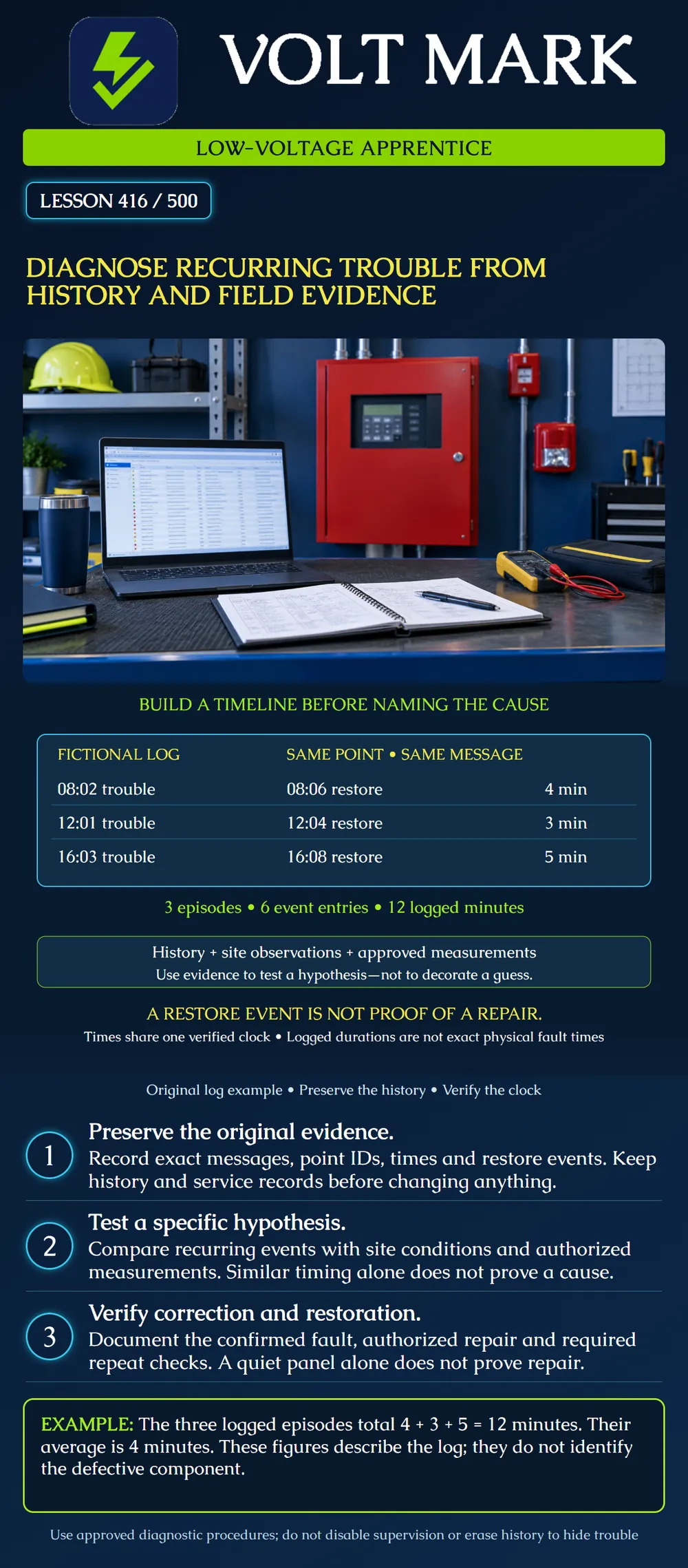
The fictional log uses one verified clock on the same day and the same point/message. Each trouble entry has one matching restoration entry, with no missing entries in the supplied exercise.
08:02 trouble; 08:06 restore — 4 minutes. 12:01 trouble; 12:04 restore — 3 minutes. 16:03 trouble; 16:08 restore — 5 minutes.
There are three episodes and six event entries. Total logged trouble time = 4 + 3 + 5 = 12 minutes. Mean logged episode duration = 12 / 3 = 4 minutes.
The onset intervals are 3 hours 59 minutes and 4 hours 2 minutes. This suggests a recurring timing pattern worth comparing with reliable site records. It does not prove a four-hour timer exists or identify a defective component.
The durations are based on logged timestamps. Detection delay, logging resolution and restoration logic can make the physical fault interval different. These figures are not a reliability rating or an allowable outage.
An observation is “the supplied records show three similar events near four-hour spacing.” A hypothesis is “a shared periodic operating condition may be associated with the events.” A supported cause requires additional evidence that distinguishes that hypothesis from alternatives.
For each hypothesis, identify what evidence would support it, what would contradict it and which approved diagnostic method can obtain that evidence. The responsible qualified person selects the method and scope. Avoid replacing several parts at once without a documented reason; doing so can obscure which change affected the fault.
Use manufacturer troubleshooting information and appropriate instruments. Record test location, equipment state, instrument and relevant values/units. A measurement made after an intermittent condition disappeared may not describe the condition during the event.
An apprentice may assemble logs, identify discrepancies and assist authorized diagnostics under supervision. Do not improvise shorts, grounds, bypasses, wiring changes or live resistance measurements. Do not disable supervision just to stop the indication.
Coordinate any test that may affect protection or connected systems through the site's approved procedure. If a required diagnostic would exceed the worker's qualifications, hand it to the responsible specialist with the evidence already collected.
Document the supported finding, authorized corrective action, affected equipment and applicable repeat verification. Keep the original failed evidence alongside the new result. Acknowledge, silence, reset and repair describe different actions.
Verify the required restoration and monitor recurrence for the period and conditions established by the responsible procedure. No recurrence during a short observation is useful evidence but not unlimited proof of reliability. Record the actual observation window and any conditions not encountered.
If the cause remains uncertain, say so. “Intermittent event not reproduced; original history retained; further investigation assigned” is more accurate than “fixed” without evidence. Keep required protection and escalation active through the responsible process.
Q1. How many episodes and entries appear in the example?
Fire-Lite ES-200X Series Manual, LS10131-000FL-E:F, May 23, 2022; trouble operation and history sections: https://prod-edam.honeywell.com/content/dam/honeywell-edam/hbt/en-us/documents/manuals-and-guides/installation-guides/ba-fire-ES-200X-Manual-LS10131-000FL-E-F.pdf
Timeline, arithmetic and diagnostic reasoning exercise are original. No specific equipment fault is diagnosed from fictional records, and no product-specific button sequence or universal follow-up interval is prescribed.
Mistake: Counting trouble and restore entries as six separate fault episodes. Correction: Pair each onset with its restoration; the supplied log has three episodes.
Mistake: Declaring a four-hour timer faulty from approximately four-hour event spacing. Correction: Compare reliable operating records and test a specific hypothesis before assigning a cause.
Mistake: Calling an automatic restore or brief quiet period a permanent repair. Correction: Retain the correction evidence and document the actual follow-up window and conditions.
Texas journeyman, 15 questions, scored by topic against the 70% mark. No card, and no account needed to start.
Free study material for low-voltage apprentices. This is a national foundation course: requirements differ by state and by local jurisdiction, and a practice that is common in one place is not a rule everywhere. Nothing here is a licence, a certification, or authority to work unsupervised, and completing it does not count as apprenticeship hours or continuing-education credit. Check the codes adopted where you are working, the licensing authority for that work, and your employer's safety programme. VoltMark is not affiliated with, endorsed by, or sponsored by NFPA, OSHA, NICET, BICSI, FOA, or any state or local licensing authority.

Electrician licensing exam prep: practice questions, timed exam simulations, and step-by-step help finding every answer in the NEC.