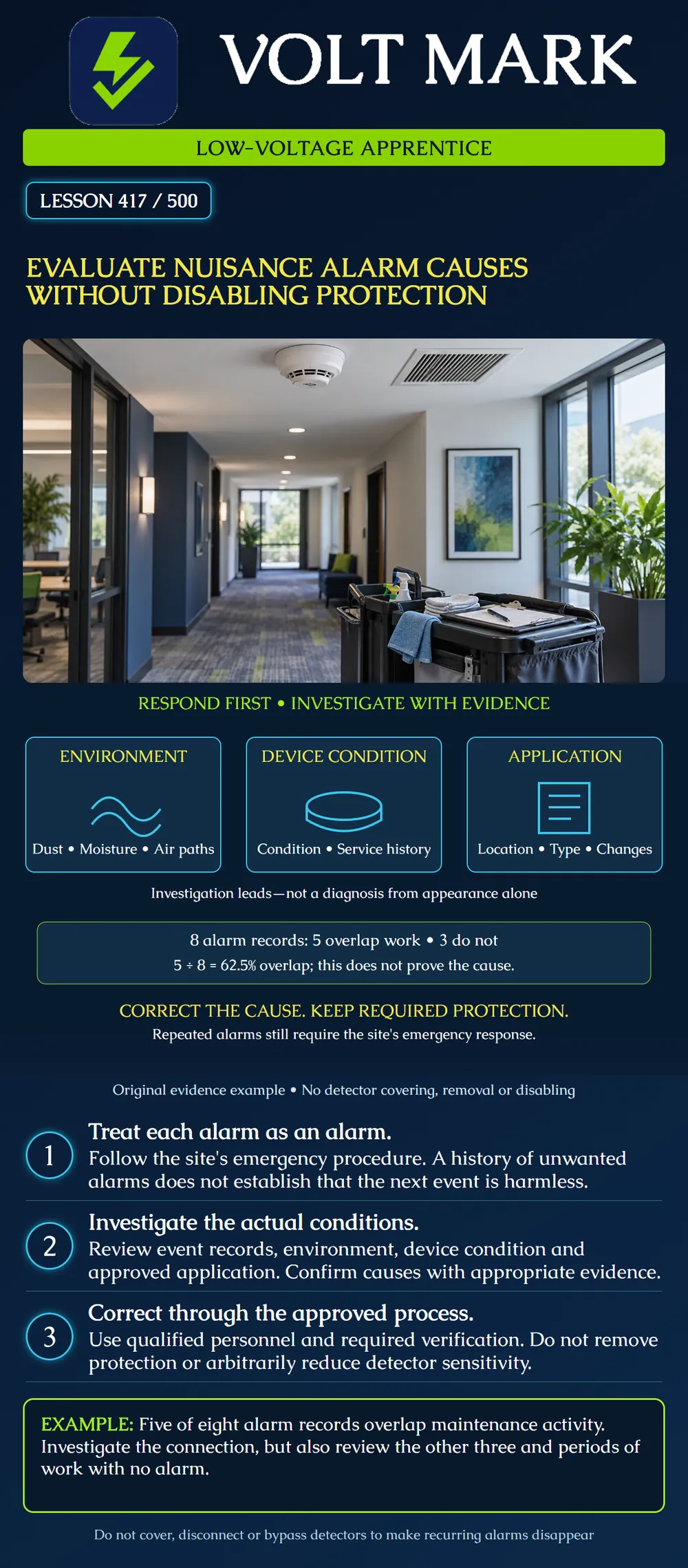
Evaluate possible causes of unwanted fire-alarm activations without treating a repeated alarm as harmless or removing required protection. Separate emergency response, investigation and authorized corrective work.
Follow the site's emergency response procedure for each alarm. A previous unwanted activation does not establish that a new event has the same cause. An apprentice must not dismiss an alarm or delay the required response while trying to prove it is a nuisance.
Use “unwanted” or “nuisance” as an investigated classification, not an assumption made because occupants are frustrated. Record who assessed the event, what evidence supported the classification and any unresolved uncertainty. If actual fire or hazardous conditions are identified, follow the site's emergency process.
System Sensor's System Smoke Detectors Applications Guide, SPAG91, discusses alarm logs and potential influences including environment, contamination, installation conditions, building work and air movement. Its foreword warns that repeated unwanted alarms and disconnection undermine protection. The guide supports systematic investigation, not a conclusion that every unwanted alarm has the same cause.
OSHA 29 CFR 1910.164 addresses operable condition, knowledgeable trained personnel and maintenance/restoration within its stated scope of automatic fire detection systems installed to meet a particular OSHA standard. That scope is not expanded here to every installation.
Preserve the event time, exact device or point identity, displayed information and relevant sequence of events. Record the responder's observations and what was happening in the area. Distinguish direct observations from later recollections.
Check whether the same physical device, several nearby devices or unrelated locations are involved. Review documented changes in use, construction, maintenance, ventilation and equipment. Keep timing sources and clock differences visible when comparing records.
Do not count duplicated reports as separate alarms or assume that missing reports represent quiet periods. A useful investigation includes known periods of the suspected activity without alarms as well as alarm periods without that activity.
Environment: consider observed dust-producing work, moisture conditions, airborne contaminants and possible air paths. These are leads for a qualified investigation. A visible cloud or a nearby activity is not, by itself, proof of what entered the sensing chamber during an earlier event.
Device condition: review approved inspection findings, contamination indications, service history and required performance evidence. Cleaning may be appropriate when supported by the equipment instructions and findings, but it is not a universal cure.
Application: compare the actual location, detector type and operating environment with approved documents and manufacturer instructions. Changes to rooms, partitions, equipment or airflow may affect suitability. An apprentice should refer possible application problems to the responsible designer or qualified specialist.
Do not move a detector, substitute a different technology or alter settings merely because a nearby location seems quieter. Coverage, response and compatibility must remain consistent with the approved requirements.
A fictional review contains eight distinct alarm records. Five occurred during documented maintenance activity; three occurred outside that activity.
5 + 3 = 8 records. 5 / 8 = 0.625 = 62.5% overlap.
This percentage describes only the supplied alarm records. It is not the probability that maintenance caused an alarm, and it does not prove that all five overlapping events share a cause.
The record does not yet state how many maintenance periods occurred without alarms. Without those periods and other relevant conditions, the comparison is incomplete. Also investigate the three alarms outside the maintenance windows; more than one cause may be present.
A reasonable next step is to compare exact locations, task descriptions and timing, then have qualified personnel evaluate the proposed mechanism using approved methods. Do not reproduce dust, steam or smoke around live detectors as an improvised experiment.
Write a hypothesis in a way that can be supported or contradicted. For example, “airborne material from this documented task may have reached this detector” needs evidence about timing, transport path, material and detector response. It is more useful than “the detector is bad.”
The responsible team selects authorized inspections, measurements or tests appropriate to the equipment and conditions. Record their scope and limitations. A device that passes a functional check afterward may still have experienced an environmental stimulus; a passing result does not reconstruct the earlier event.
Maintain the distinction between a detector correctly responding to non-fire particles and a malfunctioning device. The remedy may differ, and neither conclusion should be asserted without evidence.
Do not cover, remove, disconnect or bypass detectors to stop complaints. Do not arbitrarily reduce sensitivity or enable a delay. Silence and reset are operating actions, not evidence that the cause has been corrected.
If authorized corrective work requires a temporary impairment, the responsible site process governs approvals, notifications, protective measures and restoration. This lesson provides no impairment or disabling instructions and does not authorize an apprentice to initiate one.
Possible authorized corrections may involve servicing the actual device, addressing a documented environmental source or reviewing the approved application with the responsible specialist. The applicable design and manufacturer procedures determine the permitted work.
Document the supported finding, authorized action, affected equipment and required post-work verification. Retain the original alarm records and link repeat-test results. Confirm the required final system condition through the responsible procedure.
Track subsequent events over an appropriate documented period and under relevant conditions. A brief quiet interval alone is not proof that the cause is eliminated. Record what conditions occurred during follow-up and what remains uncertain.
Do not claim a successful remedy simply because a point was disabled and no further alarms appeared. That would remove the observation mechanism and required protection rather than establish correct performance.
Q1. Does a previous nuisance event make the next alarm harmless?
System Sensor, System Smoke Detectors Applications Guide, SPAG91; foreword and unwanted-alarm investigation sections: https://prod-edam.honeywell.com/content/dam/honeywell-edam/hbt/en-us/documents/manuals-and-guides/reference-guides/System-Smoke-Detectors-AppGuide-SPAG91.pdf?download=false OSHA 29 CFR 1910.164: https://www.osha.gov/laws-regs/regulations/standardnumber/1910/1910.164
Legacy guide intervals and references are not asserted as current local law. No temporary shutdown suggestion in general guidance is adopted as a field instruction. Original diagram and statistical exercise; no equipment failure or event cause diagnosed from fictional data.
Mistake: Treating maintenance overlap as proof that maintenance caused the alarms. Correction: Compare event details and maintenance periods without alarms, and investigate the proposed mechanism.
Mistake: Dismissing a new alarm because earlier events were unwanted. Correction: Follow the site emergency response and assess the new event on its own evidence.
Mistake: Reporting a remedy successful because a disabled detector stopped producing alarms. Correction: Restore required protection through the authorized process and evaluate performance under relevant follow-up conditions.
Texas journeyman, 15 questions, scored by topic against the 70% mark. No card, and no account needed to start.
Free study material for low-voltage apprentices. This is a national foundation course: requirements differ by state and by local jurisdiction, and a practice that is common in one place is not a rule everywhere. Nothing here is a licence, a certification, or authority to work unsupervised, and completing it does not count as apprenticeship hours or continuing-education credit. Check the codes adopted where you are working, the licensing authority for that work, and your employer's safety programme. VoltMark is not affiliated with, endorsed by, or sponsored by NFPA, OSHA, NICET, BICSI, FOA, or any state or local licensing authority.

Electrician licensing exam prep: practice questions, timed exam simulations, and step-by-step help finding every answer in the NEC.