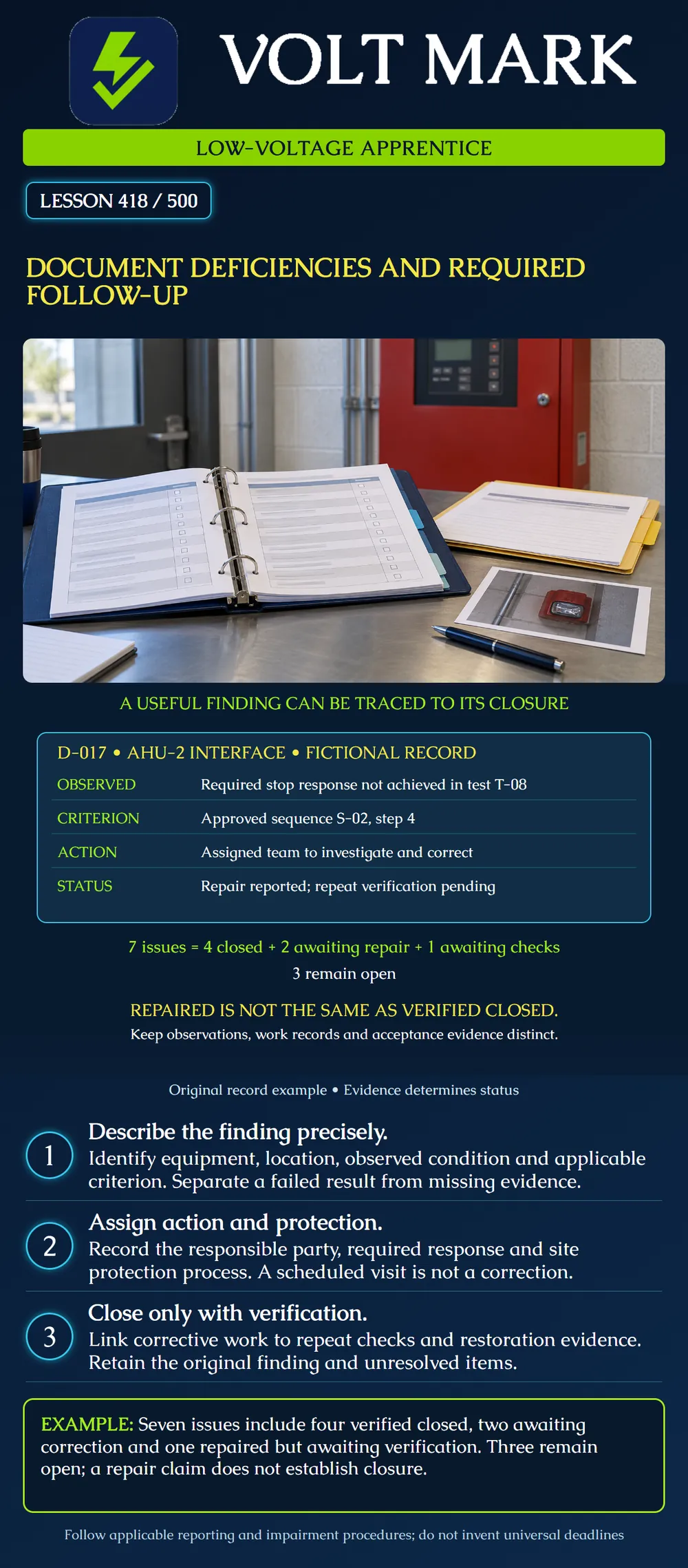
Create a clear deficiency record that links an observed condition to the applicable criterion, responsible action and evidence needed for closure. Distinguish a proven failed response from incomplete verification and preserve the original finding.
Identify the equipment, location, function and date. Describe what was observed or measured, under what conditions and by which method. Include relevant record, photograph, instrument or event references where authorized.
Avoid vague entries such as “system bad” or “needs fixing.” A useful entry might state that a required equipment response was not achieved during a defined test. That is different from saying the controller is defective; the failed response alone may not identify the component causing it.
Record the applicable approved criterion with a usable document reference and revision. If the requirement itself is uncertain, identify that uncertainty for responsible review. Do not invent a code violation, requirement number or acceptance threshold to make the report look complete.
A test result that does not meet its applicable criterion is a documented failed result. An unperformed test, inaccessible device or missing record establishes an incomplete evaluation, not necessarily a physical equipment failure.
Both can require follow-up. Label them accurately so the responsible team knows whether to investigate a demonstrated problem, complete a required check or resolve documentation. Do not convert “not tested” to “pass,” and do not claim a defective device solely because its record is absent.
UCSF's January 2026 integrated-testing bulletin describes recording faults, failures and discrepancies, their resolution dates and corrective-action information. It also calls for test documentation identifying simulated conditions and system responses. This is a local institutional example of traceable follow-up, not a national reporting form or a universal deadline.
OSHA 29 CFR 1910.164 addresses maintaining operable condition and restoration for automatic fire detection systems installed to meet a particular OSHA standard. Its stated scope matters; this lesson does not assume that every installation is covered by that provision or that a paperwork entry alone restores protection.
Identify affected functions and the known extent of the condition without guessing beyond the evidence. Refer the condition to the responsible site personnel for the applicable impairment and protective-measure process.
Record required notifications and acknowledgments through the authorized workflow. A sent report is not proof that every required recipient received or acted on it. Keep evidence of required communication where the process calls for it.
An apprentice should report findings promptly within assigned scope, not independently disable equipment or declare protection adequate. This lesson is a desk exercise and does not direct notifications, impairment actions or field work.
Issue: D-017. Equipment/function: AHU-2 fire-alarm shutdown interface. Observation: Required stop response not achieved during fictional test T-08. Criterion: Approved sequence S-02, step 4, in the supplied fictional project record. Cause: Not established by the initial observation. Assigned action: Responsible fire-alarm/HVAC/controls team to investigate and correct under its approved procedure. Current status: Repair reported; required repeat verification pending.
The criterion identifier is fictional, not a code reference. The example does not establish a permissible stopping time or diagnose a component. The responsible team must retain the actual test conditions, observations and applicable criteria in a real record.
The repair report should identify what was changed and by whom. It does not replace repeat verification of the required function and associated restoration. D-017 remains open until the evidence and responsible closeout process are satisfied.
A separate fictional issue log contains: Four issues with complete required correction, verification and closure evidence. Two issues awaiting correction. One issue with repair reported but verification pending.
4 + 2 + 1 = 7 issues. 2 + 1 = 3 issues remain open.
Five issues may have some corrective work reported, but only four are verified closed in this example. Do not count the pending-verification issue as closed merely because a technician reported replacing a part.
If a repeat check fails, retain the new failure and continue the issue through the responsible process. If a supposedly closed problem recurs, link the recurrence to the earlier record rather than hiding the relationship under an unexplained new entry.
The closeout record should connect the original finding, approved correction, work performed, required repeat-test results, relevant system/interface observations and restoration. Include dates and the responsible reviewer or acceptance reference.
A normal panel display, a photograph of a new component or a completed invoice may support one part of the history but does not automatically satisfy every closure criterion. State the scope of each item of evidence.
Keep restrictions, unresolved functions and temporary measures visible until the responsible process permits their removal. Closure of one deficiency does not establish acceptance of unrelated equipment or the entire system.
Use stable identifiers, revision history and dated entries. Correct errors transparently rather than silently rewriting the original result. Retain supporting material in an authorized location with appropriate access.
Summarize open items in terms the owner and next technician can act on: what remains, who is responsible and what evidence is needed. Do not obscure the issue behind abbreviations or unsupported conclusions.
Q1. Does a missing test record prove the device is physically defective?
UCSF Fire Prevention Design Bulletin #0003, revised January 2026, documentation and corrective-action sections: https://ehs.ucsf.edu/fire-prevention-design-bulletin-0003-integrated-fire-protection-and-life-safety-system-testing OSHA 29 CFR 1910.164: https://www.osha.gov/laws-regs/regulations/standardnumber/1910/1910.164
UCSF provisions are explicitly local examples and OSHA scope is retained. Record fields, fictional identifiers and arithmetic are original teaching material. No nationwide tag colors, reporting deadline or approval authority is invented.
Mistake: Diagnosing a defective controller from a failed shutdown response alone. Correction: Record the observed response and applicable criterion while leaving cause open for coordinated investigation.
Mistake: Closing D-017 because a repair was reported. Correction: Keep it open until required repeat verification and restoration evidence are linked.
Mistake: Recording a missing test sheet as a proven physical failure. Correction: Identify it as an evidence gap and assign the specific missing check or record.
Texas journeyman, 15 questions, scored by topic against the 70% mark. No card, and no account needed to start.
Free study material for low-voltage apprentices. This is a national foundation course: requirements differ by state and by local jurisdiction, and a practice that is common in one place is not a rule everywhere. Nothing here is a licence, a certification, or authority to work unsupervised, and completing it does not count as apprenticeship hours or continuing-education credit. Check the codes adopted where you are working, the licensing authority for that work, and your employer's safety programme. VoltMark is not affiliated with, endorsed by, or sponsored by NFPA, OSHA, NICET, BICSI, FOA, or any state or local licensing authority.
Electrician licensing exam prep: practice questions, timed exam simulations, and step-by-step help finding every answer in the NEC.